Evidentiary Architecture™ Series | Article 15 of 20
Building the Defensible Enterprise through Governance Evidence
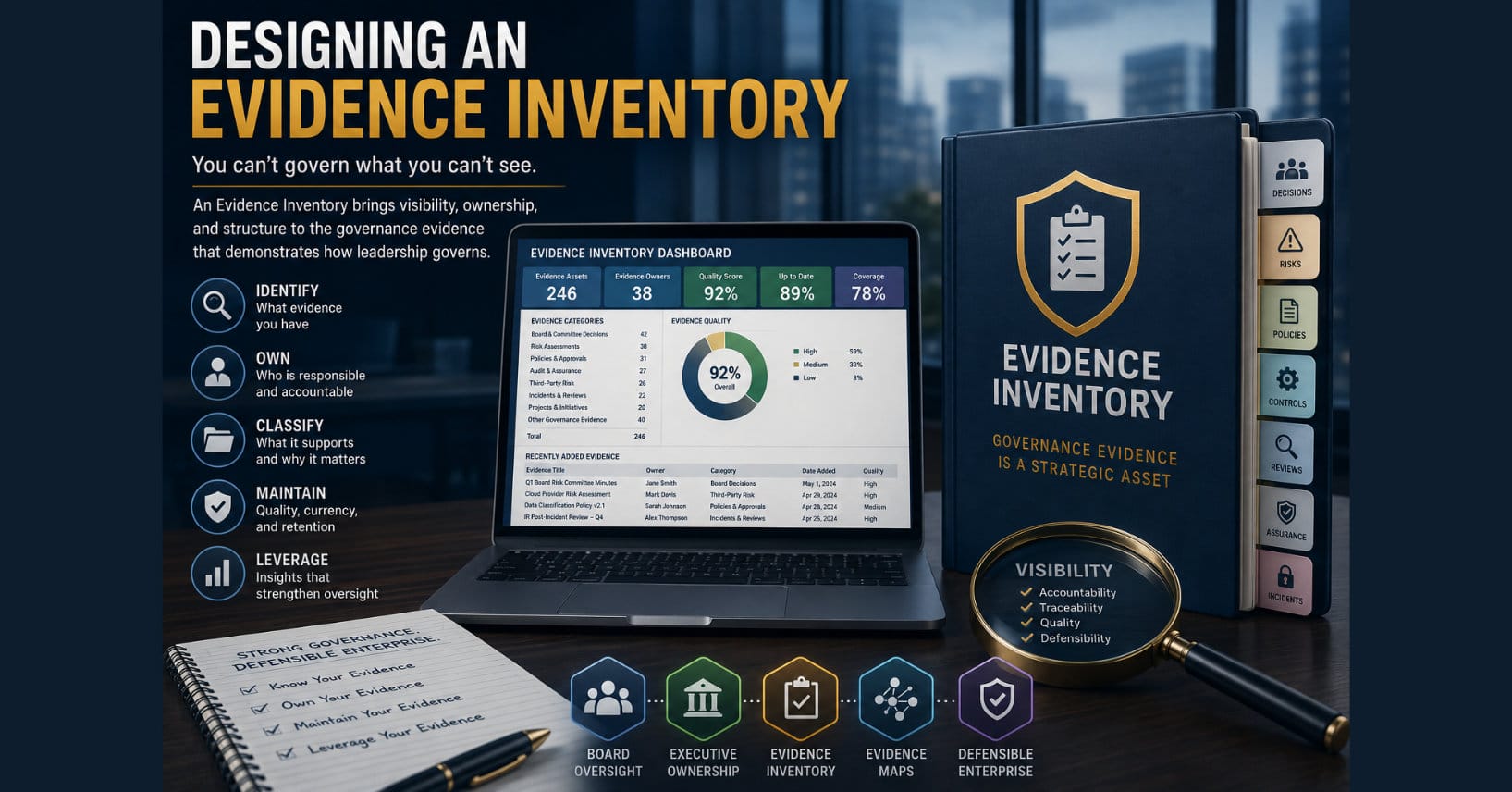
Organizations routinely inventory hardware, software, data, and information assets, yet few maintain an inventory of their governance evidence. This article introduces the Evidence Inventory as a foundational component of Evidentiary Architecture™. By identifying, classifying, assigning ownership, measuring quality, and maintaining governance evidence as a strategic enterprise asset, organizations gain greater visibility into board oversight, expose evidence gaps, strengthen accountability, and improve their ability to demonstrate reasonable cybersecurity governance.
Every mature organization inventories its critical assets.
Hardware.
Software.
Data.
Applications.
Cloud services.
Vendors.
Information.
The reason is obvious.
You cannot effectively manage what you do not know exists.
The same principle applies to governance.
Yet very few organizations can answer a surprisingly simple question:
What governance evidence do we possess?
That question introduces one of the most practical concepts in Evidentiary Architecture™—the Evidence Inventory.
Governance Evidence Is an Enterprise Asset
Most organizations treat governance evidence as a byproduct.
Meeting minutes are filed away.
Risk assessments are archived.
Board presentations disappear into portals.
Audit reports are stored in separate repositories.
Policy approvals live in document management systems.
Individually, each artifact appears valuable.
Collectively, they represent something far more significant.
They are enterprise governance assets.
Like any strategic asset, they should be identified, classified, maintained, and governed.
An Inventory Changes Perspective
When organizations build asset inventories, they move from assumptions to visibility.
An Evidence Inventory creates the same transformation.
Instead of asking:
“Where might we find evidence?”
Leadership begins asking:
“What governance evidence do we have, who owns it, where is it maintained, and how does it support oversight?”
That change in thinking is foundational.
Evidence becomes intentional.
Not incidental.
What Belongs in an Evidence Inventory?
An Evidence Inventory is not limited to documents.
It includes every significant source of governance evidence.
Examples include:
- Board and committee decisions.
- Risk assessments.
- Risk acceptance records.
- Executive approvals.
- Policy approvals and revisions.
- Governance dashboards.
- Audit reports.
- Management responses.
- Control validation results.
- Third-party risk assessments.
- Regulatory correspondence.
- Incident governance records.
- Post-incident reviews.
- Strategic cybersecurity initiatives.
- Evidence maps and evidence lineage records.
Each item contributes to the organization’s governance story.
Inventory the Metadata Too
Knowing that evidence exists is only the beginning.
Leadership should also understand the characteristics of that evidence.
An effective inventory records information such as:
- Evidence owner.
- Business function.
- Governance process supported.
- Date created.
- Review frequency.
- Related risks.
- Related policies.
- Supporting controls.
- Linked governance decisions.
- Evidence quality rating.
- Retention requirements.
- Repository location.
This metadata transforms a simple list into a governance management tool.
Evidence Should Have Owners
One of the most common governance weaknesses is orphaned evidence.
No one knows who maintains it.
No one reviews it.
No one verifies its accuracy.
No one notices when it becomes obsolete.
Every significant governance evidence asset should have a clearly identified owner.
Ownership promotes accountability.
Accountability improves evidence quality.
Evidence Ages
Unlike many technology assets, governance evidence changes in value over time.
Some evidence becomes more valuable.
Historical board decisions may explain strategic direction years later.
Other evidence loses relevance.
Outdated risk assessments.
Superseded policies.
Obsolete governance assumptions.
An Evidence Inventory helps distinguish active governance evidence from historical reference material.
That distinction improves decision-making.
Visibility Creates Confidence
Imagine a board asking:
“What evidence supports our third-party cybersecurity governance?”
Without an inventory, management begins searching.
With an inventory, leadership immediately identifies:
- Relevant board decisions.
- Vendor risk assessments.
- Contract approvals.
- Security reviews.
- Executive accountability.
- Ongoing monitoring.
- Audit validation.
- Governance metrics.
The evidence already exists.
The inventory simply makes it visible.
A Living Enterprise Resource
Like Evidence Maps, an Evidence Inventory should never become static.
New governance decisions create new evidence.
Projects conclude.
Risks evolve.
Policies change.
Audits generate findings.
Investigations produce lessons learned.
The inventory should evolve continuously alongside governance itself.
When properly maintained, it becomes an authoritative catalog of the organization’s governance knowledge.
From Inventory to Intelligence
The greatest value of an Evidence Inventory is not knowing what evidence exists.
It is understanding where governance is weak.
Gaps become visible.
Missing ownership becomes obvious.
Incomplete evidence stands out.
Disconnected governance relationships emerge naturally.
The inventory becomes a management instrument rather than an administrative exercise.
It enables leadership to improve governance before anyone questions it.
Preparing the Defensible Enterprise
Organizations have spent decades improving asset management.
The next evolution is governance evidence management.
Boards already expect inventories for technology assets because those assets represent organizational value.
Governance evidence deserves the same discipline.
It represents organizational accountability.
An organization that can identify, classify, measure, maintain, and continuously improve its governance evidence possesses something few enterprises have today:
A comprehensive understanding of the evidence that demonstrates how leadership governs.
That is a defining characteristic of a defensible enterprise.
Governance Takeaway
An Evidence Inventory treats governance evidence as a strategic enterprise asset rather than a collection of disconnected documents. By identifying ownership, quality, relationships, location, and governance purpose for every significant evidence source, organizations gain visibility into their governance strengths, expose evidence gaps, and strengthen board oversight.
Coming Next
Operational Metrics Every Board Should Understand
Evidence should not only exist—it should be measurable. In the next article, we’ll examine the operational and governance metrics every board should understand, including MTTD, MTTR, MTTC, evidence completeness, decision latency, governance coverage, evidence quality, and other indicators that demonstrate whether governance is functioning effectively before, during, and after a cyber event.