Why Cybersecurity Oversight Is Becoming a Governance Standard Across Sectors
For years, cybersecurity expectations varied widely by industry.
Public companies faced disclosure pressure.
Financial institutions faced supervisory scrutiny.
Healthcare entities faced privacy enforcement.
Nonprofits operated with comparatively lighter oversight.
That era is ending.
Across sectors, regulatory posture is converging around one principle:
Cybersecurity is a governance responsibility.
This edition examines why oversight expectations are tightening — and why boards should not wait for enforcement to catch up with exposure.
The Shift From Technical Compliance to Governance Accountability
Early regulatory approaches focused heavily on controls:
Encryption requirements.
Access management policies.
Technical safeguards.
Increasingly, regulators are asking a different question:
Did leadership exercise reasonable oversight?
This shift moves cybersecurity from operational compliance into governance architecture.
The focus is no longer only on whether controls existed.
It is on whether boards were informed, engaged, and structured.
Convergence Across Sectors
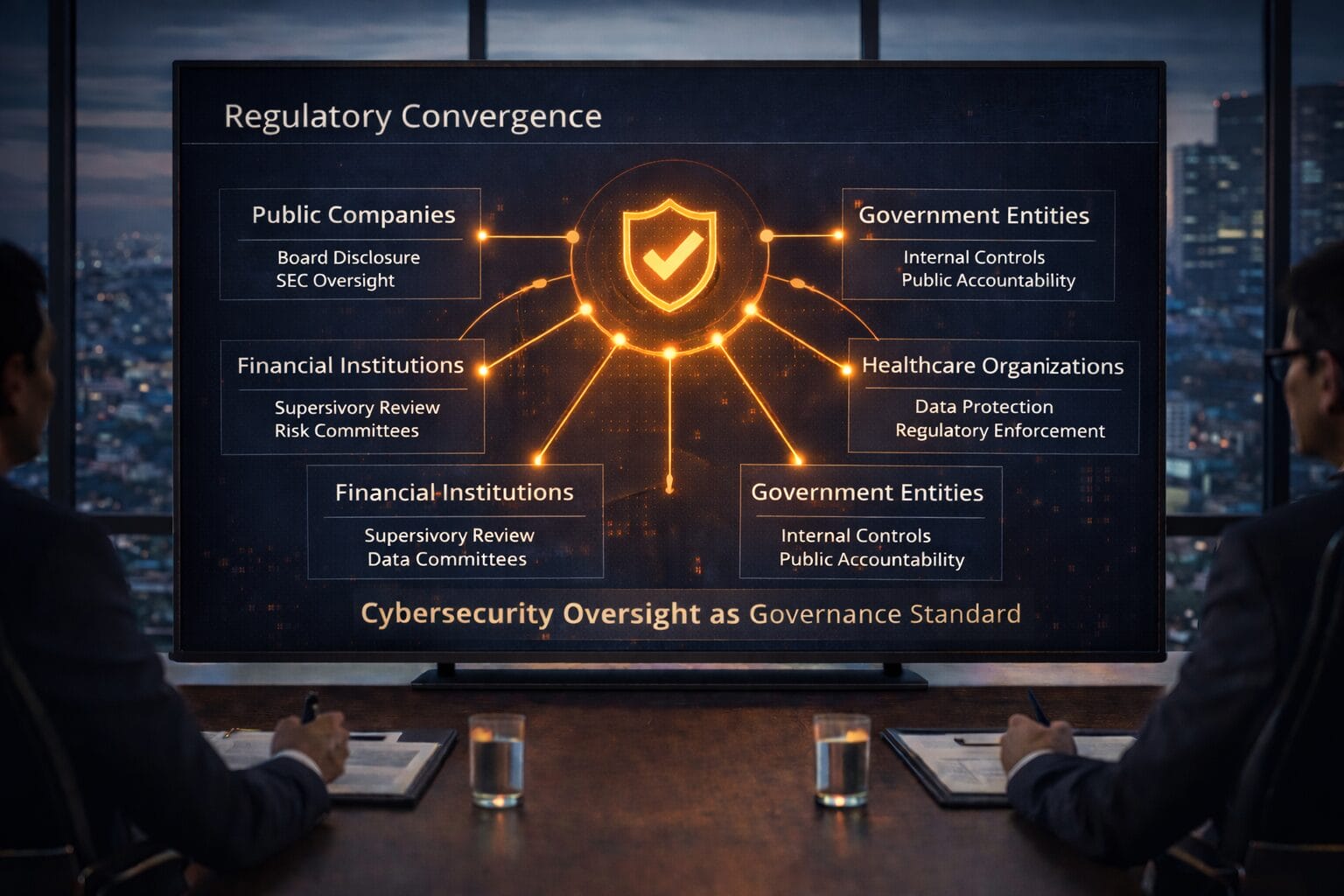
While specific regulatory frameworks differ, oversight themes are aligning.
Across industries, expectations increasingly include:
- Board-level visibility into cyber risk
- Defined reporting systems
- Escalation discipline
- Documented oversight
- Periodic independent validation
- Alignment between risk tolerance and investment
This convergence is visible in:
Public company disclosure scrutiny
Financial supervisory examinations
Healthcare enforcement patterns
Federal internal control expectations
Grant oversight frameworks
The language differs.
The governance principle does not.
Why This Matters for Nonprofits and Mid-Sized Organizations
Some boards assume that heightened expectations apply only to large, publicly traded companies.
That assumption is risky.
Digital dependency does not scale by organization size.
Regulatory scrutiny may increase following:
- Data breaches
- Federal funding involvement
- Cross-border operations
- Insurance claims
- Public trust exposure
Oversight expectations are expanding, not narrowing.
Volunteer status does not reduce fiduciary duty.
The Insurance Factor
Cyber insurers increasingly examine governance posture during underwriting and post-incident review.
They may request:
- Board oversight documentation
- Risk assessment records
- Policy approval evidence
- Incident response governance structure
Insurance markets are reinforcing regulatory convergence.
Governance maturity affects premium stability and claim defensibility.
Enforcement Trends and Documentation
After major cyber events, enforcement inquiries often focus on:
- What did leadership know?
- When did they know it?
- What actions were taken?
- Was disclosure timely?
- Were risk warnings ignored?
This is governance scrutiny.
Documentation becomes central.
Boards that treat cybersecurity as operational reporting may struggle to demonstrate structured oversight.
Boards that embed cyber risk into enterprise governance frameworks demonstrate deliberation.
From Optional to Expected
Cyber governance is transitioning from best practice to baseline expectation.
Boards should anticipate that:
- Disclosure obligations will expand
- Incident reporting timelines will shorten
- Documentation scrutiny will increase
- Governance-level literacy will be expected
Waiting for sector-specific mandates invites reactive governance.
Proactive alignment builds resilience.
Practical Board Actions
Directors should consider:
- Reviewing how cyber risk is embedded in enterprise risk frameworks
- Confirming escalation protocols are documented
- Ensuring oversight discussions appear in minutes
- Obtaining periodic independent assessments
- Aligning investment decisions with declared risk tolerance
These actions are not extraordinary.
They are becoming standard.
The Core Principle
Regulatory convergence is not about uniform rules.
It is about uniform expectations of governance discipline.
Cyber risk is no longer confined to IT.
It intersects with financial reporting, compliance, disclosure, and fiduciary responsibility.
Across sectors, the message is consistent:
Oversight must be deliberate.
Reporting must be structured.
Documentation must be defensible.
Boards that internalize this shift now will not need to react later.
In our next edition, we will examine what investigators and regulators request after a cyber incident — and how prepared boards can anticipate that scrutiny.
If you serve on a board or advise executive leadership teams, subscribe to The Cyber Governance Brief for continued analysis on cybersecurity as fiduciary responsibility.