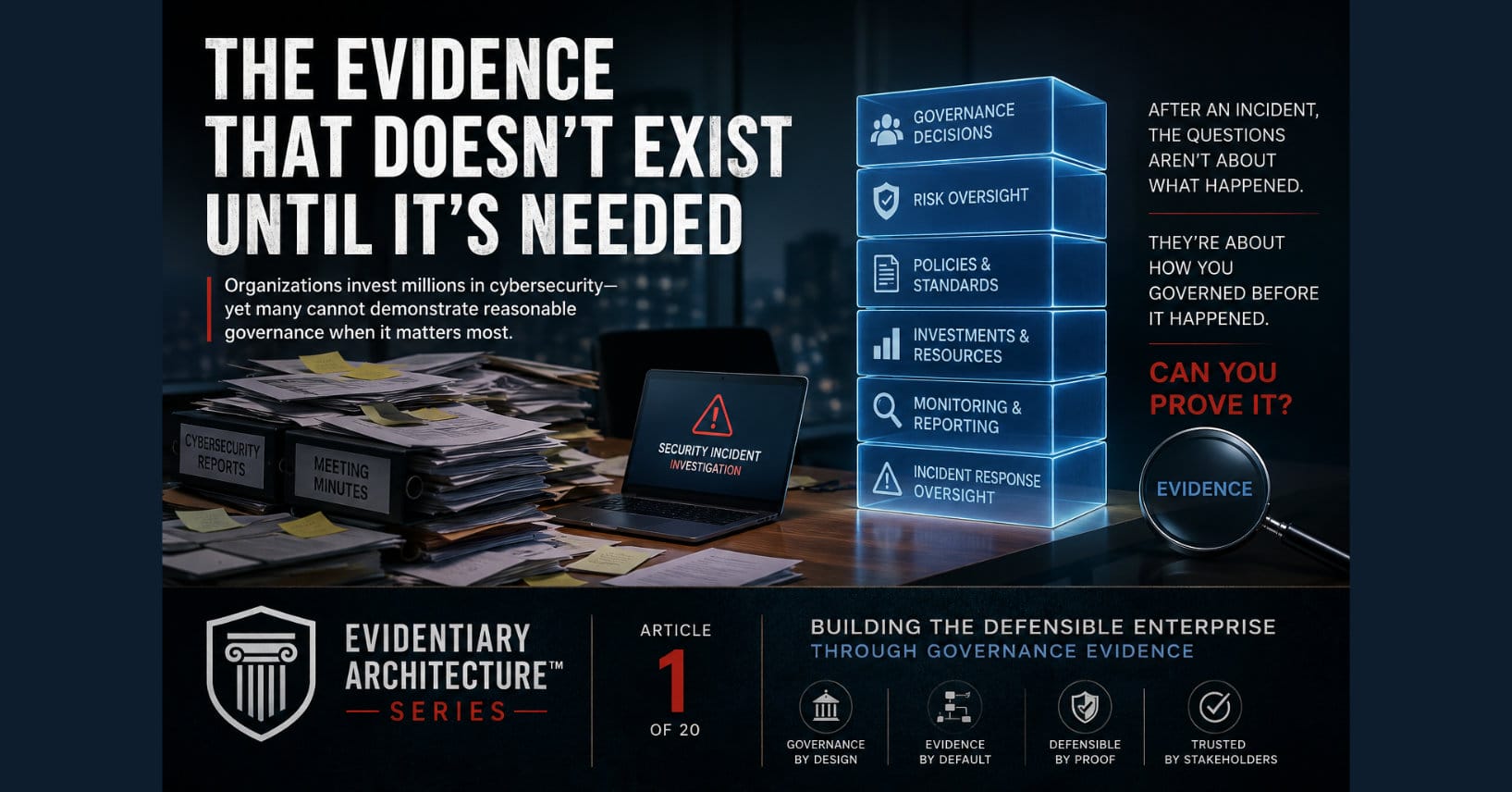

Why 2 CFR 200 Internal Control Expectations Make Cyber Oversight a Board Responsibility
Many nonprofit boards assume cybersecurity expectations apply primarily to public companies and large financial institutions.
That assumption is increasingly dangerous.
Nonprofits handle:
- Donor financial information
- Beneficiary personal data
- Sensitive case records
- Federal and state grant data
- Health, education, or child welfare information
Public trust is their primary asset.
Federal funding is often their financial backbone.
When digital risk intersects with public trust and federal dollars, cybersecurity governance becomes more than operational hygiene.
It becomes an internal control obligation.
The Misconception: “We’re Too Small to Be a Target”
Nonprofit boards often hear:
“We’re not big enough to attract attention.”
Threat actors do not evaluate organizational mission before exploiting vulnerabilities.
They evaluate:
- Data value
- System access
- Credential reuse
- Vendor pathways
- Payment systems
Smaller organizations may actually present easier entry points due to limited security resources.
But the governance issue extends beyond targeting.
It extends to compliance.
2 CFR 200 and Internal Control Expectations
Federal grant recipients are subject to the Uniform Guidance under 2 CFR 200.
Among its core requirements:
Organizations must establish and maintain effective internal controls over federal awards.
While the regulation does not list “cybersecurity” explicitly as a line item, internal controls necessarily include safeguards that:
- Protect sensitive information
- Ensure data integrity
- Prevent unauthorized access
- Preserve system availability
- Support accurate reporting
Digital systems now underpin grant reporting, financial management, and program delivery.
Weak cybersecurity posture can undermine internal control effectiveness.
Boards should recognize this intersection.
Internal Controls Are Governance, Not IT
Internal control frameworks emphasize:
- Risk assessment
- Control activities
- Information and communication
- Monitoring
- Accountability
These are governance functions.
Cyber risk directly impacts each of them.
For example:
Risk Assessment
Has cyber exposure been formally evaluated within enterprise risk discussions?
Control Activities
Are access controls, monitoring systems, and segregation of duties functioning?
Information & Communication
Is sensitive grant data safeguarded? Are breach notification pathways defined?
Monitoring
Are periodic independent assessments conducted?
Accountability
Are oversight discussions documented at the board level?
Cyber risk is embedded in internal control integrity.
The Grant Exposure Dimension
Following a significant cyber incident, grantors may request:
- Evidence of internal control systems
- Risk assessment documentation
- Incident response records
- Board oversight minutes
- Evidence of corrective action
Failure to demonstrate structured oversight can impact:
- Grant continuation
- Funding eligibility
- Reimbursement timing
- Public reporting obligations
This is not theoretical.
It is increasingly visible in post-incident reviews.
Volunteer Boards and Fiduciary Standards
Nonprofit directors often serve without compensation.
That does not reduce fiduciary duty.
In fact, it may increase reputational exposure.
Directors must exercise:
- Duty of care
- Duty of loyalty
- Duty of obedience to mission and regulatory obligations
Cyber risk now intersects with each.
Boards that treat cybersecurity as a technical afterthought may unintentionally weaken internal control posture.
Common Nonprofit Governance Gaps
Across nonprofit environments, recurring weaknesses include:
- Cyber risk not embedded in enterprise risk review
- Limited board-level reporting
- No defined escalation thresholds
- No governance-level tabletop exercises
- Minimal documentation of cyber oversight
- Overreliance on external vendors without structured review
These gaps are not malicious.
They are inherited from an era when digital dependency was lighter.
That era has passed.
Practical Board Actions for Nonprofits
Directors of grant-funded organizations should consider:
- Embedding cyber risk explicitly into internal control discussions
- Confirming that cyber posture aligns with 2 CFR 200 expectations
- Reviewing escalation and breach notification protocols
- Ensuring independent assessments occur periodically
- Documenting oversight discussions in minutes
These actions strengthen:
- Grant defensibility
- Public trust
- Regulatory alignment
- Enterprise resilience
The Core Principle
Cybersecurity governance in nonprofits is not about sophistication.
It is about structure.
Federal internal control expectations do not distinguish between digital and non-digital risk.
If digital systems support grant administration, service delivery, and financial reporting, then cyber oversight is internal control oversight.
And internal control oversight is a board responsibility.
In our next edition, we will examine grant funding and cyber oversight more directly — and how boards can strengthen defensibility before scrutiny arrives.
If you serve on a nonprofit board or advise grant-funded organizations, subscribe to The Cyber Governance Brief for continued analysis on cybersecurity as fiduciary responsibility.