Many boards take comfort in one statement:
“We’re in the cloud.”
Cloud infrastructure can be modern, scalable, and secure.
It is not a governance strategy.
Moving systems to a major cloud provider does not eliminate:
- Data classification responsibilities
- Access management failures
- Misconfiguration risk
- Vendor concentration exposure
- Incident response obligations
- Regulatory reporting duties
The cloud shifts architecture.
It does not shift accountability.
The Shared Responsibility Reality
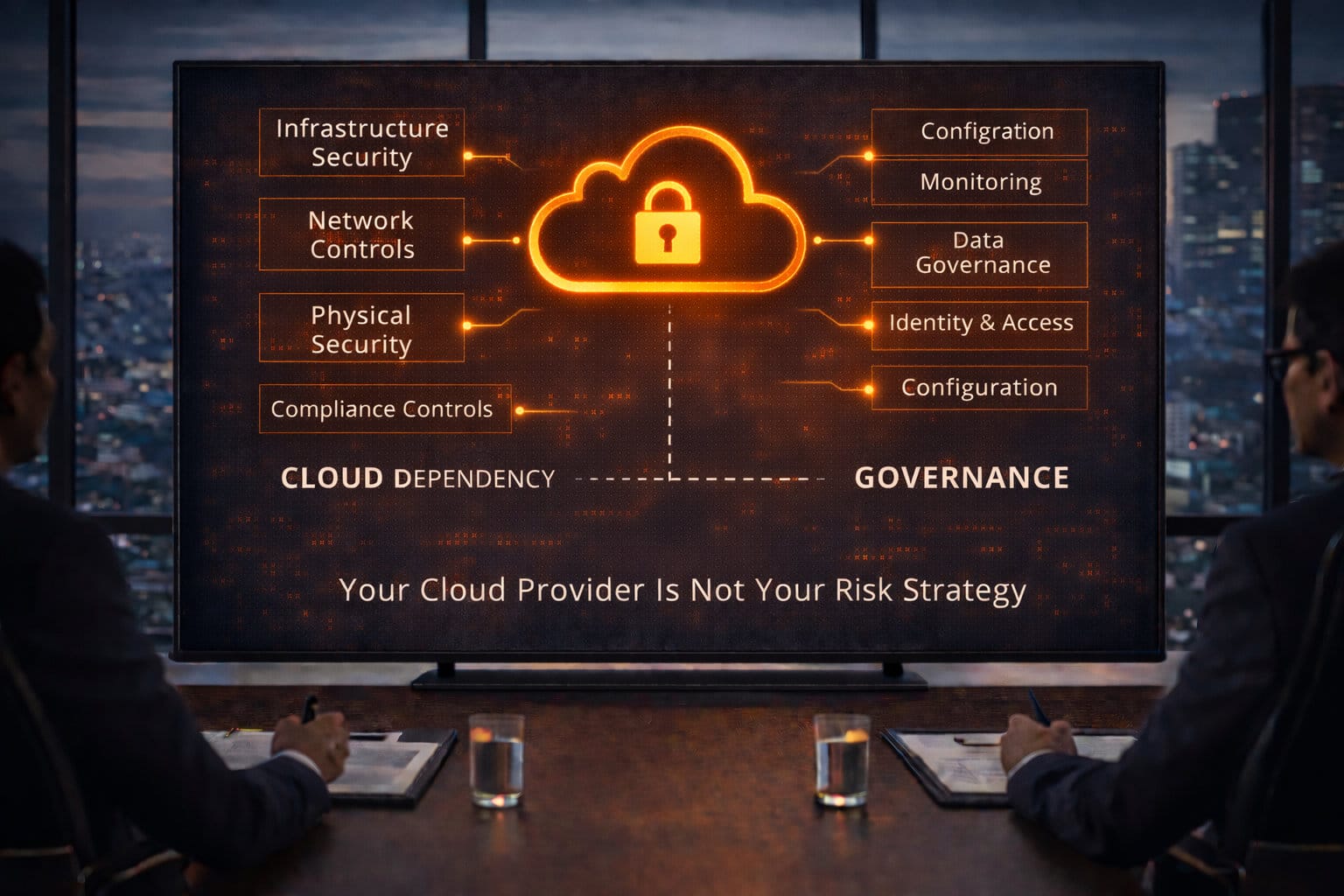
Cloud providers secure the infrastructure.
Organizations secure:
- Identity and access controls
- Configuration management
- Application security
- Data governance
- Monitoring and response
- Internal controls
Misunderstanding that division creates governance blind spots.
Boards should not assume that vendor reputation equals risk elimination.
Concentration Risk Revisited
When an organization consolidates systems into:
- One cloud platform
- One identity provider
- One SaaS ecosystem
Efficiency increases.
So does systemic dependency.
If a cloud outage, misconfiguration, or third-party compromise occurs, the impact can cascade rapidly.
Cloud centralization is a structural exposure.
Boards must treat it accordingly.
What Directors Should Be Asking
- Have we assessed single-provider dependency risk?
- Do we understand shared responsibility boundaries?
- Are misconfiguration risks periodically evaluated?
- Have we tested cloud-specific incident response scenarios?
- Is vendor risk integrated into enterprise risk discussions?
These are not technical questions.
They are governance questions.
The Illusion of Transfer
Cyber insurance does not eliminate cloud exposure.
Vendor contracts do not eliminate fiduciary duty.
Brand recognition does not eliminate configuration risk.
Cloud adoption without governance discipline can create false confidence.
The Core Principle
Technology decisions can improve resilience.
They cannot replace oversight.
Your cloud provider supplies infrastructure.
Your board supplies governance.
Conflating the two creates vulnerability.

#BoardGovernance #CloudRisk #CyberRisk #EnterpriseRisk #FiduciaryDuty