If risk recognition establishes what leadership knew, control decisions establish how leadership responded, and board oversight establishes that leadership engaged—this fourth layer answers a critical question:
Did the organization do what it said it would do?
Operational execution is where governance intent meets reality.
Policies, standards, and decisions do not reduce risk on their own.
Execution does.
But in a governance context, execution must be more than activity.
It must be traceable to decisions and verifiable as performed.
This is the fourth layer of the Governance Evidence Stack.
From Decision to Action
Organizations often demonstrate execution through evidence of activity:
Systems configured.
Controls deployed.
Processes running.
But under scrutiny, activity alone is insufficient.
Evaluators are not asking whether something was done.
They are asking whether what was done aligns with what leadership decided.
This is the difference between execution and defensible execution.
Execution becomes evidence only when it can be clearly connected back to:
- identified risks
- approved policies and control decisions
- defined oversight expectations
Without that connection, execution appears operational—disconnected from governance.
What Operational Execution Produces
When execution is aligned with governance, it produces artifacts that demonstrate consistency, discipline, and follow-through.
Common examples include:
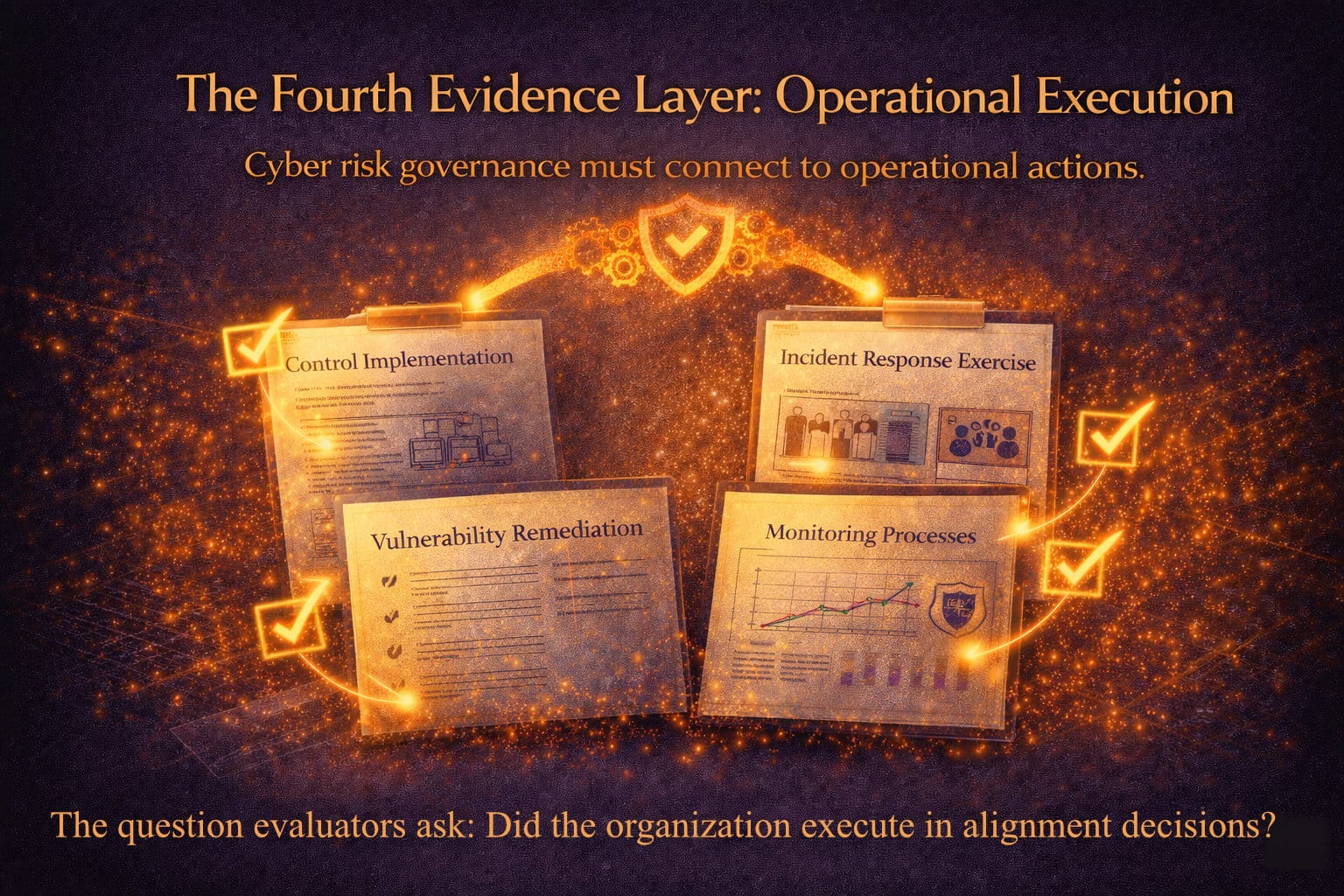
- Control implementation records that show systems configured as approved
- Incident response exercises that validate readiness and coordination
- Vulnerability remediation logs demonstrating timely risk reduction
- Monitoring processes and outputs that show ongoing control performance
These artifacts answer a fundamental question:
Was the organization operating in accordance with its stated governance model?
The Importance of Alignment
The strength of this layer is not measured by the volume of activity.
It is measured by alignment.
Evaluators look for clear linkage:
- Do implemented controls match approved policies and standards?
- Do remediation efforts address identified risks?
- Do incident exercises reflect defined response strategies?
- Do monitoring processes validate the controls leadership approved?
If these elements are aligned, execution reinforces governance.
If they are not, execution creates doubt.
The Risk of Operational Drift
One of the most common challenges at this layer is drift.
Over time, operations evolve:
- configurations change
- processes adapt
- teams implement workarounds
- priorities shift
Without continuous alignment to governance decisions, execution begins to diverge.
This creates a gap between what leadership believes is happening… and what is actually occurring.
In a post-incident evaluation, that gap becomes visible.
Organizations may present policies and decisions that appear sound.
But if execution does not reflect those decisions, governance credibility is weakened.
Execution as Verifiable Behavior
Operational execution must be demonstrable.
This requires more than system activity.
It requires evidence that execution is:
- consistent over time
- measurable against defined expectations
- monitored and validated
- corrected when deviations occur
This transforms execution from action into proof.
Without this discipline, organizations are left to assert that controls were functioning.
With it, they can demonstrate it.
Connecting Oversight to Operations
The fourth layer is where oversight is tested.
It is not enough for leadership to recognize risk, make decisions, and discuss oversight.
Those actions must translate into operational reality.
Evaluators examine whether:
- board-level decisions are reflected in operational practices
- oversight discussions result in measurable actions
- follow-up items are implemented and validated
- governance expectations are enforced within operations
This is where governance moves from intention to enforcement.
The Fourth Layer in Context
The Governance Evidence Stack builds toward this point:
- Risk recognition establishes awareness
- Control decisions establish response
- Board oversight establishes engagement
- Operational execution establishes follow-through
Together, these layers answer:
- Did leadership know?
- Did leadership act?
- Did leadership oversee?
- Did the organization execute?
Each must be supported by evidence.
Because governance is not proven by intent.
It is proven by outcomes—aligned, traceable, and verifiable.
Establishing Defensible Execution
To strengthen this layer, organizations must ensure that execution is:
- explicitly tied to governance decisions
- consistently documented and monitored
- validated through testing and exercises
- corrected when deviations occur
This creates continuity.
It allows evaluators to follow a clear line from governance intent to operational reality.
Without that continuity, governance appears fragmented.
With it, governance becomes defensible.
The Proof of Follow-Through
Operational execution is where many organizations believe they are strongest.
And in many cases, they are.
But strength at this layer is not defined by capability.
It is defined by traceability.
Because in the end, the question is not simply whether the organization acted.
It is whether the organization can prove that it acted in accordance with its own governance decisions.
And whether that proof can withstand scrutiny.