Up to this point, the Cyber Governance Evidence Series has defined a model.
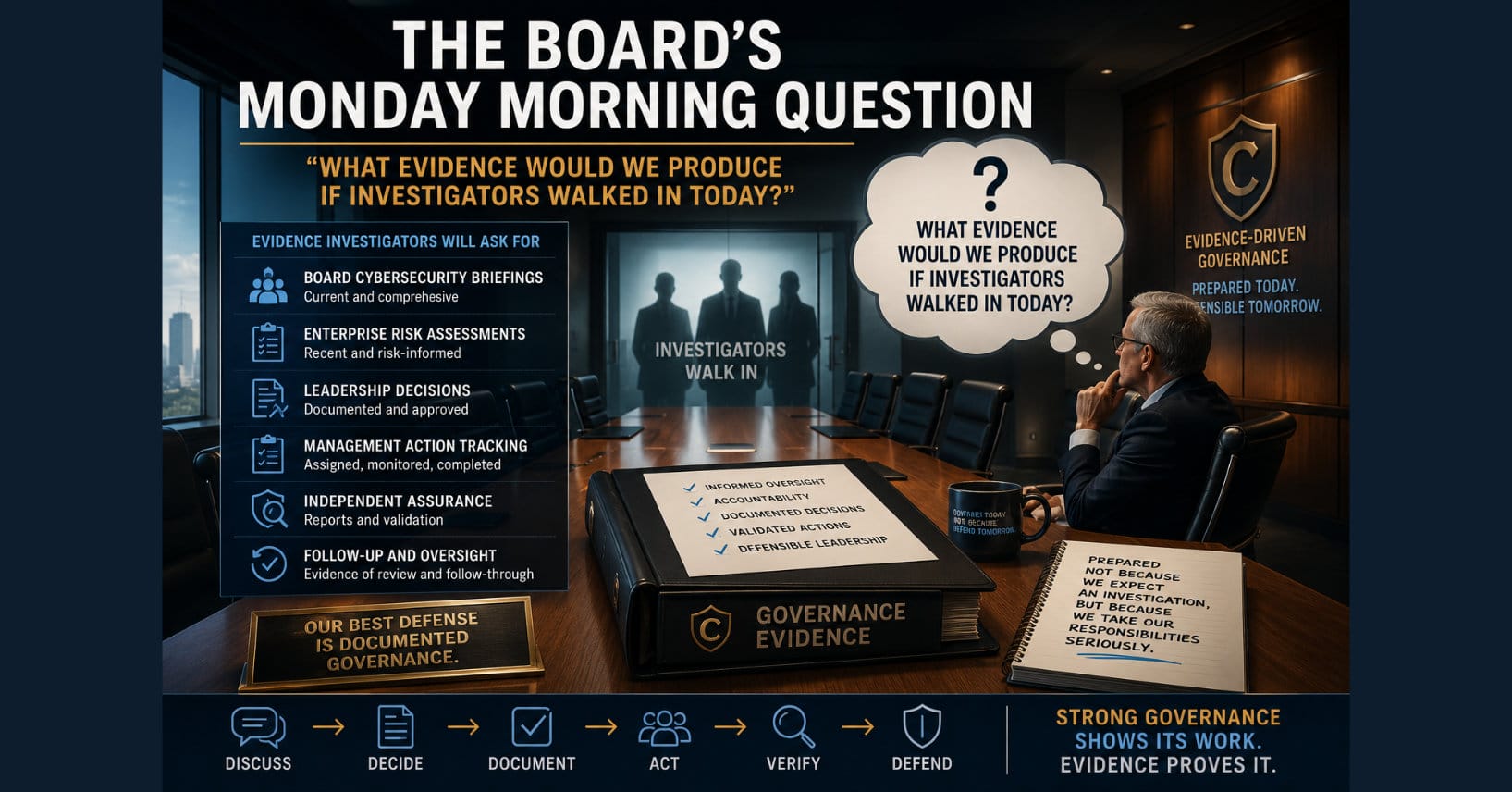
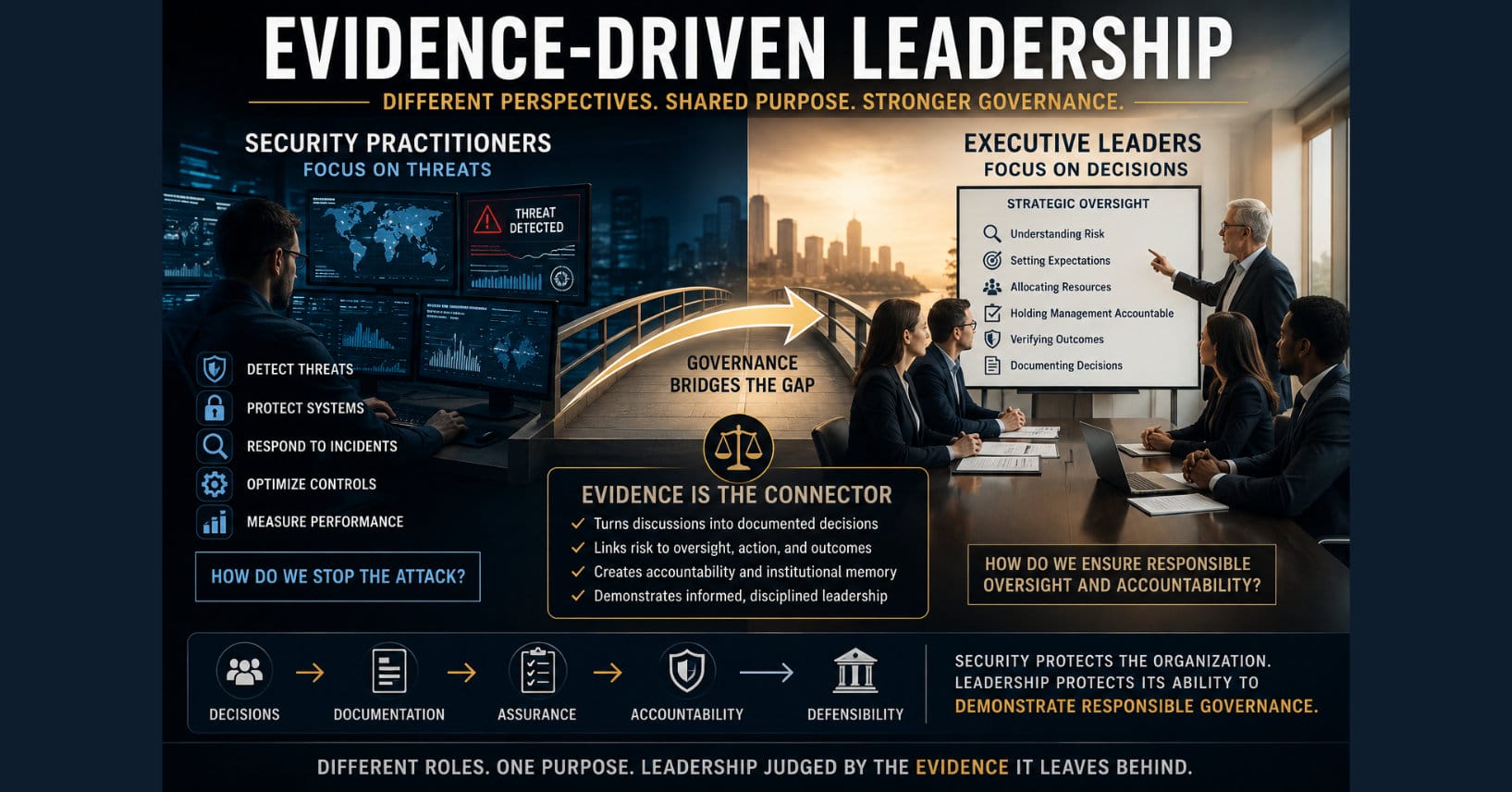
We established that governance produces evidence.
We built the Governance Evidence Stack.
We examined each layer individually.
We defined how evaluators assess readiness.
Now the question becomes practical:
How do you measure it?
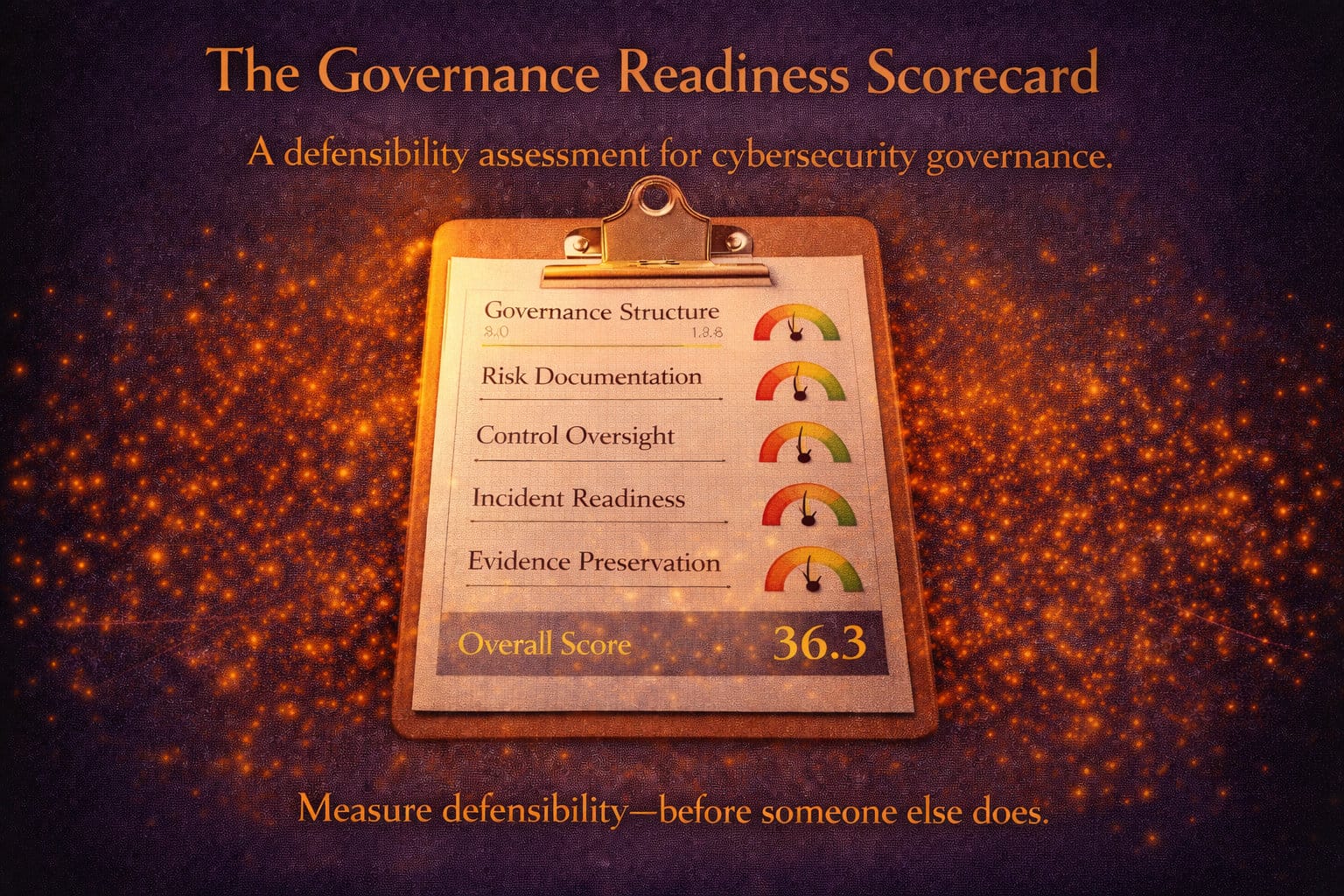
This is where the Governance Readiness Scorecard comes in.
It translates the evidentiary model into a structured, repeatable evaluation framework—one that allows organizations to assess not just what they are doing, but how defensible their governance truly is.
From Concept to Measurement
Most organizations measure cybersecurity readiness through:
- control maturity
- framework alignment
- compliance status
These are useful—but incomplete.
They measure implementation.
The Governance Readiness Scorecard measures defensibility.
It evaluates whether governance can be demonstrated under scrutiny—clearly, consistently, and credibly.
The Core Evaluation Categories
The scorecard organizes evaluation into five categories, each aligned to the Governance Evidence Stack:
1. Governance Structure
This category evaluates whether the organization has established clear governance foundations.
Key considerations include:
- defined roles and responsibilities for cyber oversight
- board and committee structures
- reporting lines between security and leadership
- formal governance processes
This determines whether governance is structurally in place.
Without structure, evidence cannot be consistently produced.
2. Risk Documentation
This category examines how well risk is formally recognized and recorded.
Evaluators look for:
- comprehensive risk registers
- consistent risk assessment methodologies
- clear prioritization and materiality definitions
- documented communication of risk to leadership
This measures whether risk awareness is documented—and therefore governable.
3. Control Oversight
This category evaluates how leadership decisions translate into control selection and governance.
Key elements include:
- documented policy adoption and approvals
- alignment between controls and identified risks
- oversight of control effectiveness
- evidence of leadership involvement in decision-making
This determines whether control decisions are deliberate, traceable, and governed.
4. Incident Readiness
This category focuses on the organization’s ability to respond in alignment with governance expectations.
Evaluators assess:
- incident response plans and testing
- tabletop exercises and scenario validation
- escalation pathways and communication protocols
- alignment between response actions and governance decisions
This measures whether execution reflects governance intent under pressure.
5. Evidence Preservation
This category evaluates whether governance evidence is durable and defensible over time.
Key considerations include:
- audit log retention and integrity
- change history and traceability
- policy version control
- accessibility and retrievability of records
This determines whether the organization can produce evidence when it matters most.
Scoring What Matters
Each category is not simply marked as present or absent.
It is evaluated based on:
- completeness — are the necessary elements in place?
- consistency — are they applied uniformly across the organization?
- traceability — can they be connected across the Governance Evidence Stack?
- defensibility — would they withstand external scrutiny?
This creates a multidimensional view of readiness.
Not just what exists—but how well it holds together.
What the Scorecard Reveals
The Governance Readiness Scorecard does more than assign a score.
It reveals:
- gaps between governance intent and execution
- disconnects between risk, decisions, and oversight
- weaknesses in evidence preservation and retrieval
- areas where governance is assumed but not demonstrable
Most importantly, it highlights where the evidentiary chain breaks.
Because that is where defensibility fails.
From Assessment to Action
A scorecard is not an endpoint.
It is a diagnostic tool.
It allows organizations to:
- identify weaknesses before they are exposed under scrutiny
- prioritize improvements based on evidentiary impact
- align governance practices with real-world evaluation standards
- strengthen their ability to respond to regulatory, legal, and insurance inquiries
This shifts readiness from reactive to proactive.
The Strategic Implication
Organizations often invest heavily in cybersecurity capabilities.
But capability without defensibility creates risk.
The Governance Readiness Scorecard bridges that gap.
It ensures that:
- governance is not only performed, but provable
- oversight is not only exercised, but visible
- decisions are not only made, but traceable
- evidence is not only created, but preserved
This is the difference between operational readiness and governance readiness.
The Natural Next Step
At some point, every organization faces external scrutiny.
The question is not whether that moment will come.
It is whether the organization will be ready for it.
The Governance Readiness Scorecard provides a structured way to answer that question—before it is asked by someone else.
Because in the end, readiness is not defined by confidence.
It is defined by proof.
And proof must be measurable.