
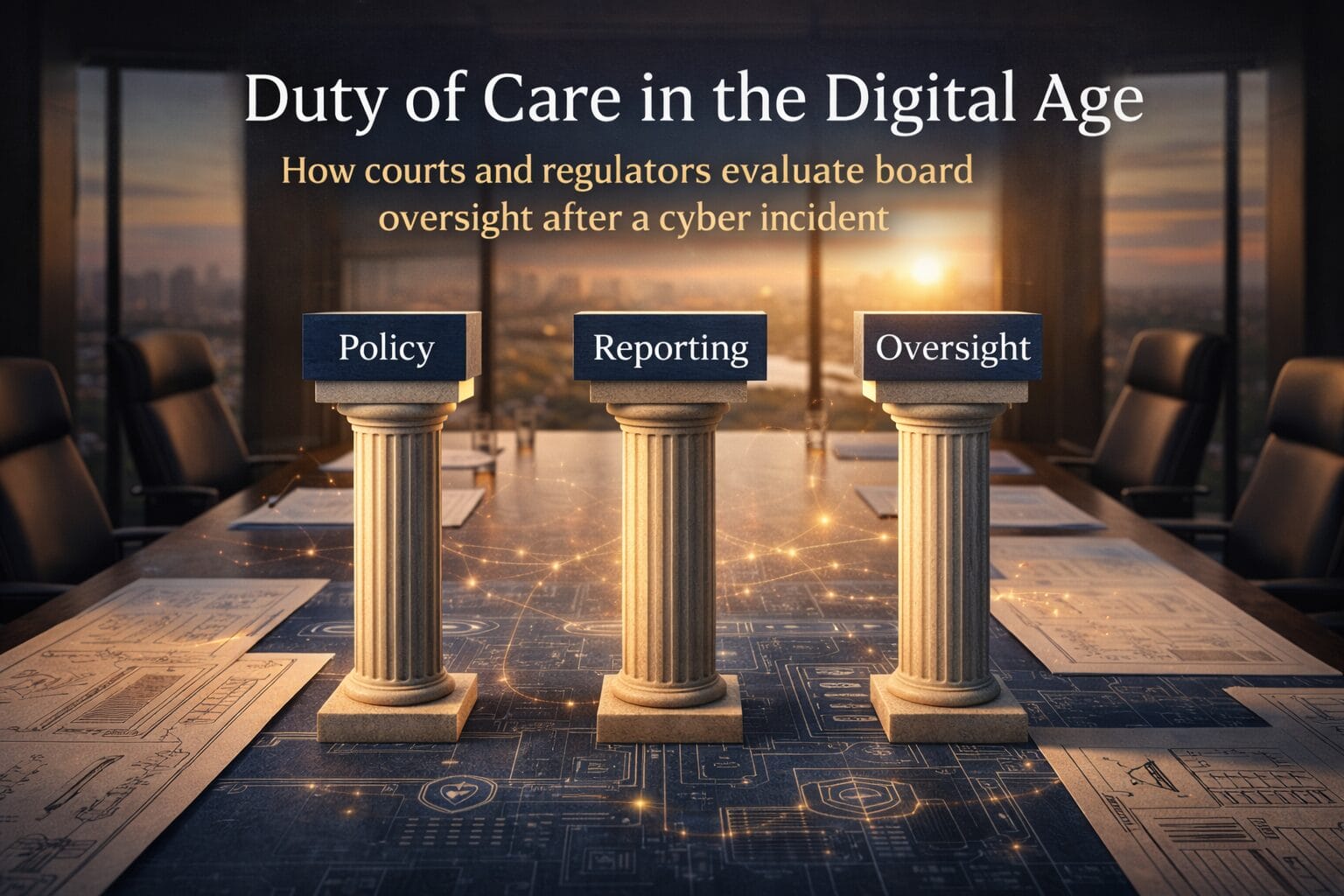
How courts and regulators evaluate board oversight after a cyber incident

When a significant cyber incident occurs, the first wave of response is operational.
Systems are contained.
Forensics begin.
Public statements are drafted.
But almost immediately, a second wave begins.
Regulators ask questions.
Plaintiffs examine records.
Insurers review representations.
Auditors request documentation.
At that moment, the technical details of the breach matter. But something else matters more:
Did the board exercise its duty of care?
This edition examines what that duty means in a digital environment — and how oversight is evaluated after risk materializes.
The Duty of Care: A Governance Standard, Not a Technical Standard
The duty of care requires directors to act:
- In good faith
- With reasonable diligence
- On an informed basis
It does not require directors to predict every risk or prevent every failure. It does require that material risks receive structured attention.
Cyber risk now qualifies as material for most organizations.
Digital infrastructure supports revenue, operations, regulatory compliance, and public trust. When digital systems fail, consequences cascade.
The governance question is not whether a breach occurred.
The governance question is whether directors established and monitored a system reasonably designed to detect and manage cyber risk.
That distinction is critical.
How Oversight Is Evaluated After an Incident
When courts and regulators review governance, they do not look for technical perfection. They look for process.
They examine:
- Whether cyber risk was formally recognized at the board level
- Whether structured reporting reached directors
- Whether escalation thresholds were defined
- Whether resource decisions were documented
- Whether oversight discussions appear in meeting minutes
If those elements exist, boards can demonstrate diligence.
If they do not, the absence becomes evidence.
In post-incident reviews, silence in documentation can be as damaging as negligence in action.
The Reporting System Requirement
Longstanding governance doctrine emphasizes that boards must ensure reporting systems exist for significant risks.
In the digital era, this principle applies directly to cyber risk.
A reporting system does not mean occasional updates from IT.
It means:
- Defined cadence
- Clear ownership
- Escalation clarity
- Enterprise impact framing
- Documentation discipline
Without a structured reporting system, directors cannot demonstrate informed oversight.
With one, they can.
What Regulators Increasingly Expect
Across sectors, regulatory posture is converging toward governance accountability.
Whether in publicly traded companies, healthcare entities, financial institutions, or federally funded nonprofits, oversight expectations now include:
- Board-level engagement
- Formalized risk assessment processes
- Documented policy review cycles
- Defined incident response governance
- Alignment between stated risk tolerance and investment
The pattern is clear.
Cybersecurity is no longer viewed solely as a technical control function. It is viewed as part of enterprise governance architecture.
The Documentation Imperative
In litigation and enforcement environments, documentation becomes decisive.
Meeting minutes that reflect:
- Questions asked
- Risks discussed
- Escalation reviewed
- Resources approved
can demonstrate reasonable oversight.
Conversely, minutes that show no meaningful engagement invite scrutiny.
Directors should not seek theatrical detail in minutes. But they should ensure that material discussions are accurately reflected.
Governance is not proven by intention. It is proven by record.
Common Governance Gaps
In advising boards, several recurring patterns appear:
- Cyber risk is discussed only after an incident.
- Reporting focuses on technical metrics rather than enterprise impact.
- Escalation thresholds are undefined.
- Independent assessment has not occurred in years.
- Oversight conversations are not captured in minutes.
None of these gaps are malicious. Most are inherited from an earlier era when cyber risk was viewed as operational.
But inherited structures can become inherited liabilities.
Practical Board Actions
To strengthen alignment with duty-of-care expectations, boards should consider:
- Confirming that cyber risk is integrated into enterprise risk discussions.
- Reviewing the cadence and format of cyber reporting.
- Clarifying board notification triggers in writing.
- Ensuring periodic independent assessment.
- Verifying that oversight discussions are documented accurately.
These steps are structural. They do not require technical fluency. They require governance discipline.
The Cultural Component
Directors influence posture through inquiry.
When boards treat cyber risk as peripheral, management will report accordingly.
When boards treat it as material, structured, and fiduciary, reporting evolves.
Tone at the top remains one of the most powerful control mechanisms in any organization.
The Core Insight
The duty of care in the digital age does not require directors to prevent every breach.
It requires them to build and monitor systems reasonably designed to detect and manage risk.
Oversight is architectural.
Architecture is deliberate.
And deliberation is defensible.
In our next edition, we will examine how to design board-level cyber oversight architecture — moving from principle to structure.
If you serve on a board or advise executive leadership teams, subscribe to The Cyber Governance Brief for continued analysis on cybersecurity as fiduciary responsibility.