
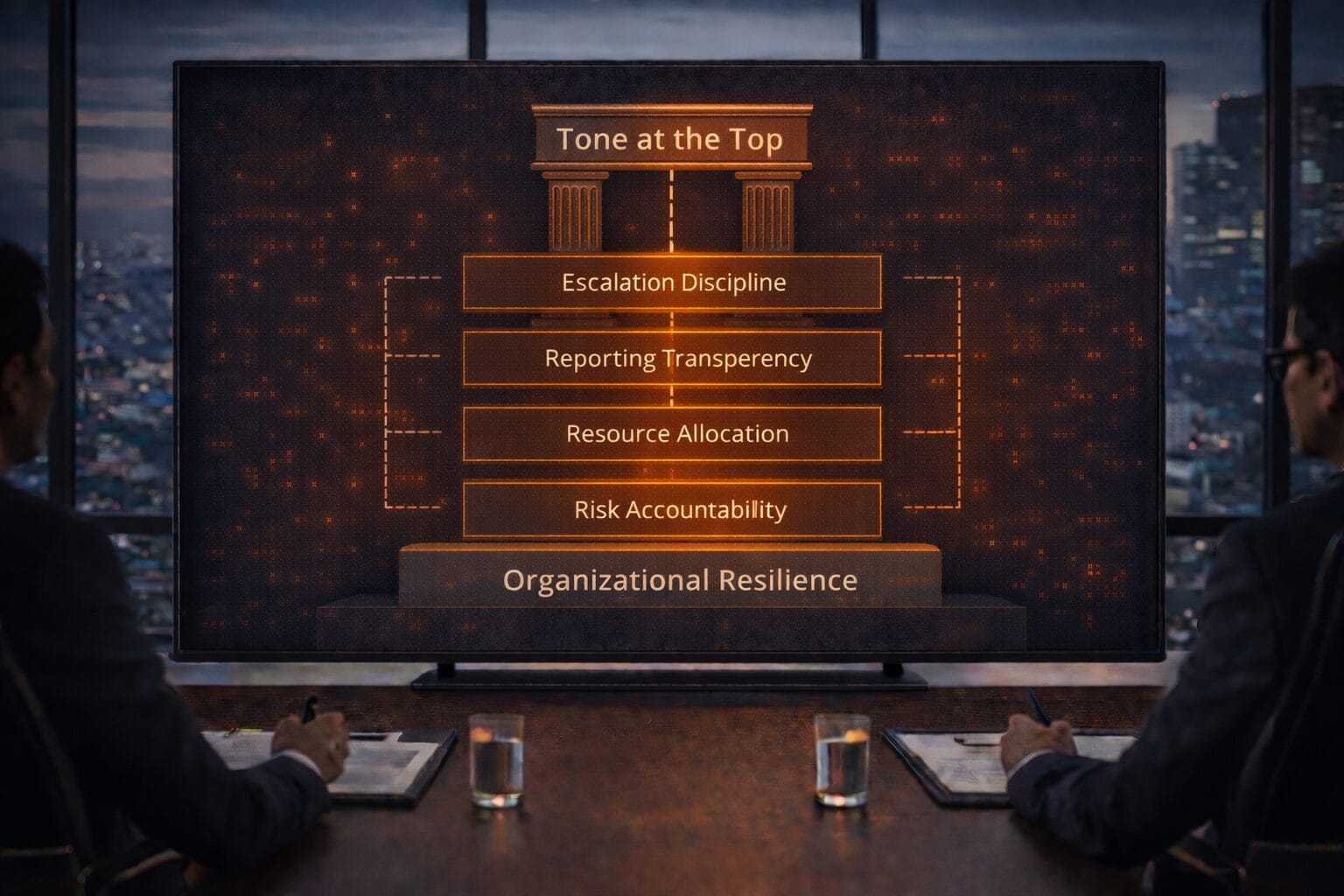
The Governance Impact of Tone at the Top
Boards often focus on policies, frameworks, and reporting systems.
Those matter.
But there is a quieter control that shapes every other safeguard in an organization:
Culture.
Specifically, tone at the top.
Cybersecurity governance does not operate in isolation from organizational behavior.
It is reinforced — or weakened — by how leadership signals priority, seriousness, and accountability.
This edition examines why culture is itself a control, and how board posture shapes enterprise resilience.
Culture as an Invisible Control Mechanism
Traditional control frameworks emphasize:
- Risk assessment
- Control activities
- Monitoring
- Documentation
These are structural controls.
Culture is behavioral control.
When leadership treats cybersecurity as peripheral, operational teams respond accordingly.
When leadership treats it as enterprise risk, posture changes.
Culture influences:
- Budget prioritization
- Escalation discipline
- Incident transparency
- Reporting candor
- Compliance rigor
It is difficult to quantify.
It is impossible to ignore.
What Tone at the Top Looks Like in Practice
Board posture is communicated through questions.
When directors ask:
“How many attacks were blocked?”
They signal operational curiosity.
When directors ask:
“What could materially disrupt our mission?”
They signal enterprise seriousness.
Tone is also reflected in:
- Agenda placement
- Reporting cadence
- Time allocated to discussion
- Follow-up accountability
- Documentation discipline
If cybersecurity consistently appears as the final agenda item, culture absorbs that signal.
If it is integrated into enterprise risk dialogue, culture adjusts.
Escalation Behavior Reflects Culture
In organizations where tone at the top is dismissive:
- Incidents may be underreported.
- Risk warnings may be softened.
- Budget requests may be delayed.
- Vulnerabilities may remain unaddressed.
In organizations where tone at the top is disciplined:
- Escalation is prompt.
- Reporting is candid.
- Risk discussions are structured.
- Accountability is documented.
Escalation behavior often reveals cultural posture more clearly than policy documents.
Psychological Safety and Cyber Governance
An overlooked dimension of cyber culture is psychological safety.
Do technical leaders feel comfortable escalating uncomfortable truths?
Do compliance officers feel supported when identifying weaknesses?
Do executives encourage transparency, even when inconvenient?
If culture punishes candor, governance degrades.
If culture rewards transparency, resilience strengthens.
Boards influence that environment through reaction, not rhetoric.
Culture and Resource Allocation
Budget decisions are cultural signals.
When cybersecurity investment is consistently deferred while other initiatives are prioritized, the message is clear.
When cyber risk alignment is part of strategic planning discussions, the signal changes.
Culture determines whether risk tolerance statements are taken seriously or treated as formalities.
The Investigative Lens
After a significant incident, investigators evaluate structure.
But they also evaluate behavior.
Questions often include:
- Were prior warnings ignored?
- Were vulnerabilities known but unaddressed?
- Were internal concerns escalated?
- Did leadership respond with urgency?
Documentation tells part of the story.
Organizational behavior tells the rest.
Tone at the top becomes visible in hindsight.
Practical Board Actions
Directors can intentionally shape cyber culture by:
- Placing cyber risk within enterprise discussions
- Asking consequence-oriented questions
- Encouraging transparent reporting
- Supporting independent assessments
- Ensuring follow-up accountability
- Reflecting oversight engagement in minutes
These actions do more than check compliance boxes.
They establish expectation.
Expectation shapes behavior.
Behavior shapes resilience.
The Core Principle
Policies are necessary.
Controls are essential.
But culture determines whether they function.
Tone at the top is not symbolic.
It is operational.
When boards treat cybersecurity as enterprise risk, organizations follow.
When boards treat it as technical maintenance, organizations follow that as well.
Culture is a control.
And boards are its architects.
In our next edition, we will examine executive compensation and cyber accountability — and whether incentive structures reinforce governance posture or undermine it.
If you serve on a board or advise executive leadership teams, subscribe to The Cyber Governance Brief for continued analysis on cybersecurity as fiduciary responsibility.