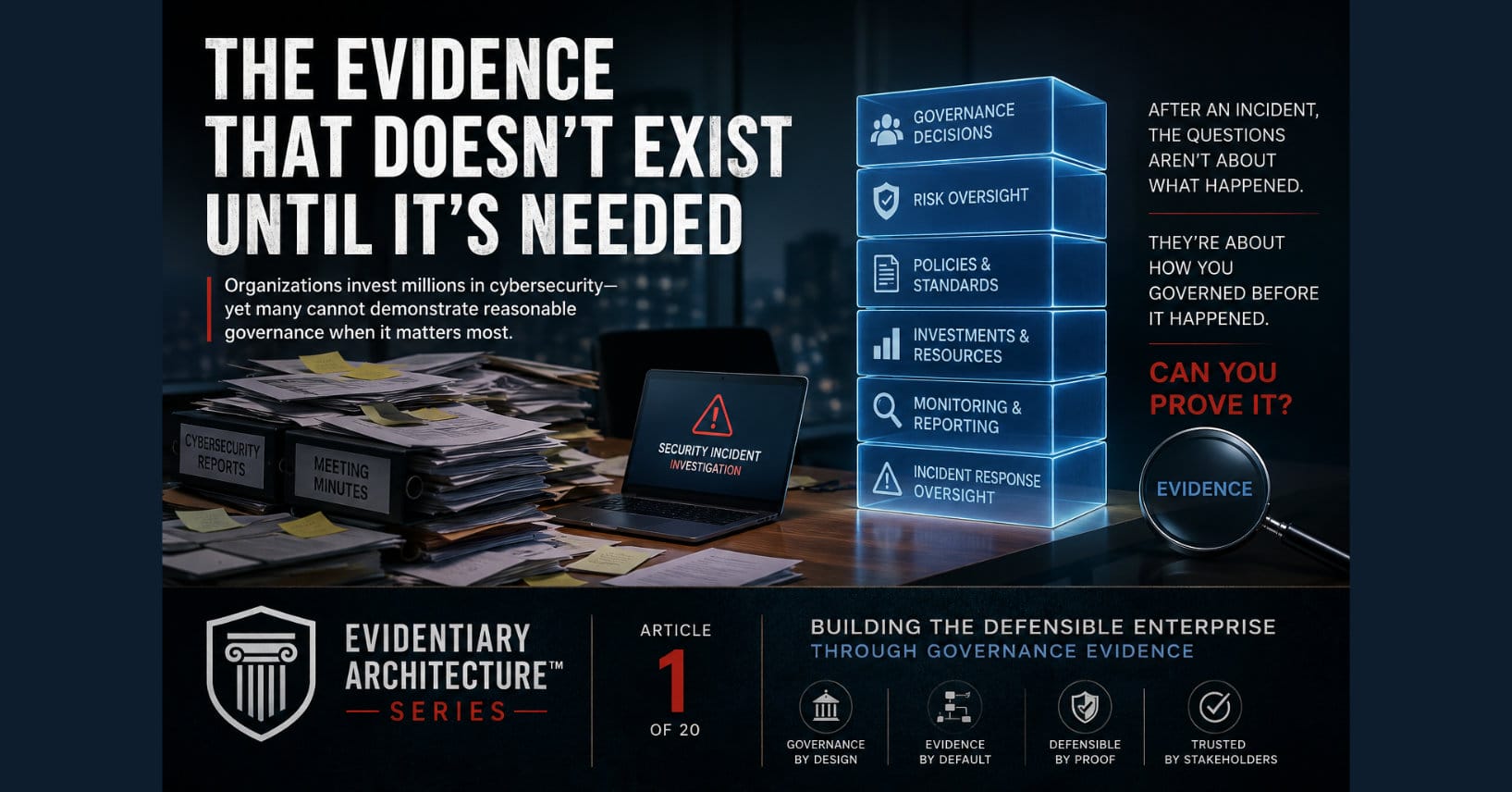
What Boards Must Define Before a Crisis Occurs
Cyber incidents do not create governance structure.
They expose its absence.
When a material cyber event occurs, organizations enter a compressed decision cycle:
Systems are isolated.
Legal counsel is engaged.
Communications teams draft statements.
Insurers are notified.
Regulators may be contacted.
Under that pressure, one question determines whether leadership appears disciplined or reactive:
Did the board define its role before the incident occurred?
Incident response is not only an operational playbook.
It is a governance discipline.
The Governance Layer of Incident Response
Most organizations have some form of incident response plan.
Fewer have defined:
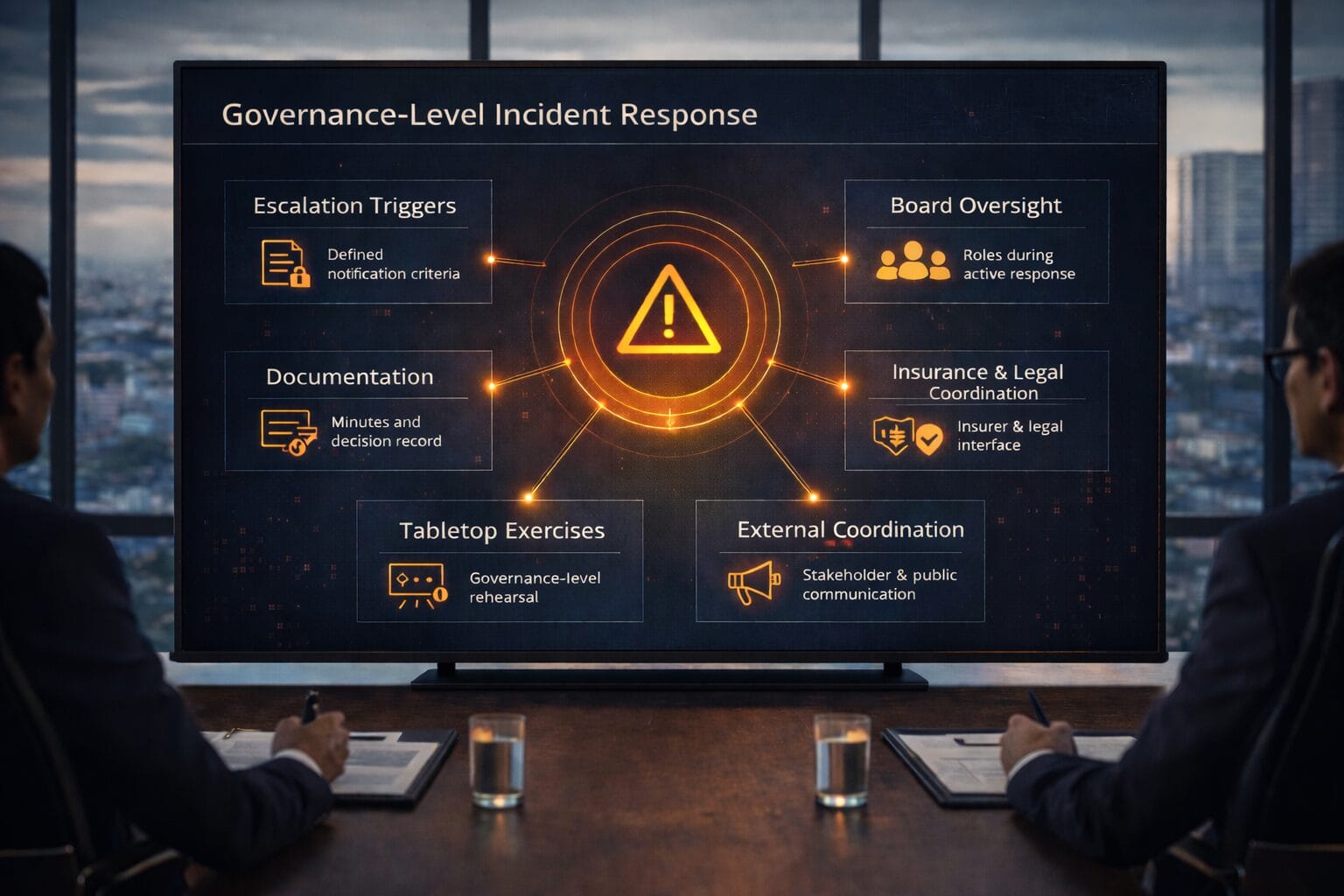
- Board notification triggers
- Escalation timing requirements
- Oversight responsibilities during active events
- Communication approval thresholds
- Documentation expectations
Operational teams manage containment.
Boards govern consequence.
That distinction must be established in advance.
Escalation Discipline
Escalation is where governance maturity is most visible.
Boards should formally clarify:
- What constitutes a board-notifiable cyber incident?
- Within what timeframe must directors be informed?
- Who communicates the update?
- What information must be included?
- How frequently will updates occur during active response?
Without defined triggers, escalation becomes subjective.
Subjectivity creates risk.
Role Clarity During an Incident
Boards do not manage technical response.
They do:
- Ensure adequate resources are deployed
- Confirm legal and regulatory obligations are addressed
- Oversee disclosure decisions
- Evaluate enterprise impact
- Document oversight engagement
Confusion between management and governance during a crisis can slow response and create liability.
Clarity strengthens both speed and defensibility.
The Documentation Dimension
After an incident, documentation becomes critical.
Board minutes should reflect:
- When directors were notified
- What information was presented
- Questions asked
- Strategic decisions made
- Oversight follow-up
In crisis, documentation often becomes secondary to action.
That is understandable.
It is also risky.
Prepared boards predefine documentation protocols.
Tabletop Exercises at the Governance Level
Many organizations conduct technical tabletop exercises.
Fewer include the board.
Governance-level exercises should test:
- Escalation timing
- Information flow
- Decision authority
- Communication sequencing
- Role boundaries
Directors do not need to simulate firewall adjustments.
They need to simulate decision-making under uncertainty.
Preparedness is rehearsal.
Disclosure and Public Communication
One of the most consequential governance moments in a cyber incident is disclosure.
Boards should predefine:
- When public communication is required
- Who approves statements
- How investor or donor communication is structured
- How regulatory notification is coordinated
Improvised disclosure under pressure invites missteps.
Defined frameworks reduce error.
Insurance and External Coordination
Cyber insurance policies often require specific notification timing.
Boards should understand:
- Notification obligations
- Policy exclusions
- Cooperation requirements
- Documentation expectations
Incident governance intersects with legal and insurance realities.
It cannot be purely technical.
Common Governance Gaps
Recurring weaknesses in incident preparedness include:
- Undefined board notification thresholds
- No formal escalation timeline
- Infrequent governance-level exercises
- Fragmented communication authority
- Minimal documentation during crisis
These gaps rarely surface during calm periods.
They surface during scrutiny.
Practical Board Actions
Directors should confirm:
- Escalation triggers are written and approved.
- Notification timelines are clear.
- Governance-level tabletop exercises occur periodically.
- Communication authority is defined.
- Incident oversight is documented appropriately.
Preparedness is not paranoia.
It is prudence.
The Core Principle
Cyber incidents are not hypothetical.
The only uncertainty is timing and scale.
Boards cannot prevent every breach.
They can prevent governance chaos.
Incident preparedness is not about technical containment.
It is about structured oversight under pressure.
And structured oversight is what distinguishes resilient institutions from reactive ones.
In our next edition, we will examine the first 24 hours after a breach — and what boards must do immediately to protect enterprise stability and fiduciary defensibility.
If you serve on a board or advise executive leadership teams, subscribe to The Cyber Governance Brief for continued analysis on cybersecurity as fiduciary responsibility.