Cyber insurance discussions in the boardroom often focus on one question:
“What does the policy cover?”
A more important question is often overlooked:
“What does it not cover?”
That is where governance risk lives.
Premiums Signal More Than Cost
Premiums are not just pricing.
They are signals.
Insurers evaluate:
- Security posture
- Control maturity
- Incident history
- Vendor exposure
- Governance structure
Rising premiums or stricter terms often reflect perceived risk — not market fluctuation alone.
Boards should treat underwriting feedback as an external view of their risk posture.
Exclusions Define Real Exposure
Every policy has exclusions.
Common ones include:
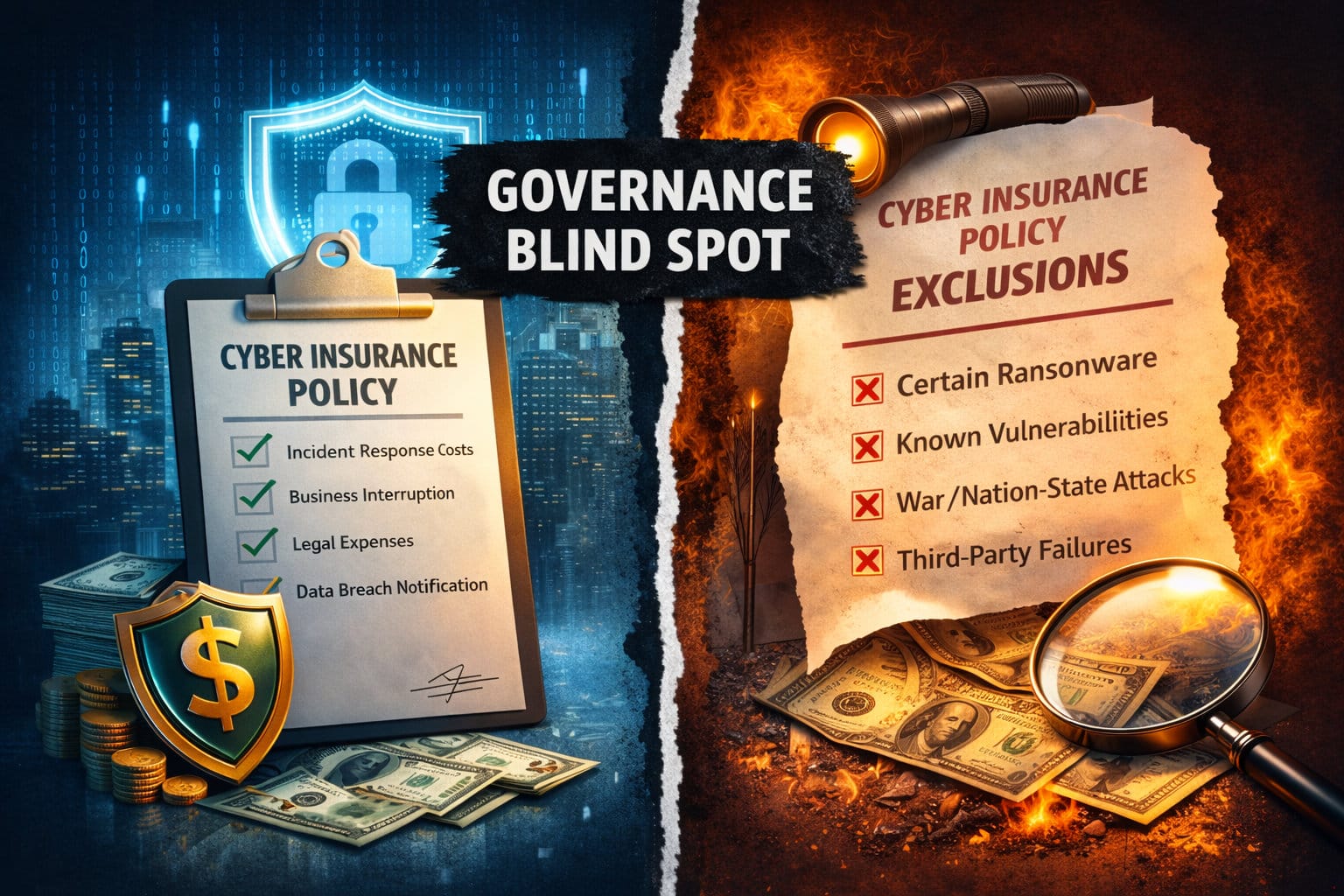
- Certain ransomware conditions
- Known vulnerabilities
- Third-party failures
- Acts of war or nation-state activity
- Failure to meet policy requirements
These exclusions are not footnotes.
They define where the organization remains fully exposed.
If boards are not reviewing exclusions, they may misunderstand their actual risk position.
Conditions That Create Denial Risk
Coverage often depends on compliance with policy conditions:
- Timely incident notification
- Maintenance of specified controls
- Adherence to documented procedures
- Accurate representations during underwriting
Failure in any of these areas can lead to denied claims.
At that point, governance questions intensify.
The Governance Blind Spot
The blind spot emerges when boards:
- Review premiums but not exclusions
- Assume coverage without validating conditions
- Treat insurance as protection rather than instrument
- Do not connect policy terms to internal controls
This creates a gap between perceived protection and actual exposure.
What Boards Should Be Asking
- What exclusions create our largest residual risk?
- What conditions must we meet to maintain coverage?
- Are our internal controls aligned with policy requirements?
- How does our governance posture influence premiums?
- Would a claim scenario expose gaps in documentation?
These are governance questions, not insurance questions.
Insurance as a Governance Input
Cyber insurance should inform oversight, not replace it.
Policies provide:
- External risk perspective
- Financial exposure boundaries
- Insight into insurer expectations
Boards that integrate this information into enterprise risk discussions strengthen defensibility.
The Core Principle
Premiums tell you how risk is priced.
Exclusions tell you where risk remains.
Governance determines whether either is understood.
Cyber insurance can reduce financial impact.
It cannot reduce accountability.

#BoardGovernance #CyberRisk #CyberInsurance #EnterpriseRisk #FiduciaryDuty