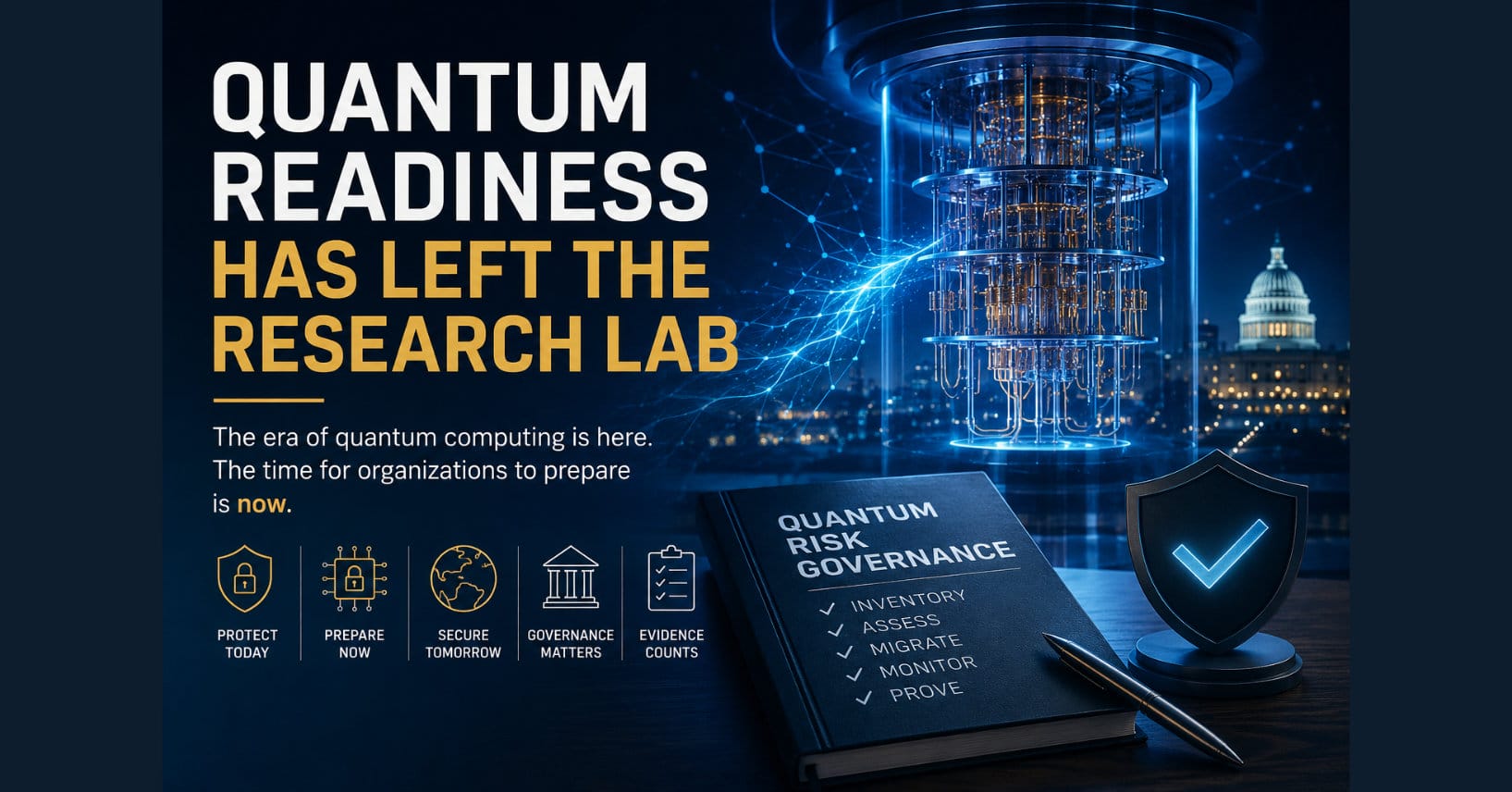
For years, quantum computing has been viewed as a distant research initiative with little impact on day-to-day business operations. That assumption is rapidly becoming outdated. Advances in quantum hardware and increasing investment from governments and industry mean organizations must begin preparing now for the eventual disruption of current cryptographic standards.
This article explains why quantum readiness is no longer solely an IT concern but an emerging governance responsibility. It explores the risks posed by “harvest now, decrypt later” attacks, the importance of cryptographic agility, and the role boards should play in ensuring long-term resilience. The organizations that begin planning today will be far better positioned when quantum capabilities reach practical maturity.
Executive Brief
For years, quantum computing has been discussed as a future technology with future implications. That framing is no longer accurate. While large-scale quantum computers capable of breaking today’s public-key cryptography are still emerging, the transition to quantum-resistant security has already begun. Governments, regulators, standards bodies, and technology providers are moving from research to implementation. For boards and executive leadership, quantum readiness is no longer a technology discussion—it is becoming a governance responsibility.
The Business Reality
Cybersecurity has always been a race between those defending information and those attempting to compromise it. Quantum computing changes the rules of that race.
Today’s public-key cryptography—including widely used algorithms such as RSA and Elliptic Curve Cryptography (ECC)—forms the foundation of digital trust. It protects financial transactions, software updates, VPNs, digital certificates, identity systems, and secure communications. Once cryptographically relevant quantum computers become available, those algorithms are expected to become vulnerable.
The risk is not limited to the future.
Nation-state adversaries and sophisticated threat actors are already believed to be collecting encrypted information today with the expectation that it can be decrypted years from now when quantum capabilities mature. This “Harvest Now, Decrypt Later” strategy means that information requiring long-term confidentiality may already be at risk.
Recognizing this shift, the federal government recently accelerated the nation’s transition to Post-Quantum Cryptography (PQC) through Executive Order 14412, directing agencies to move more aggressively toward quantum-resistant cryptographic standards and preparing federal contractors for the same journey. At the same time, the National Institute of Standards and Technology (NIST) has finalized the first generation of standardized post-quantum cryptographic algorithms, providing organizations with a clear migration path.
This is a fundamental change in how organizations should think about cybersecurity.
The conversation is no longer:
“Will quantum computing eventually matter?”
The conversation has become:
“How prepared are we to transition our cryptographic infrastructure?”
Organizations should already be asking practical questions:
- Where are we using vulnerable public-key cryptography?
- Which business systems depend upon it?
- Which information must remain confidential for ten years or longer?
- How long will a complete migration require?
- Can we demonstrate measurable progress to customers, regulators, insurers, and auditors?
These are no longer purely technical questions. They are enterprise risk questions.
What Leadership Often Misses
Many executives assume quantum readiness begins when new encryption algorithms are deployed.
In reality, deployment is one of the final steps.
Organizations must first discover where cryptography exists throughout their environment, understand which business processes depend upon it, assess the operational impact of replacing it, and develop a migration strategy that minimizes business disruption. For large enterprises, that effort may span years rather than months.
Waiting until quantum computers become commercially disruptive is equivalent to waiting until a hurricane reaches the shoreline before developing an evacuation plan.
The organizations that begin planning now will have options.
Those that delay may find themselves attempting to migrate critical infrastructure under regulatory, customer, or market pressure.
Questions Every Executive Should Ask
- Do we know where quantum-vulnerable cryptography exists across our enterprise?
- Have we identified information that requires long-term confidentiality?
- Is post-quantum migration included in our long-term cybersecurity roadmap?
- How would we demonstrate quantum readiness to our board, insurers, regulators, or customers?
- Who within the organization owns this initiative?
Governance Takeaway
Quantum readiness has officially moved beyond research and into enterprise governance. Boards do not need to understand quantum physics, but they do need confidence that management understands the organization’s cryptographic exposure, has a strategy for migration, and can demonstrate measurable progress over time.
Like every major cybersecurity challenge, the organizations that succeed will not be those that react first—they will be those that prepare first.