
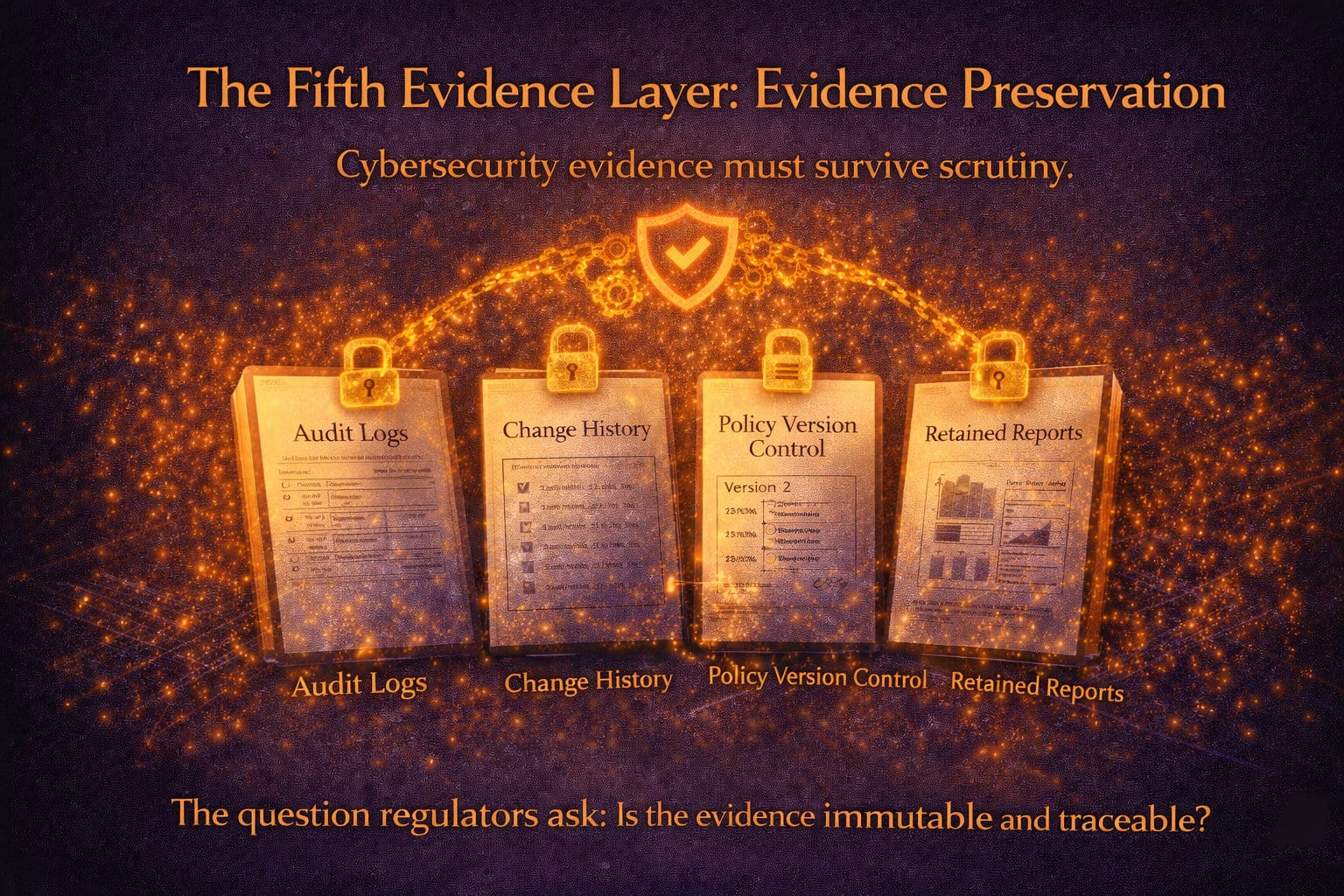
If risk recognition establishes what leadership knew, control decisions establish how leadership responded, board oversight establishes engagement, and operational execution establishes follow-through—this final layer answers the most decisive question:
Can the organization still prove it?
Evidence that cannot be produced is indistinguishable from evidence that never existed.
This is the fifth layer of the Governance Evidence Stack.
It determines whether every prior layer survives scrutiny.
From Activity to Retention
Organizations generate vast amounts of cybersecurity data and documentation.
Logs are created.
Reports are produced.
Policies are updated.
Decisions are recorded.
But generation is not preservation.
Preservation requires that evidence is:
- retained in a structured and accessible manner
- protected from alteration or loss
- time-bound and version-controlled
- retrievable under scrutiny
Without these characteristics, evidence degrades over time.
And when it is needed most, it may not be available—or may not be credible.
What Evidence Preservation Produces
When preservation is properly governed, it produces artifacts that demonstrate continuity, integrity, and traceability.
Common examples include:
- Audit logs that record system activity and control behavior
- Change histories that document modifications to systems, configurations, and policies
- Policy version control showing how governance decisions evolved over time
- Retained reports that provide historical context for risk and oversight
These artifacts do more than document the past.
They establish that the organization maintained a reliable record of its governance activities.
The Standard of Immutability
Under regulatory and legal scrutiny, evidence is evaluated not only for existence—but for integrity.
Regulators and investigators expect evidence to be:
- immutable — protected against unauthorized alteration
- traceable — clearly linked to specific events, decisions, and timeframes
- consistent — aligned across systems and records
- verifiable — capable of independent validation
If evidence can be modified without detection, its credibility is compromised.
If it cannot be traced to specific points in time, its relevance is diminished.
This is why preservation is not a storage function.
It is a governance requirement.
The Role of Traceability
Traceability allows evaluators to reconstruct events and decisions.
It connects:
- risk identification to decision-making
- decisions to execution
- execution to outcomes
Without traceability, the evidentiary chain breaks.
Organizations may possess individual artifacts—but cannot demonstrate how they relate to one another.
With traceability, the full story can be followed.
Clearly. Consistently. Credibly.
The Risk of Ephemeral Evidence
Many organizations rely on systems and processes that generate evidence—but do not ensure its long-term preservation.
Logs are overwritten.
Reports are not archived.
Policy changes are not version-controlled.
Historical records are difficult to retrieve.
This creates a critical vulnerability.
In the immediate moment, governance appears intact.
Over time, the evidence erodes.
And when scrutiny arrives—often months or years after an event—the organization cannot produce a complete record.
This is not a failure of activity.
It is a failure of preservation.
Preservation as a Governance Control
Evidence preservation must be treated as a control in its own right.
It requires:
- defined retention policies aligned to regulatory and business requirements
- systems that enforce immutability and integrity
- processes that ensure consistent archiving of governance artifacts
- mechanisms for rapid retrieval and review
This elevates preservation from passive storage to active governance.
The Fifth Layer in Context
The Governance Evidence Stack reaches its conclusion here:
- Risk recognition establishes awareness
- Control decisions establish response
- Board oversight establishes engagement
- Operational execution establishes follow-through
- Evidence preservation establishes durability
Together, these layers answer:
- Did leadership know?
- Did leadership act?
- Did leadership oversee?
- Did the organization execute?
- Can it still be proven?
The final question carries unique weight.
Because governance is not evaluated in real time.
It is evaluated after the fact.
And after the fact, only preserved evidence remains.
The Durability of Governance
Evidence preservation ensures that governance survives beyond the moment it occurred.
It allows organizations to demonstrate:
- consistency over time
- integrity of records
- continuity of oversight
- accountability across decisions
Without it, governance becomes transient.
With it, governance becomes durable.
The Final Standard
This final layer reinforces a defining principle of modern cybersecurity governance:
It is not enough to act.
It is not enough to document.
It must be preserved.
Because in the end, the question is not whether evidence once existed.
It is whether it can be produced—intact, traceable, and credible—when it matters most.
And whether that evidence can withstand scrutiny.