Cybersecurity governance begins at a point many organizations assume has already been achieved:
Risk is known.
In practice, that assumption is often untested.
Organizations operate with awareness of threats, vulnerabilities, and exposures—but awareness alone is not governance. Governance begins when risk is formally recognized, defined, and documented in a way that can be reviewed, challenged, and acted upon.
If risk is not formally recognized, it cannot be governed.
And if it cannot be governed, it cannot be proven.
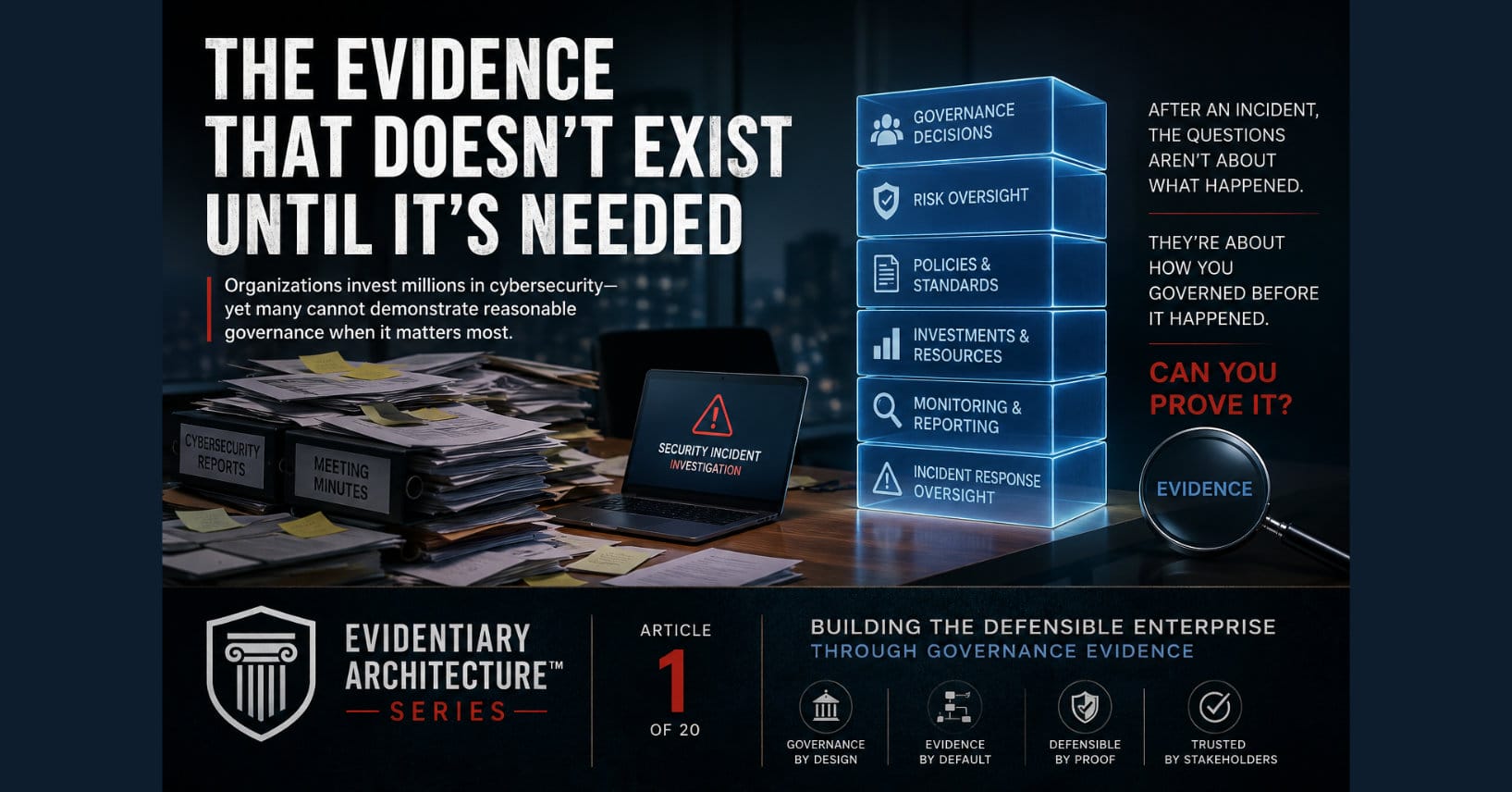
This is the first layer of the Governance Evidence Stack.
From Awareness to Recognition
There is a critical distinction between knowing and recognizing risk.
Awareness exists informally—within teams, discussions, and technical environments.
Recognition exists formally—within documented structures that elevate risk into governance.
Risk recognition requires that threats and exposures are:
- identified in clear, decision-relevant terms
- assessed for impact and likelihood
- prioritized relative to organizational objectives
- communicated to leadership in a structured format
Until this occurs, risk remains operational. It has not yet entered governance.
What Risk Recognition Produces
When risk is formally recognized, it produces artifacts.
These artifacts are the evidence that leadership had visibility into the organization’s risk landscape.
Common examples include:
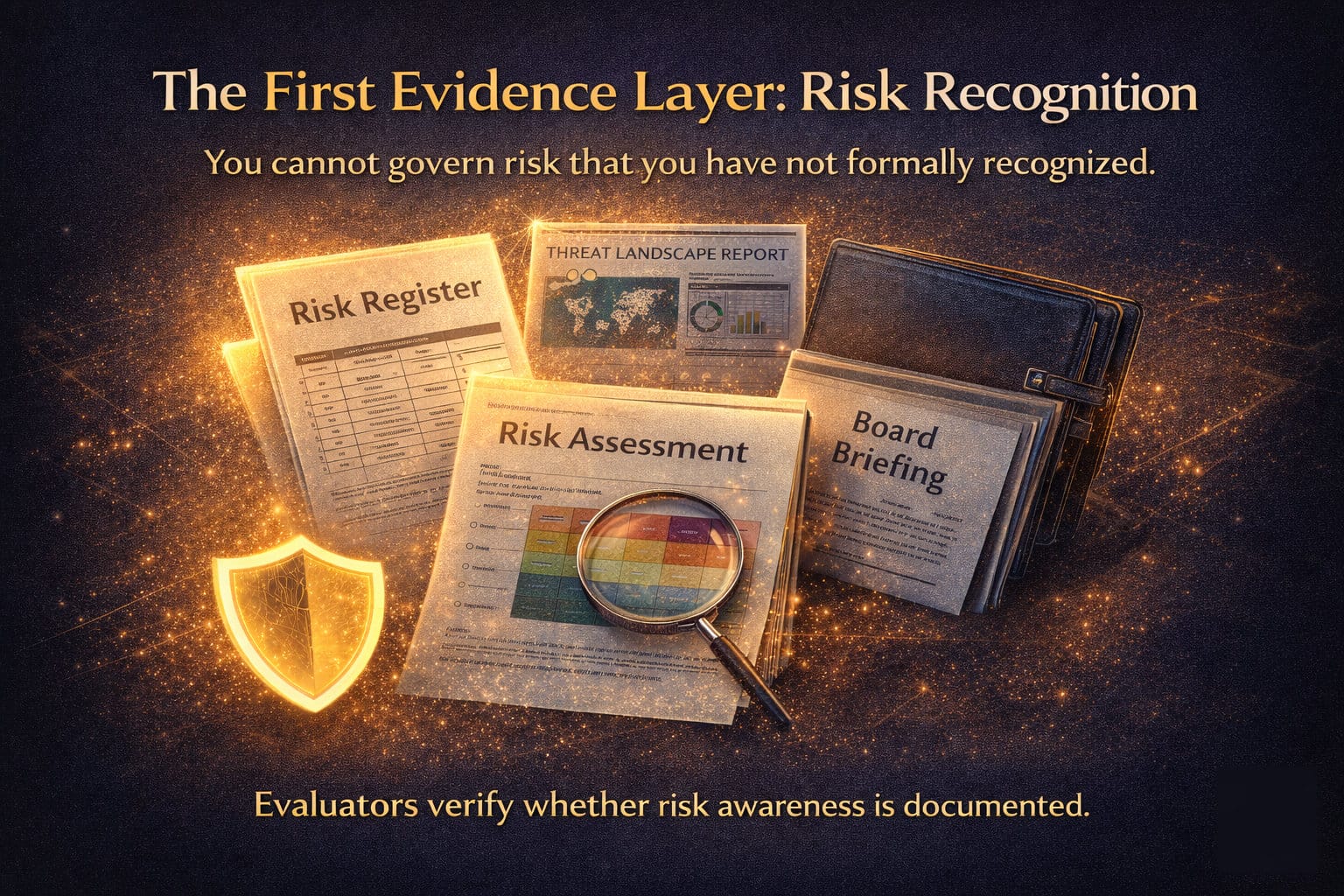
- Risk registers that catalog identified risks and their attributes
- Formal risk assessments that evaluate likelihood, impact, and exposure
- Board and committee briefings that communicate material risks
- Threat landscape reports that contextualize external risk factors
These are not merely informational tools. They are evidentiary records.
They establish that risk was not only present—but known.
What Evaluators Look For
Under scrutiny, evaluators do not assume that organizations understood their risks.
They verify it.
The question is not whether risks existed.
It is whether those risks were formally recognized by leadership.
This is assessed by examining:
- whether risk documentation exists and is maintained
- whether risks are defined consistently and clearly
- whether material risks are elevated to the appropriate governance level
- whether leadership engagement with risk is documented
If these elements are absent or inconsistent, organizations face a fundamental problem:
They cannot demonstrate that leadership was aware of the risks they were expected to oversee.
Without that demonstration, every subsequent governance action is weakened.
The Consequence of Unrecognized Risk
When risk is not formally recognized, organizations often attempt to compensate at later stages:
They implement controls.
They produce reports.
They respond to incidents.
But without documented risk recognition, these actions lack context.
They appear reactive rather than deliberate.
In a post-incident evaluation, this creates a critical vulnerability.
Organizations may assert:
“We were aware of this risk.”
But if that awareness is not documented, it cannot be substantiated.
And in evidentiary terms, unsubstantiated awareness carries little weight.
Recognition as the Entry Point to Oversight
Risk recognition is the moment where cybersecurity becomes a governance issue.
It is where operational knowledge is translated into leadership visibility.
Once risks are formally recognized:
- decisions can be made
- oversight can be exercised
- accountability can be established
Without recognition, none of these can occur in a defensible way.
This is why the first layer of the Governance Evidence Stack is not control implementation or reporting.
It is recognition.
Because governance does not begin with action.
It begins with acknowledgment.
Building Defensible Risk Recognition
To strengthen this layer, organizations must ensure that risk recognition is:
- structured rather than ad hoc
- documented rather than assumed
- consistent rather than fragmented
- integrated into governance processes rather than isolated within technical teams
This requires alignment between security, risk management, and leadership functions.
It also requires discipline.
Risks must be revisited, updated, and re-communicated as conditions change.
Recognition is not a one-time event. It is an ongoing governance process.
Establishing the Evidentiary Foundation
Every layer that follows—policy decisions, oversight discussion, execution, and preservation—depends on this first step.
If risk was not clearly recognized:
- decisions cannot be traced to risk
- oversight cannot be evaluated against risk
- execution cannot be aligned to risk
- evidence cannot demonstrate that risk was managed
The entire stack becomes unstable.
This is why evaluators begin here.
Not with controls.
Not with outcomes.
With recognition.
Because before governance can be judged, one question must be answered:
Did leadership know what they were responsible for governing?
And more importantly—
Can it be proven?