
Why Activity Metrics Fail Boards
Boards are often presented with cybersecurity dashboards that appear sophisticated.
Color-coded risk levels.
Blocked attack counts.
Patch compliance percentages.
Vulnerability totals.
The presentation is polished.
The charts are precise.
The data is abundant.
And yet, many of these dashboards fail directors.
Not because they are inaccurate.
Because they are misaligned with governance responsibility.
This edition examines why operational metrics often create the illusion of oversight — and what boards should demand instead.
The Activity Trap
Most cybersecurity dashboards are designed for operators.
Security teams need to track:
- Intrusion attempts
- Malware detections
- Endpoint coverage
- Patch deployment rates
- Vulnerability remediation timelines
These metrics are necessary for management.
They are insufficient for governance.
Boards are not responsible for operational throughput.
They are responsible for enterprise risk oversight.
When dashboards focus exclusively on activity, they obscure the questions directors must answer.
What Boards Actually Need to Know
Directors require clarity around consequence, not volume.
Instead of asking:
“How many attacks were blocked?”
Boards should understand:
- What scenarios could materially disrupt operations?
- What systems are mission-critical?
- What data exposures create regulatory liability?
- Where known risks remain unmitigated?
- How current posture compares to defined risk tolerance?
Operational dashboards rarely answer those questions.
The False Comfort of Green Indicators
A dashboard full of green status indicators can create psychological reassurance.
But green does not mean safe.
It may mean:
- Controls are functioning as designed
- Policies are being followed
- Monitoring tools are active
It does not necessarily mean:
- Material risk is low
- Residual exposure is acceptable
- Investment aligns with enterprise consequence
Boards must resist equating operational stability with enterprise security.
They are not the same.
Translating Technical Metrics Into Governance Insight
Effective board-level reporting should transform operational data into strategic clarity.
That translation includes:
- Trend DirectionIs risk posture improving, stable, or degrading over time?
- Enterprise Impact FramingWhat would be the business consequence of a major failure?
- Risk Tolerance AlignmentWhere does current exposure exceed board-approved thresholds?
- Investment ContextWhat risks remain unfunded or deferred?
- Escalation UpdatesHave any incidents triggered defined notification criteria?
These elements convert activity into oversight.
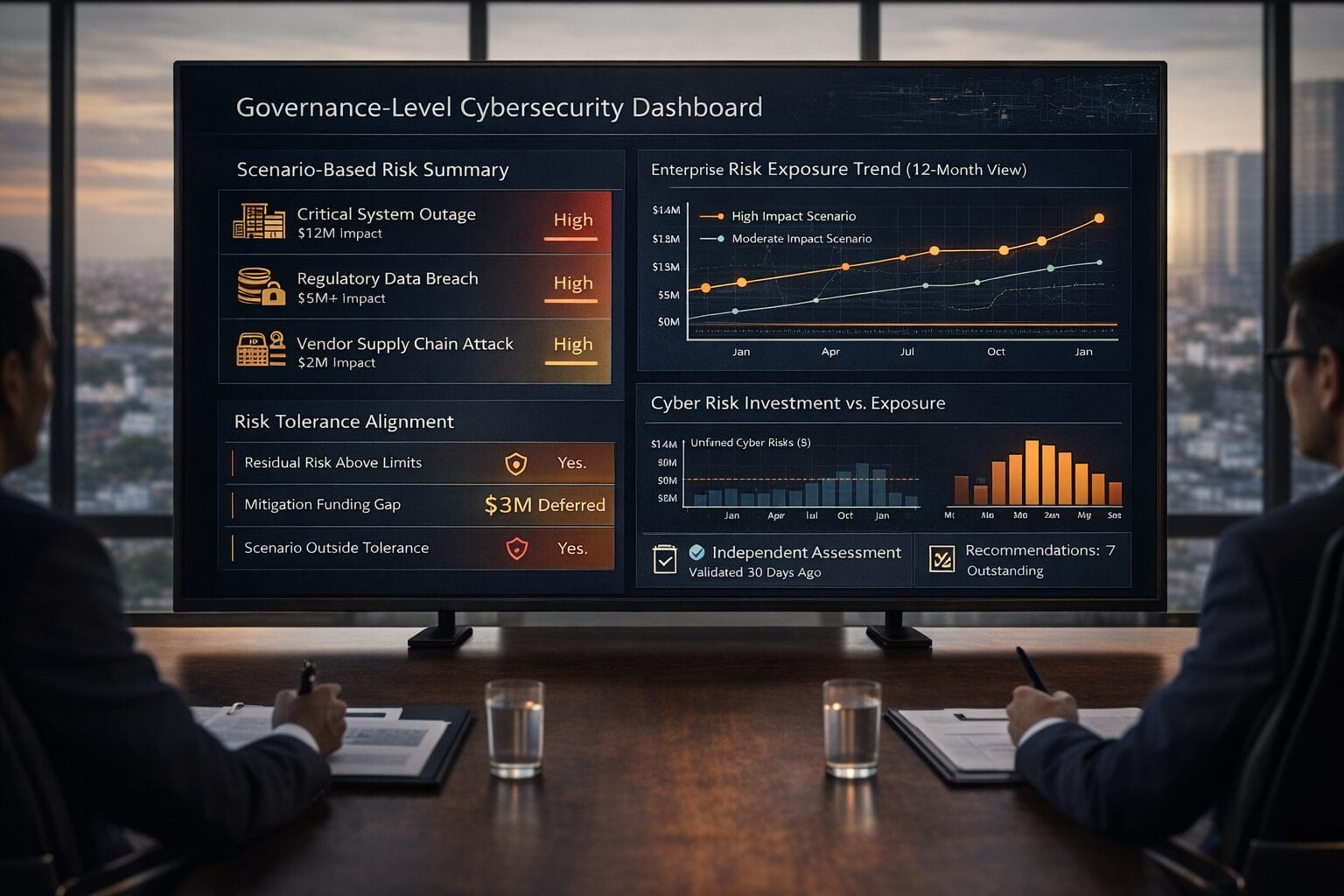
The Governance-Level Dashboard
Boards should not eliminate dashboards.
They should redesign them.
A governance-aligned dashboard is:
- Simplified
- Strategic
- Focused on consequence
- Anchored in risk tolerance
- Linked to enterprise objectives
It may include:
- Scenario-based risk summaries
- Residual risk assessments
- Control effectiveness validation
- Independent assessment findings
- Investment gap analysis
The goal is not more data.
It is clearer signal.
Why This Matters After an Incident
After a significant cyber event, oversight is evaluated through hindsight.
Investigators will ask:
- Did the board understand enterprise exposure?
- Were material risks identified?
- Was posture trending downward without action?
- Were resource decisions documented?
If board reporting consisted solely of blocked attack counts and patch metrics, governance may appear superficial.
If reporting reflected enterprise consequence and risk alignment, oversight appears deliberate.
Documentation begins with reporting structure.
Common Dashboard Red Flags
Boards should question reporting if:
- Metrics are entirely technical.
- No scenario-based analysis is provided.
- Financial impact framing is absent.
- Risk tolerance is undefined.
- Trend data is inconsistent.
- Independent validation is missing.
Dashboards that generate comfort without clarity weaken governance.
Practical Board Actions
At your next cyber update, consider asking:
• What enterprise-impact scenarios should concern us most?
• Where are we outside our defined risk tolerance?
• What material risks remain unfunded?
• How does our posture trend over the past 12 months?
The Core Principle
Cyber dashboards should not measure busyness.
They should illuminate exposure.
Boards do not govern activity.
They govern risk.
When dashboards shift from operational reporting to enterprise insight, oversight becomes strategic rather than symbolic.
In our next edition, we will examine incident preparedness as a governance discipline — and what boards must define before a crisis occurs.
If you serve on a board or advise executive leadership teams, subscribe to The Cyber Governance Brief for continued analysis on cybersecurity as fiduciary responsibility.