If risk recognition establishes what leadership knew, control decisions establish how leadership responded.
This is the second layer of the Governance Evidence Stack.
It is where awareness becomes intent.
Organizations often point to the existence of controls as evidence of governance. Firewalls, identity systems, monitoring platforms, and security tools are presented as proof that risk is being managed.
But controls, by themselves, are not evidence of governance.
They are evidence of implementation.
Governance is demonstrated through the decisions that led to those controls—why they were selected, how they align to risk, and who approved them.
Without that connection, controls appear disconnected from leadership oversight.
And under scrutiny, that distinction matters.
From Risk to Response
Once risks are formally recognized, leadership is expected to respond in a structured and deliberate way.
This response must be:
- informed by the nature and priority of the risk
- aligned to organizational objectives and risk appetite
- documented in a way that can be reviewed and traced
This is not simply a technical exercise.
It is a governance function.
Leadership must be able to demonstrate that they did not just deploy controls—but made decisions about how risk would be addressed.
What Control Decisions Produce
When governance operates effectively, control decisions generate clear artifacts.
These artifacts form the evidentiary record that leadership engaged with risk and made deliberate choices.
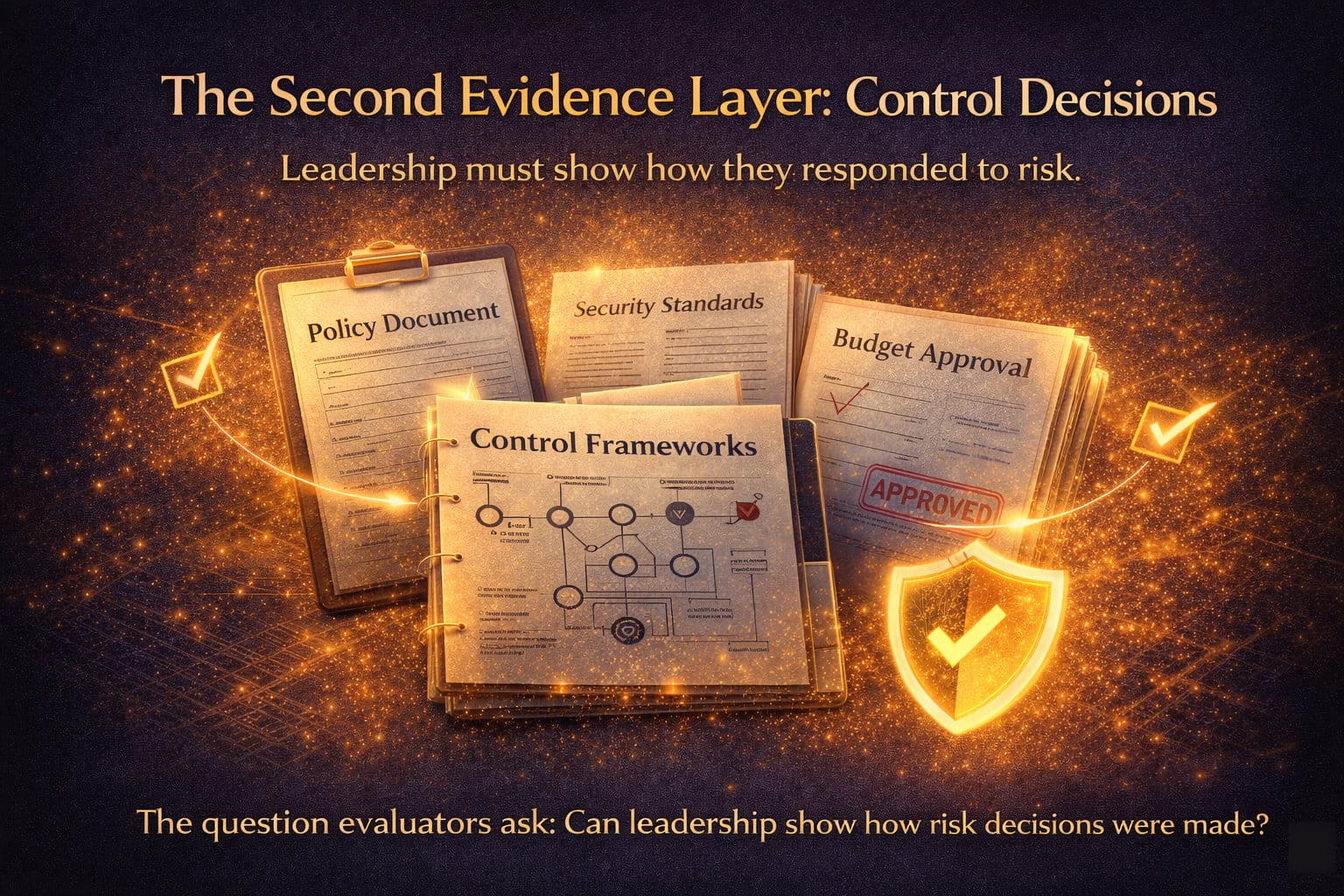
Common examples include:
- Policy adoption and formal approvals
- Security standards that define expected control behavior
- Control frameworks mapped to identified risks
- Budget approvals that allocate resources to risk mitigation
Each of these represents a decision point.
They show that leadership moved from awareness to action—not reactively, but intentionally.
The Critical Question
Under evaluation, the existence of controls is not the primary focus.
The question is more specific:
Can leadership show how risk decisions were made?
This requires more than documentation of what exists.
It requires documentation of:
- the rationale behind decisions
- the alternatives considered
- the alignment between risk and chosen controls
- the level of leadership involvement and approval
If this cannot be demonstrated, governance appears superficial.
Controls may be present—but the decision-making process behind them is unclear.
The Risk of Disconnected Controls
Many organizations implement controls through operational or technical processes without clearly linking them back to governance decisions.
This creates a gap.
Controls exist, but the evidentiary chain is incomplete.
In a post-incident evaluation, this leads to difficult questions:
- Were these controls selected based on identified risks?
- Were they approved at the appropriate governance level?
- Were trade-offs considered and documented?
If the answers are not supported by evidence, controls can appear arbitrary—even if they are technically sound.
This weakens the organization’s ability to demonstrate that leadership exercised informed oversight.
Decision-Making as Evidence
Control decisions are not just internal milestones.
They are evidence of leadership engagement.
They show that:
- risks were taken seriously
- responses were considered and selected deliberately
- resources were allocated in alignment with priorities
This is what transforms cybersecurity from a technical function into a governance discipline.
Without documented decisions, organizations are left to assert intent after the fact.
With documented decisions, they can demonstrate it.
Aligning Decisions to Risk
To strengthen this layer, organizations must ensure that control decisions are:
- explicitly linked to identified risks
- documented with sufficient context and rationale
- reviewed and approved at appropriate governance levels
- revisited as risks evolve
This creates traceability.
It allows evaluators to follow a clear line from risk recognition to response.
Without that line, governance appears fragmented.
With it, governance becomes defensible.
The Second Layer in Context
The Governance Evidence Stack builds sequentially.
Risk recognition establishes awareness.
Control decisions establish response.
Together, they answer two foundational questions:
- Did leadership know?
- Did leadership act?
But answering these questions is not enough.
It must be proven.
That proof resides in the artifacts created at this layer—policies, standards, frameworks, and approvals that demonstrate how decisions were made.
Because in the end, cybersecurity governance is not evaluated by the presence of controls.
It is evaluated by the quality and traceability of the decisions behind them.
And the ability to show—clearly and credibly—how those decisions were made.