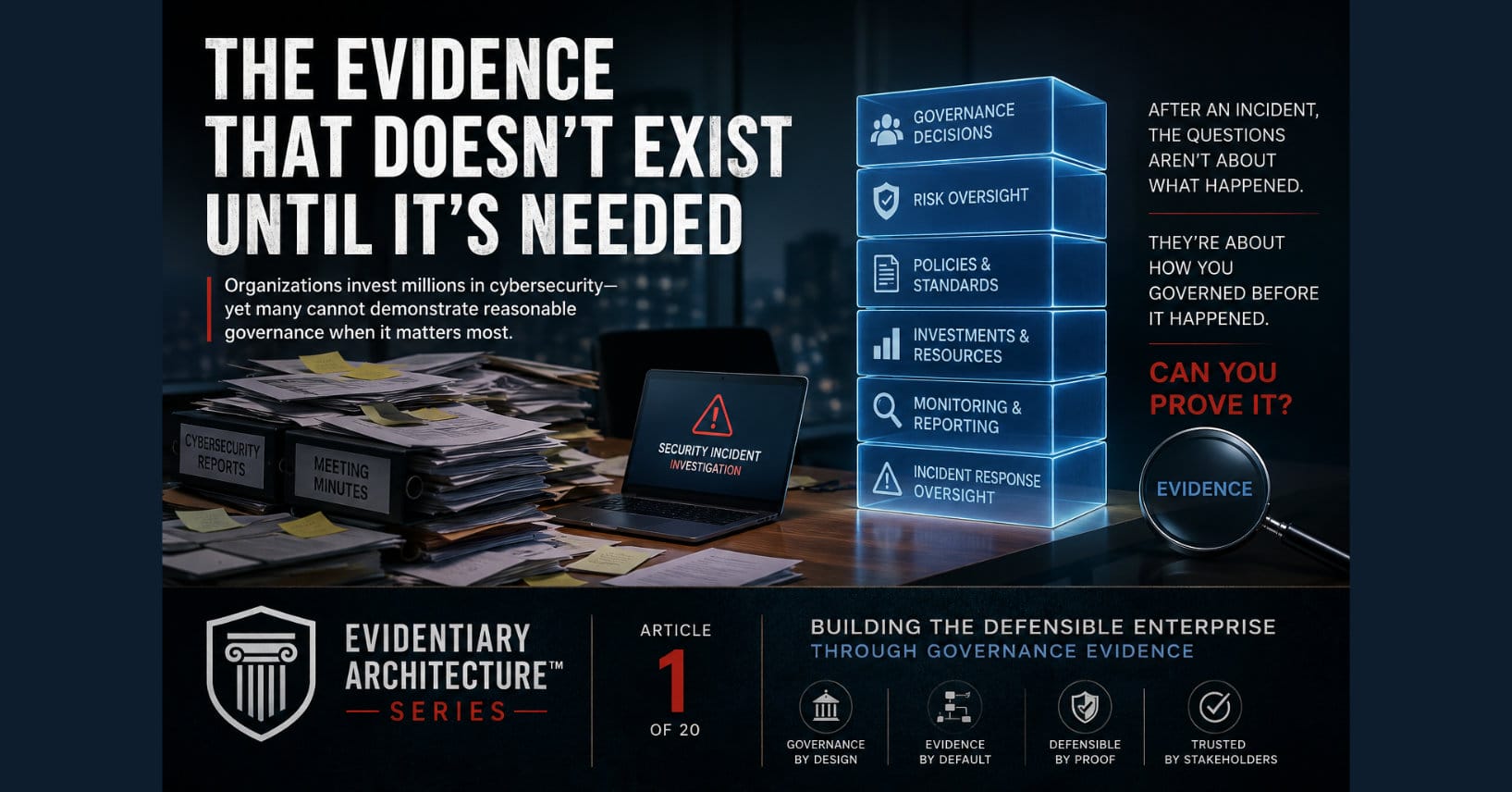
If risk recognition establishes what leadership knew, and control decisions establish how leadership responded, the third layer answers a more consequential question:
Did leadership actively oversee the risk?
This is where cybersecurity governance becomes visible at the highest level of the organization.
Not through structure.
Not through policy.
But through engagement.
Board oversight is not defined by the existence of meetings.
It is defined by what happens within them—and what is documented as a result.
This is the third layer of the Governance Evidence Stack.
Oversight as Observable Behavior
Governance is often described in terms of roles and responsibilities.
Boards oversee. Committees review. Executives report.
But under scrutiny, those descriptions carry little weight unless they are supported by evidence.
Oversight must be observable.
It must show that leadership:
- received information about cybersecurity risk
- engaged with that information
- asked questions
- challenged assumptions
- guided decisions
If these behaviors are not documented, they cannot be demonstrated.
And if they cannot be demonstrated, oversight is assumed—not proven.
What Board Oversight Produces
When oversight is exercised effectively, it produces artifacts.
These artifacts are not administrative records.
They are the evidence that governance occurred.
Key examples include:
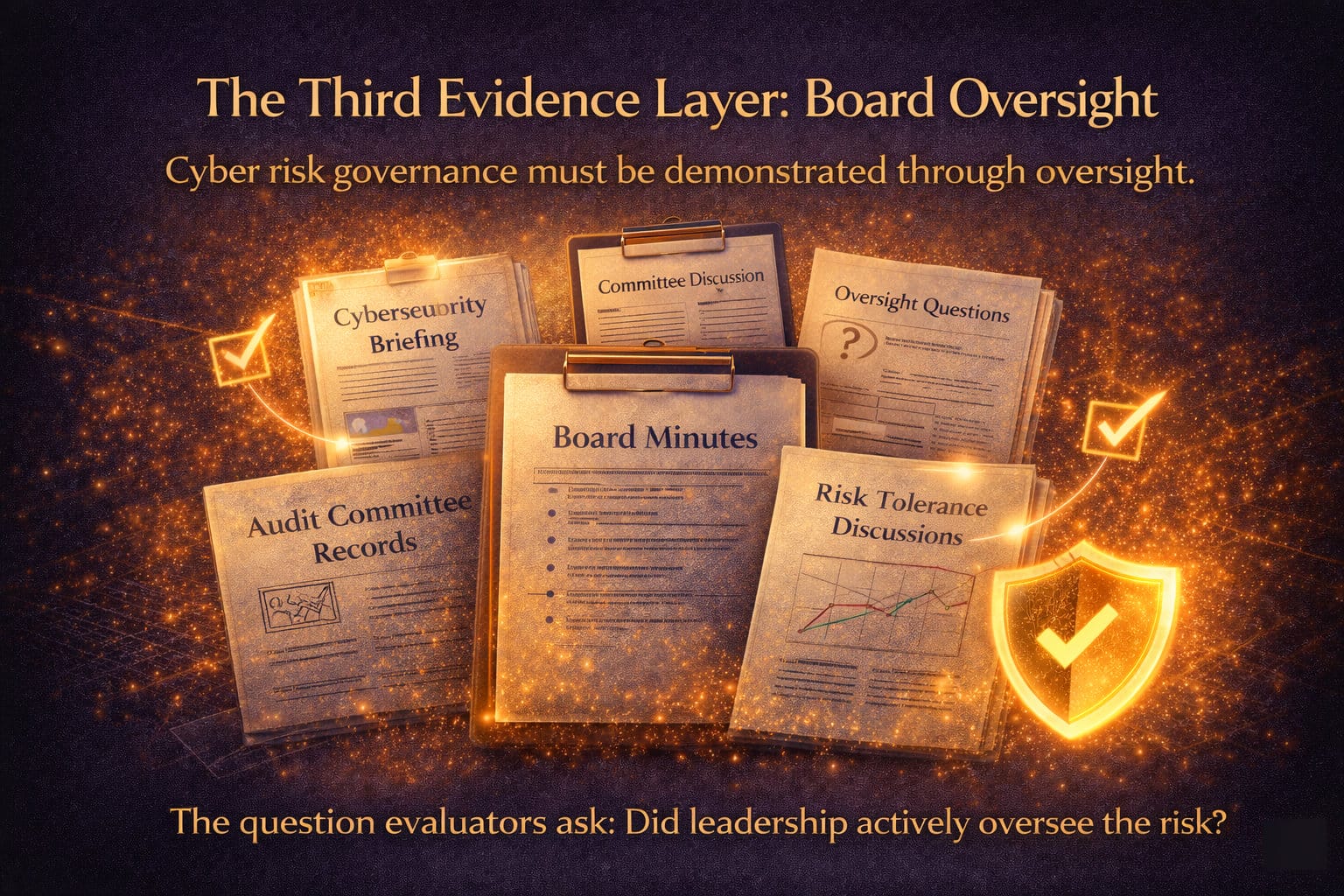
- Cybersecurity briefings presented to the board or committees
- Documented oversight questions raised by directors
- Discussions of risk tolerance and acceptable exposure levels
- Audit committee records reflecting review and challenge
These records establish that cybersecurity was not treated as a technical issue delegated away from leadership, but as a governance issue actively overseen.
The Importance of the Record
Among all governance artifacts, board and committee minutes carry particular weight.
They are the official record of what leadership knew, discussed, and decided.
Under evaluation, these records are examined closely.
Not for volume.
For substance.
Minutes that reflect passive receipt of information weaken the evidentiary position.
Minutes that reflect engagement—questions, challenges, direction—strengthen it.
The difference is not stylistic.
It is evidentiary.
The Nature of Effective Oversight
Effective oversight is not measured by how frequently cybersecurity appears on an agenda.
It is measured by the quality of the discussion.
Evaluators look for evidence that leadership engaged in meaningful governance:
- Were risks presented in decision-relevant terms?
- Did directors ask probing, informed questions?
- Were trade-offs and priorities discussed?
- Was risk tolerance explicitly considered?
- Were follow-up actions defined and tracked?
These elements transform oversight from formality into function.
Without them, governance appears procedural.
With them, it becomes defensible.
The Role of Committees
Oversight often occurs within specialized structures—particularly audit and risk committees.
These bodies serve as extensions of the board, providing deeper engagement with cybersecurity risk.
Their records are critical.
Audit committee minutes, for example, often reflect:
- detailed review of cybersecurity controls and assurance
- interaction with internal and external auditors
- validation of reporting accuracy
- escalation of concerns to the full board
These records demonstrate that oversight was not superficial, but layered and deliberate.
The Risk of Silent Oversight
Many organizations assume that because cybersecurity is discussed at the board level, oversight is established.
But if that discussion is not documented with clarity and depth, it effectively does not exist in evidentiary terms.
This creates a common and dangerous gap:
Oversight may have occurred.
But it cannot be proven.
In post-incident evaluations, this gap becomes visible.
Organizations are asked to produce records demonstrating leadership engagement.
If those records are limited to high-level summaries or lack detail, oversight appears minimal—regardless of actual activity.
Oversight as a Governance Signal
The third layer of the Governance Evidence Stack serves a critical function.
It signals that cybersecurity risk is not only recognized and responded to—but governed.
It shows that leadership:
- remained informed over time
- engaged with evolving risk conditions
- exercised judgment and direction
- held management accountable
This is what distinguishes governance from delegation.
The Third Layer in Context
The Governance Evidence Stack builds sequentially:
- Risk recognition establishes awareness
- Control decisions establish response
- Board oversight establishes engagement
Together, these layers answer:
- Did leadership know?
- Did leadership act?
- Did leadership oversee?
Each must be supported by evidence.
Because governance is not evaluated by structure alone.
It is evaluated by behavior—captured, documented, and preserved.
Reinforcing the Governance Standard
This layer reinforces a central truth:
Cybersecurity is not a technical issue presented to the board.
It is a governance issue owned by the board.
That ownership is not proven through statements.
It is proven through records.
Records of briefings.
Records of questions.
Records of discussion.
Records of oversight.
Because in the end, the question is not whether the board had responsibility.
It is whether the board exercised it.
And whether that exercise can be demonstrated—clearly, consistently, and credibly.