Cybersecurity readiness is often described in terms of maturity models, control frameworks, and compliance checklists.
Those have value.
But they are not how readiness is ultimately judged.
Under real scrutiny—regulatory review, litigation, insurance assessment, or post-incident investigation—evaluation follows a different logic.
It is not centered on what exists.
It is centered on what can be proven.
This article introduces a practical evaluation approach based on that reality.
The Shift from Compliance to Evidence
Traditional readiness assessments ask:
- Are controls in place?
- Are policies documented?
- Are frameworks aligned?
These questions measure presence.
But presence does not equal proof.
In an evidentiary context, evaluators focus on something more direct:
Can the organization demonstrate that governance was real, active, and defensible?
This shifts the evaluation from compliance to evidence.
The Three Questions That Matter
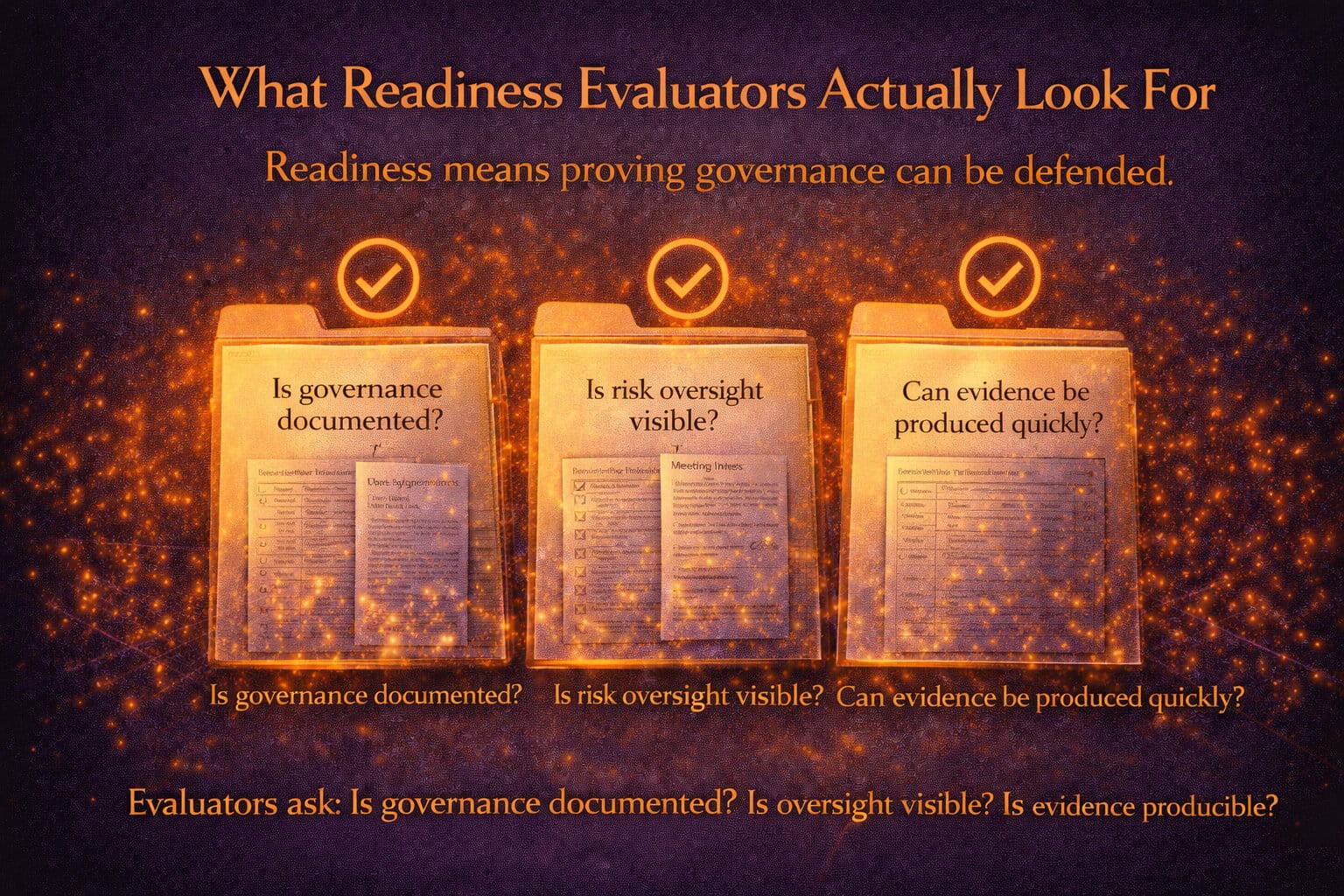
Across regulatory, legal, and insurance contexts, evaluation consistently converges on three core questions:
1. Is governance documented?
Governance that is not documented cannot be demonstrated.
Evaluators look for:
- risk registers and assessments
- policy approvals and control decisions
- board and committee minutes
- defined oversight structures
This establishes whether governance exists as a formal, reviewable record.
Without documentation, organizations are left to assert governance after the fact.
And assertions carry limited weight.
2. Is risk oversight visible?
Documentation alone is not sufficient.
Oversight must be observable.
Evaluators examine whether leadership engagement can be seen in the record:
- were cybersecurity risks presented clearly?
- did leadership ask questions and challenge assumptions?
- were risk tolerance and trade-offs discussed?
- were follow-up actions defined and tracked?
This determines whether governance was active—or merely procedural.
Visibility transforms governance from structure into behavior.
3. Can evidence be produced quickly?
Even well-documented governance loses value if it cannot be retrieved when needed.
In real-world evaluations, timing matters.
Organizations must be able to:
- locate relevant records quickly
- produce evidence in a structured and coherent form
- demonstrate traceability across decisions, actions, and outcomes
Delays, gaps, or inconsistencies in production introduce doubt.
Rapid, coherent production reinforces credibility.
This is where preservation and organization of evidence become critical.
What These Questions Reveal
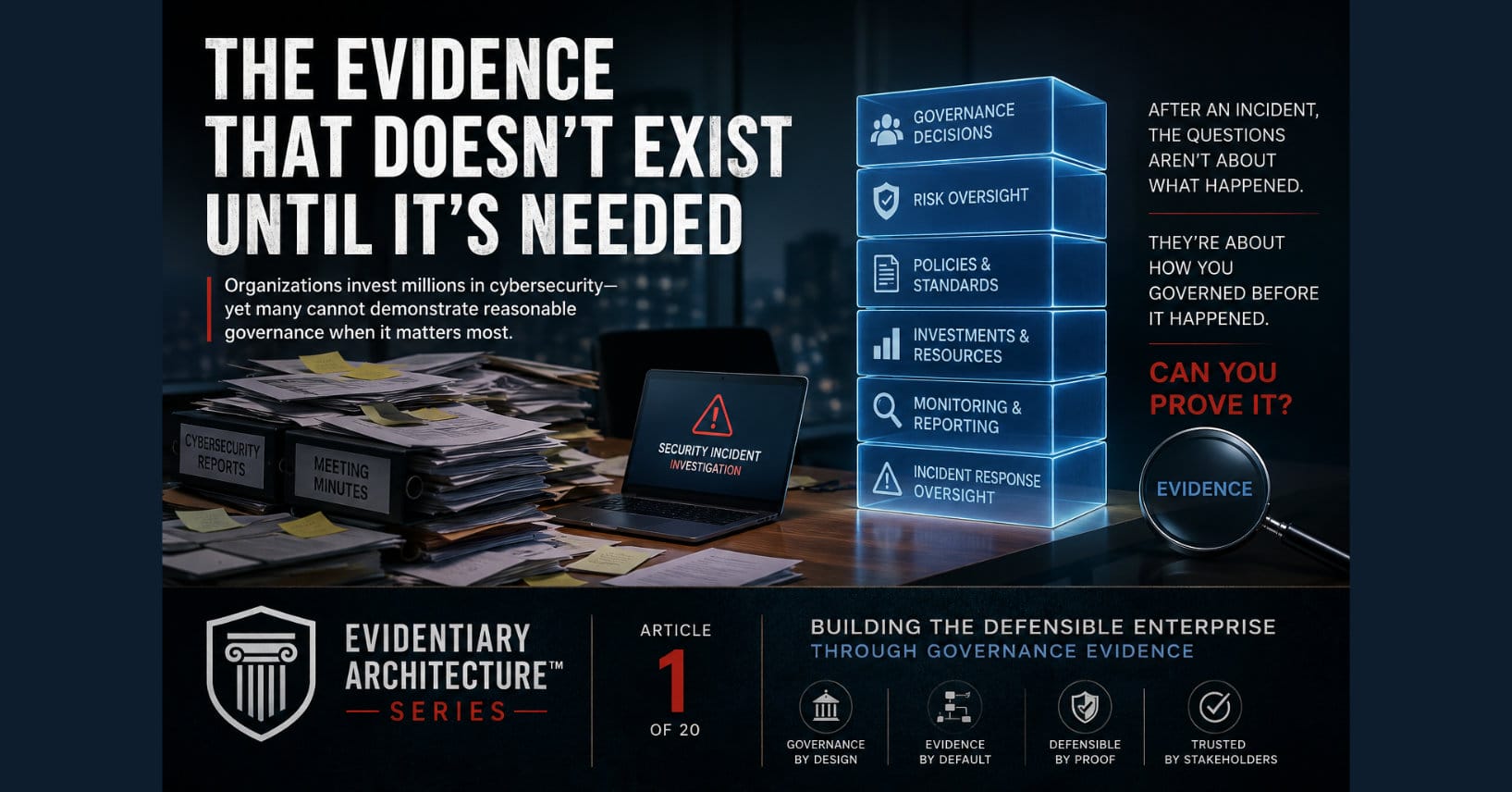
Together, these three questions evaluate the full integrity of the Governance Evidence Stack:
- documentation tests whether governance was established
- visibility tests whether governance was exercised
- producibility tests whether governance can be defended
Weakness in any one area affects the whole.
An organization may have strong controls, but if governance is poorly documented, it cannot be demonstrated.
It may have detailed records, but if oversight is not visible, it appears passive.
It may have strong governance and oversight, but if evidence cannot be produced quickly, credibility is weakened.
The Purpose of a Readiness Evaluation
A readiness evaluation is not an audit of controls.
It is an assessment of defensibility.
Its purpose is to determine whether an organization can:
- demonstrate that leadership understood risk
- show that decisions were made deliberately
- prove that oversight was active and informed
- produce evidence that supports those claims under scrutiny
In other words, it answers a single question:
If challenged today, could the organization defend its governance?
From Preparation to Positioning
Many organizations approach readiness as preparation.
Preparing for compliance.
Preparing for audit.
Preparing for certification.
But in an evidentiary model, readiness is positioning.
It positions the organization to respond with clarity, consistency, and credibility when scrutiny occurs.
It ensures that governance is not only performed—but provable.
Evaluating the Evaluators
Understanding how readiness is evaluated allows organizations to design governance more effectively.
It shifts focus:
From activity → to documentation
From reporting → to visibility
From storage → to rapid retrieval
This alignment transforms governance from an internal process into an external, defensible position.
The Practical Implication
Organizations do not fail readiness evaluations because they lack activity.
They fail because they lack evidence.
Or because their evidence is fragmented, inconsistent, or difficult to produce.
The three questions outlined here provide a clear lens:
- Is governance documented?
- Is risk oversight visible?
- Can evidence be produced quickly?
If the answer to any of these is uncertain, the organization’s evidentiary position is weakened.
If the answer to all three is clear, governance becomes defensible.
The Standard Going Forward
As cybersecurity governance continues to evolve, readiness evaluations will increasingly reflect this evidentiary model.
Not because it is theoretical.
Because it aligns with how organizations are actually judged.
And in that environment, readiness is no longer defined by what is in place.
It is defined by what can be proven—clearly, quickly, and credibly.