
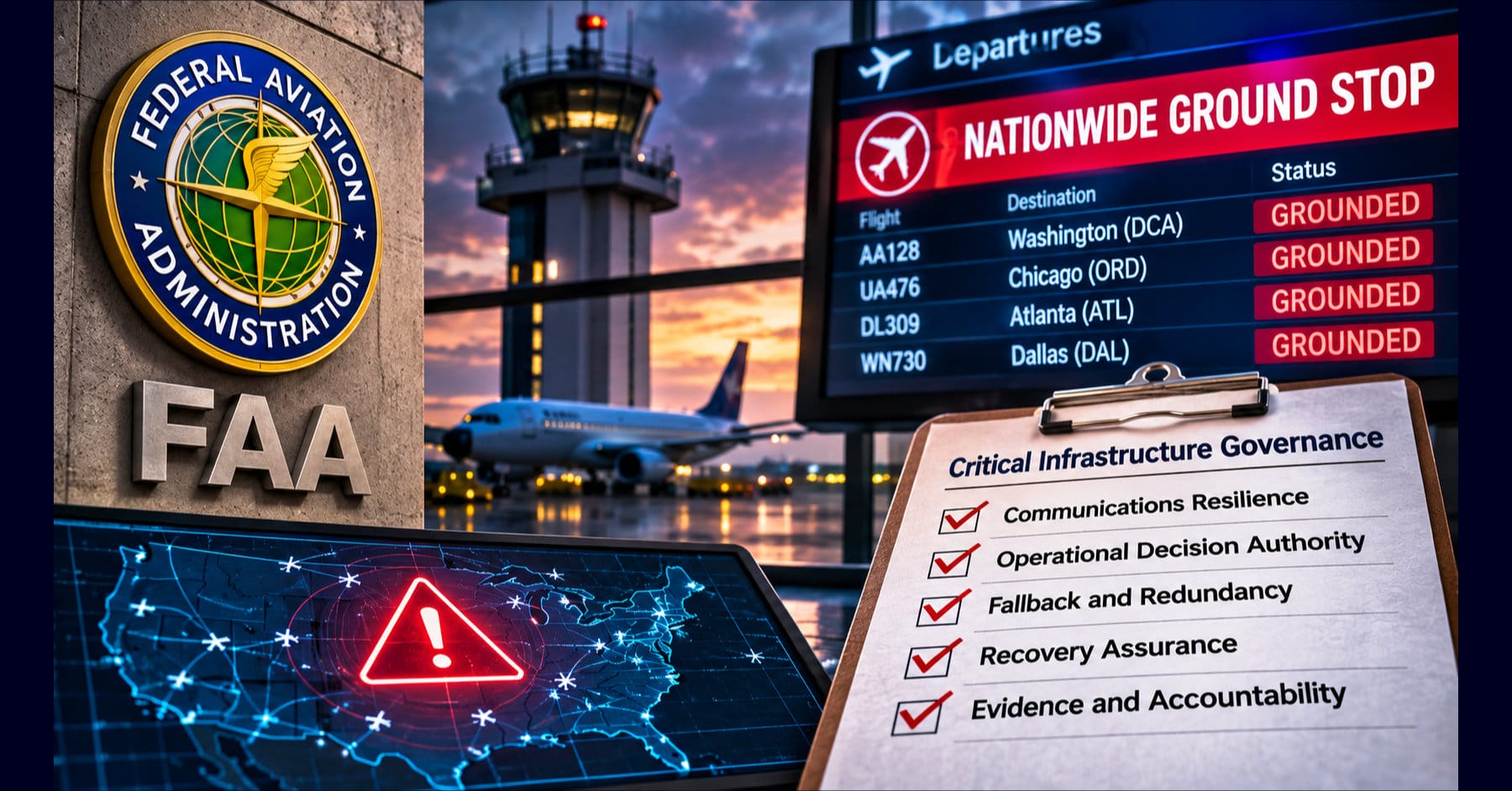
The November 13 nationwide ground stop began with a telecommunications failure during an infrastructure modernization effort. The deeper governance question is why a localized network disruption could propagate across much of the nation’s air traffic control system—and whether the risks of that transition had been adequately tested, authorized, and controlled.
Summary
The November 13, 2026, FAA ground stop followed a telecommunications disruption associated with equipment installed during a modernization effort. Reporting identified network problems involving facilities in Arkansas and Texas that affected communications at 17 of 22 high-altitude air traffic control centers. The incident raises governance questions about parallel migration, common-mode failures, vendor change authority, tested rollback procedures, and whether documented modernization risks were translated into effective safeguards. Through Evidentiary Architecture™, the article examines the evidence governing bodies should require before authorizing changes to mission-critical infrastructure.
A new highway is rarely constructed by tearing up the only road connecting two cities before the replacement is ready.
Engineers build the new route, test its connections, establish traffic controls, and plan how vehicles will move from the old infrastructure to the new.
The existing road remains available until the replacement can safely carry traffic.
The principle is straightforward: modernization should not unnecessarily compromise the continuity of the service being modernized.
Yet the November 13, 2026, nationwide aviation ground stop raises a troubling question about whether an equivalent principle was sufficiently applied to one of America’s most critical communications networks.
According to reporting by The Wall Street Journal, a newly installed router at an FAA telecommunications facility in El Dorado, Arkansas, began generating unusually heavy network traffic during a modernization effort. Equipment at a second facility in Amarillo, Texas, was also implicated.
The disruption reportedly affected communications at 17 of the FAA’s 22 high-altitude air traffic control centers.
The FAA responded by grounding departing aircraft nationwide while the communications problems were addressed.
The ground stop was subsequently lifted after the affected equipment was isolated and network conditions stabilized.
Investigators have not yet established whether the underlying technical cause involved defective equipment, configuration errors, installation practices, or interactions among network components.
That distinction matters.
But the broader governance question does not depend on identifying the final technical defect.
Why was a localized infrastructure change capable of producing a disruption with nationwide operational consequences?
And perhaps more importantly:
What evidence demonstrated that the modernization activity could be performed without exposing the national aviation system to an unacceptable common-mode failure?
Those questions reach beyond aviation.
They concern every organization modernizing essential infrastructure while continuing to depend on that infrastructure for uninterrupted operations.
The Ground Stop May Have Been the Right Decision
The first distinction is between the decision to stop operations and the conditions that made stopping necessary.
When air traffic controllers cannot rely on essential communications, continuing normal operations may introduce unacceptable safety risks.
The FAA’s authority to suspend departures exists precisely because aviation safety cannot depend on maintaining operational continuity at any cost.
A nationwide ground stop is disruptive.
It affects airlines, passengers, airports, logistics providers, and businesses throughout the economy.
But disruption alone does not establish that the decision was inappropriate.
Indeed, the ability to intervene decisively when critical operating conditions become unreliable is an essential characteristic of effective safety governance.
The FAA’s decision to ground departures may therefore demonstrate that its immediate intervention authority functioned as intended.
That should not be confused with the separate question of whether the infrastructure and modernization processes were sufficiently resilient.
Safety governance determines when operations must stop. Resilience governance determines whether preventable failures make stopping necessary.
An organization can make the correct emergency decision after an avoidable operational failure.
Both circumstances can be true.
The governance assessment must examine them separately.
One Router Should Not Become a National Failure Domain
The emerging technical account identifies an overloaded network environment associated with newly installed telecommunications equipment.
That introduces the concept of a failure domain.
A failure domain is the portion of an architecture that can be affected by a particular fault.
A well-designed system attempts to contain failures within boundaries appropriate to the criticality of the service.
A failed component should not automatically disable an entire application.
A failed application should not necessarily disable an enterprise platform.
And a localized telecommunications malfunction should not ordinarily propagate across a national infrastructure network without encountering protective controls.
That is the purpose of architectural isolation.
In telecommunications, isolation can involve independent network paths, segmentation, traffic filtering, routing controls, rate limiting, redundant communications facilities, and mechanisms that prevent abnormal activity from overwhelming shared dependencies.
The appropriate combination depends on the system’s technical requirements and safety constraints.
But the governing principle remains consistent.
The consequences of a component failure should be proportionate to the component’s intended operational responsibility.
The FAA incident raises questions about whether the network’s failure boundaries were sufficiently independent.
The presence of redundant equipment would not necessarily answer those questions.
Two routers can share the same upstream dependency.
Two network paths can converge on a common switching environment.
Separate facilities can depend on shared routing or management systems.
A backup can exist physically while remaining vulnerable to the same logical failure as the primary system.
This is the difference between redundancy and resilience.
Redundancy means another component or path exists.
Resilience means the architecture can continue delivering essential functions, or degrade safely, when something fails.
An organization may have substantial redundancy and still experience a common-mode failure if supposedly independent components share a vulnerability.
The November 13 disruption makes that distinction a matter of national infrastructure governance.
Why Wasn’t the Replacement Built Alongside the Existing System?
The question is deceptively simple.
When constructing a replacement highway, engineers frequently maintain the existing roadway while building and validating the new route.
Why not apply a comparable approach when replacing essential telecommunications infrastructure?

In enterprise architecture, parallel migration strategies are well established.
A new environment can be constructed alongside an existing environment.
Traffic can be introduced incrementally.
Performance can be monitored.
Failures can be isolated.
And the organization can preserve a tested path back to the original configuration.
This is sometimes described as a blue-green deployment or parallel-run migration.
Telecommunications networks have their own implementation requirements, but the underlying principles are similar.
A controlled modernization process should address several questions before production traffic is transferred.
- Can the new infrastructure operate independently of the old?
- Can its behavior be tested under realistic load?
- Can abnormal traffic be prevented from affecting production services?
- Can the transition be performed incrementally?
- Can the organization reverse the change?
- And has that reversal actually been tested?
The answers are not always straightforward.
Aviation communications systems operate under demanding reliability, interoperability, and safety requirements.
Legacy components may be tightly coupled to newer systems.
Physical facilities may constrain parallel installations.
Routing protocols and network dependencies may complicate isolation.
And maintaining two operational environments can introduce risks of its own.
A parallel installation is therefore not automatically the safest or most practical solution.
Nor does the existence of a parallel path guarantee protection from a shared network failure.
But those complexities strengthen the case for disciplined architectural risk assessment.
They do not eliminate the need for it.
If parallel operation was impractical, the modernization program should have documented why.
If the transition required shared dependencies, those dependencies should have been identified.
If rollback was limited, the limitations should have been understood and accepted by the appropriate authority.
And if a localized equipment malfunction could affect multiple air traffic control centers, that possibility should have been considered in the change’s risk assessment.
The essential governance question is not whether engineers selected one particular migration technique.
It is whether leadership possessed defensible evidence that the selected technique adequately controlled the risks.
The Warning Signs Preceded the Failure
The story becomes more consequential when examined against the modernization program’s documented risk environment.
The Washington Post reported that the FAA had received warnings concerning the potential operational consequences of its infrastructure modernization efforts.
A 2023 safety review reportedly identified communications risks associated with the transition.
A September 2026 Government Accountability Office report also raised concerns about modernization planning, scheduling, costs, and the potential consequences of pursuing an accelerated implementation.
The program encompasses thousands of infrastructure projects.
These findings do not establish that officials predicted the specific router malfunction in Arkansas.
Nor do they prove that a particular warning was ignored or that a documented control was deliberately bypassed.
Those conclusions would require evidence that has not yet been publicly established.
But the existence of earlier warnings changes the governance inquiry.
The question is no longer limited to whether an unexpected equipment malfunction occurred.
It now includes whether known categories of modernization risk were translated into effective operational controls.
There is an important difference between identifying a risk and governing it.
A risk assessment may document the possibility of service interruption.
A program review may identify deficiencies in coordination.
A safety analysis may recommend additional safeguards.
But none of those activities demonstrates that the underlying exposure has been reduced.
A documented risk is not a controlled risk.
Governance requires a decision.
Someone must determine whether the exposure is acceptable, what safeguards are required, who is responsible for implementing them, and what evidence will demonstrate their effectiveness.
If the risk remains unresolved, an accountable authority must decide whether the activity should proceed.
That decision should be recorded.
Its assumptions should be explicit.
And its consequences should be understood.
The FAA incident presents an opportunity to examine whether those mechanisms were functioning across the modernization program.
Vendor Maintenance Is Still Enterprise Risk
The reported involvement of L3Harris in the telecommunications modernization introduces another dimension.
Third-party contractors routinely design, install, maintain, and operate critical infrastructure.
Their specialized capabilities are essential.
But contracting for technical work does not transfer ultimate accountability for the public service that depends on the work.
The organization responsible for the service must retain effective oversight of the risks created by its vendors.
That oversight must extend beyond contract execution and performance milestones.
It must address the actual operational authority exercised during maintenance and modernization.
- Who approved the change?
- Who assessed its impact on interconnected systems?
- Who determined the maintenance window?
- Who verified the installation plan?
- Who established the rollback criteria?
- Who had authority to suspend the work?
- And who determined that the affected systems were safe to return to normal operation?
These are not merely administrative questions.
They establish the chain of decision authority governing work on critical infrastructure.
The answers become especially important when multiple organizations participate in the same change.
The contractor may control installation activities.
FAA engineers may oversee network integration.
Air traffic operations personnel may depend on the affected services.
Program management may establish implementation deadlines.
Safety officials may evaluate operational consequences.
If those responsibilities are not clearly integrated, a technically authorized change can proceed without a sufficiently complete understanding of its enterprise-wide implications.
That is a governance integration problem.
The reported concerns raised by FAA technical personnel about their involvement in the modernization process also deserve examination.
Their assertions do not, by themselves, establish that required reviews were omitted.
But they reinforce the need to determine whether the individuals responsible for operating and maintaining the affected infrastructure participated meaningfully in evaluating the proposed changes.
A contractor can be authorized to perform the work without being authorized to accept the enterprise-wide consequences of that work.
That distinction should be explicit in every critical infrastructure modernization program.
Change Management Is a Safety Control
In many enterprises, change management is treated as an IT service management discipline.
- Requests are submitted.
- Approvals are obtained.
- Maintenance windows are scheduled.
- Implementation records are completed.
- The process can become procedural.
But when a change affects critical infrastructure, change management is also a safety and resilience control.
Its purpose is not simply to document that a change occurred.
It is to establish that the organization understood and controlled the consequences before implementation.
That requires more than confirming that equipment passed acceptance testing.
A router can function correctly in isolation while behaving unexpectedly within a larger network.
A configuration can satisfy local requirements while interacting adversely with shared infrastructure.
A migration can succeed under normal operating conditions while failing under peak load or abnormal connection patterns.
Therefore, assurance must extend beyond component testing.
It must address system behavior.
For a high-impact telecommunications change, that may include realistic load testing, dependency analysis, failure injection, traffic isolation verification, rollback exercises, and independent review of the proposed implementation.
Not every technique will be appropriate for every aviation system.
But the underlying requirement is consistent.
The organization must demonstrate that the change can be performed within an acceptable operational risk boundary.
The FAA disruption raises an important question about whether those boundaries were adequately established and verified.
Modernization Spending Is Not Evidence of Resilience
The FAA’s air traffic control infrastructure has been the subject of modernization concerns for years.
Aging equipment, legacy communications systems, and the complexity of replacing technology while maintaining continuous operations have created significant challenges.
Federal officials have called for substantial additional modernization investment.
That investment may be necessary.
But the November 13 incident illustrates why modernization cannot be evaluated solely through spending, equipment replacement, or project completion.
A program can replace outdated hardware while introducing new shared dependencies.
It can increase network capacity without improving failure isolation.
It can accelerate implementation while reducing the time available for integration testing.
And it can meet contractual milestones without demonstrating that the operational environment is more resilient.
These are not inevitable consequences of modernization.
They are risks that modernization governance must explicitly address.
The governing body should therefore ask what measurable operational improvement each investment produces.
- Does the new architecture reduce the number of services affected by a component failure?
- Does it provide genuinely independent communications paths?
- Can maintenance be performed without disrupting critical operations?
- Can failures be detected and isolated before they propagate?
- Can essential functions continue during partial outages?
- And can those capabilities be demonstrated through testing?
A modernization dashboard that reports completed installations and dollars spent may tell leadership whether the program is progressing.
It does not necessarily tell leadership whether the system is becoming safer.
Modernization is an activity. Resilience is an outcome.
Governance must establish the evidence connecting the two.
The Recovery Raises Another Question
According to the emerging reporting, isolating affected telecommunications equipment helped stabilize the FAA network.
That was an important operational response.
But it introduces another architectural question.
If disconnecting the affected equipment stopped the disruption, what prevented that isolation from occurring before the problem propagated?
The answer may involve technical limitations, the speed of the failure, monitoring capabilities, operational procedures, or other factors that remain under investigation.
It would be premature to conclude that an automatic safeguard was missing or improperly configured.
Nevertheless, the distinction deserves attention.
A resilient architecture should not depend exclusively on human operators recognizing a widespread failure and manually determining which component to disconnect.
Where technically feasible and consistent with safety requirements, protective mechanisms should detect abnormal behavior and contain its effects.
Human intervention remains essential.
But the architecture should support that intervention rather than requiring operators to overcome avoidable system-wide instability.
The same principle applies to recovery.
Restoring communications is an operational milestone.
Verifying that the infrastructure can safely sustain normal activity is an assurance requirement.
Those are related but distinct accomplishments.
The decision to resume operations should be supported by evidence that the necessary systems are functioning, that applicable safety criteria have been satisfied, and that any remaining exposure is understood.
An incident is not fully resolved from a governance perspective simply because service has returned.
It is resolved when the organization understands the failure sufficiently to determine what must change and can verify that the resulting controls are effective.
Evidentiary Architecture™: Reconstructing the Decisions Before the Failure
The FAA incident illustrates why critical infrastructure governance requires more than incident logs and post-event explanations.
The most consequential evidence may concern decisions made before the failure.
Through the lens of Evidentiary Architecture™, the investigation should be able to reconstruct the modernization decision chain.
- The risk record: What failure scenarios were identified, including those involving shared telecommunications dependencies and abnormal network traffic?
- The architectural record: What analysis demonstrated that the replacement equipment and existing infrastructure could operate together without creating unacceptable common-mode exposure?
- The authorization record: Who approved the installation, what residual risks were accepted, and what conditions governed the decision to proceed?
- The assurance record: What integration tests, load tests, isolation tests, and rollback exercises were completed, and what were their results?
- The operational record: What monitoring identified the abnormal activity, how did the disruption propagate, and what intervention decisions were made?
- The recovery record: What evidence established that communications had stabilized and that operations could safely resume?
- The corrective-action record: What architectural changes, procedural improvements, and independent verification will demonstrate that the identified failure mechanisms have been addressed?
These records serve different purposes.
Technical logs explain system behavior.
Change records explain authorized activities.
Risk assessments explain anticipated exposure.
Approval records identify accountable decision-makers.
Testing evidence demonstrates whether safeguards were effective.
Together, they allow an organization to reconstruct not only what happened, but why the organization considered the activity acceptable before it happened.
That is the difference between documenting an incident and demonstrating governance.
The investigation should not begin with an assumption that every relevant decision was defective.
It should determine whether those decisions were informed, authorized, proportionate to the known risks, and supported by evidence.
A defensible governance system can explain why a decision was reasonable at the time it was made—even when the eventual outcome was unfavorable.
Conversely, a favorable outcome does not establish that the underlying decision process was sound.
Five Questions Every Critical Infrastructure Board Should Ask
The FAA disruption provides a useful framework for governing bodies overseeing modernization of essential systems.
1. Can a localized maintenance activity interrupt enterprise-wide operations?
Leadership should understand which infrastructure components create shared failure domains and how those dependencies are isolated.
2. Are replacement systems tested independently before production cutover?
The organization should be able to demonstrate that its migration strategy controls the risks of operating old and new infrastructure together.
3. Who can authorize, suspend, or reverse high-impact changes?
Decision rights should distinguish technical implementation authority from authority to accept operational and enterprise-wide risk.
4. What happens when a vendor’s work creates unexpected system behavior?
Contracts, operating procedures, monitoring, and intervention mechanisms should establish how failures are detected, contained, escalated, and investigated.
5. Can leadership produce evidence that known modernization risks were addressed?
Risk assessments, test results, approvals, exceptions, and corrective actions should form a traceable record connecting identified exposure to accountable decisions.
These questions apply to more than aviation.
Hospitals replacing clinical communications infrastructure face comparable continuity concerns.
Financial institutions modernizing payment networks must manage shared dependencies and transaction integrity.
Utilities upgrading operational technology must preserve safe operating conditions during transition.
Telecommunications providers must control the consequences of changes affecting interconnected networks.
And enterprises deploying AI agents into operational workflows must understand whether a seemingly localized configuration change can propagate through automated dependencies.
The technologies differ.
The governance principles do not.
The Real Failure May Have Preceded the Router
The November 13 ground stop will eventually have a more complete technical explanation.
Investigators may identify a hardware defect, a configuration problem, an installation issue, an unexpected network interaction, or some combination of factors.
Those findings will matter.
But they should not define the limits of the investigation.
The larger question concerns the architecture and governance processes that allowed the consequences to spread.
- Was the failure scenario foreseeable?
- Were the shared dependencies understood?
- Was the migration strategy appropriate?
- Were the safeguards tested?
- Were the right people involved?
- Who accepted the residual risk?
- And what evidence supported the decision to proceed?
The existence of prior modernization warnings makes those questions particularly important.
It does not establish that the specific incident was predicted or preventable.
But it reinforces the need to examine whether the modernization program was converting identified risks into effective controls.
The FAA’s nationwide ground stop may ultimately demonstrate that emergency intervention authority worked as intended.
The more difficult assessment concerns whether the modernization process provided sufficient assurance before the intervention became necessary.
The two conclusions must not be confused.
Boardroom Takeaway
The FAA’s November 13 communications disruption illustrates a fundamental challenge in critical infrastructure governance.
Modernizing essential systems requires organizations to introduce change into environments where failure can have consequences far beyond the equipment being replaced.
The objective is not merely to install newer technology.
It is to improve capability while preserving operational continuity, containing failure propagation, and maintaining defensible decision authority.
Parallel migration, independent failure domains, controlled cutovers, tested rollback procedures, and rigorous change governance are mechanisms for achieving that objective.
Their effectiveness must be demonstrated, not assumed.
The governing body does not need to approve router configurations.
It does need assurance that the modernization program understands its critical dependencies, controls the risks of implementation, and can produce evidence supporting its decisions.
The most important question is not why one router malfunctioned. It is why the architecture allowed a localized malfunction to become a national disruption.
And the question every board should take away is equally direct:
Before your organization replaces critical infrastructure, can leadership demonstrate that the new system can fail without taking the old system—and the enterprise—with it?