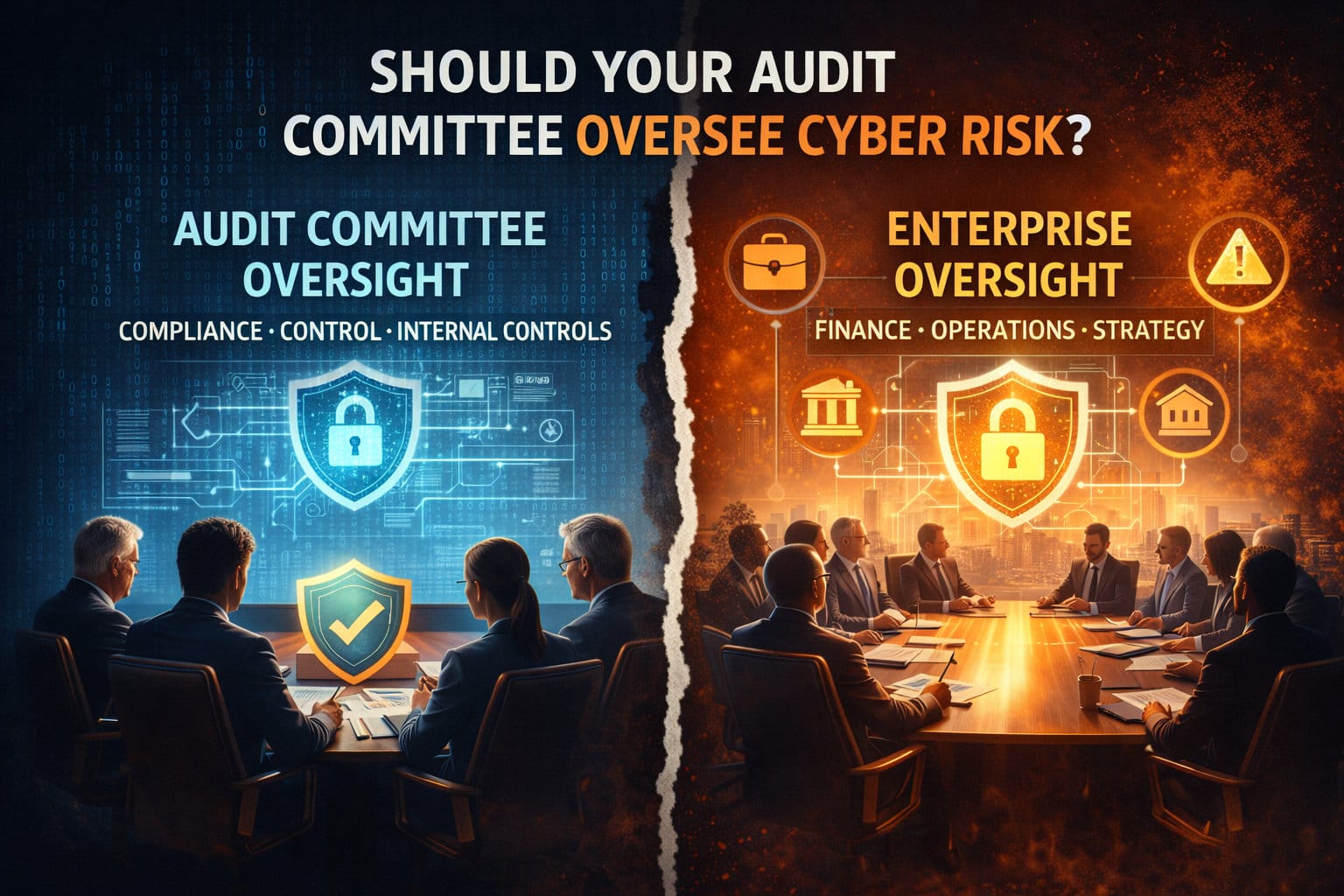
In many organizations, cyber risk oversight defaults to the audit committee.
It makes sense at first glance.
Audit committees already oversee:
- Internal controls
- Financial reporting
- Risk management processes
- External audit coordination
Cyber risk appears adjacent to these responsibilities.
So it gets assigned there.
But the question is not whether it fits.
The question is whether it belongs.
Why Audit Committees Often Inherit Cyber Oversight
Cyber risk is frequently grouped with:
- Internal control effectiveness
- Compliance obligations
- Risk reporting structures
This naturally places it within the audit committee’s scope.
In some organizations, this works.
In others, it creates blind spots.
The Limitation
Audit committees are designed to:
- Validate controls
- Review reporting accuracy
- Ensure compliance discipline
Cyber risk, however, often involves:
- Operational disruption
- Strategic dependency
- Enterprise resilience
- Real-time decision-making
These are not purely control questions.
They are enterprise risk questions.
The Structural Risk
When cyber oversight sits only within the audit committee:
- Discussions may become control-focused rather than consequence-focused
- Time allocation may be limited by financial reporting priorities
- Engagement may center on assurance rather than scenario-based risk
The result is often a narrow view of a broad exposure.
Where Cyber Risk Actually Lives
Cyber risk intersects with:
- Operations (service delivery)
- Finance (revenue impact)
- Legal (regulatory exposure)
- Strategy (digital dependency)
- Reputation (stakeholder trust)
It is not confined to one committee.
It is an enterprise issue.
Alternative Approaches
Boards are experimenting with different structures:
Audit Committee Oversight
- Works when supported by full board engagement
Dedicated Risk Committee
- Expands focus to enterprise-level exposure
Technology or Cyber Committee
- Provides deeper subject matter focus
Full Board Integration
- Embeds cyber into enterprise risk discussions
There is no single correct model.
But there are ineffective ones.
The Key Question
Regardless of structure:
Is cyber risk being governed at the level of its consequence?
If oversight is limited to control validation, the answer may be no.
What Effective Oversight Looks Like
- Enterprise-level discussion of cyber exposure
- Integration into risk appetite and tolerance
- Scenario-based evaluation
- Clear escalation pathways
- Documented board engagement
These elements matter more than committee placement.
The Core Principle
Committee structure does not determine governance quality.
Engagement does.
Audit committees can support cyber oversight.
They should not contain it.

#BoardGovernance #CyberRisk #AuditCommittee #EnterpriseRisk #FiduciaryDuty