Evidence-Driven Cybersecurity Governance Series—Article 4
Organizations often search for the one document that proves good governance—a board presentation, committee report, or policy manual. In reality, governance is demonstrated through a connected system of evidence rather than any single artifact.
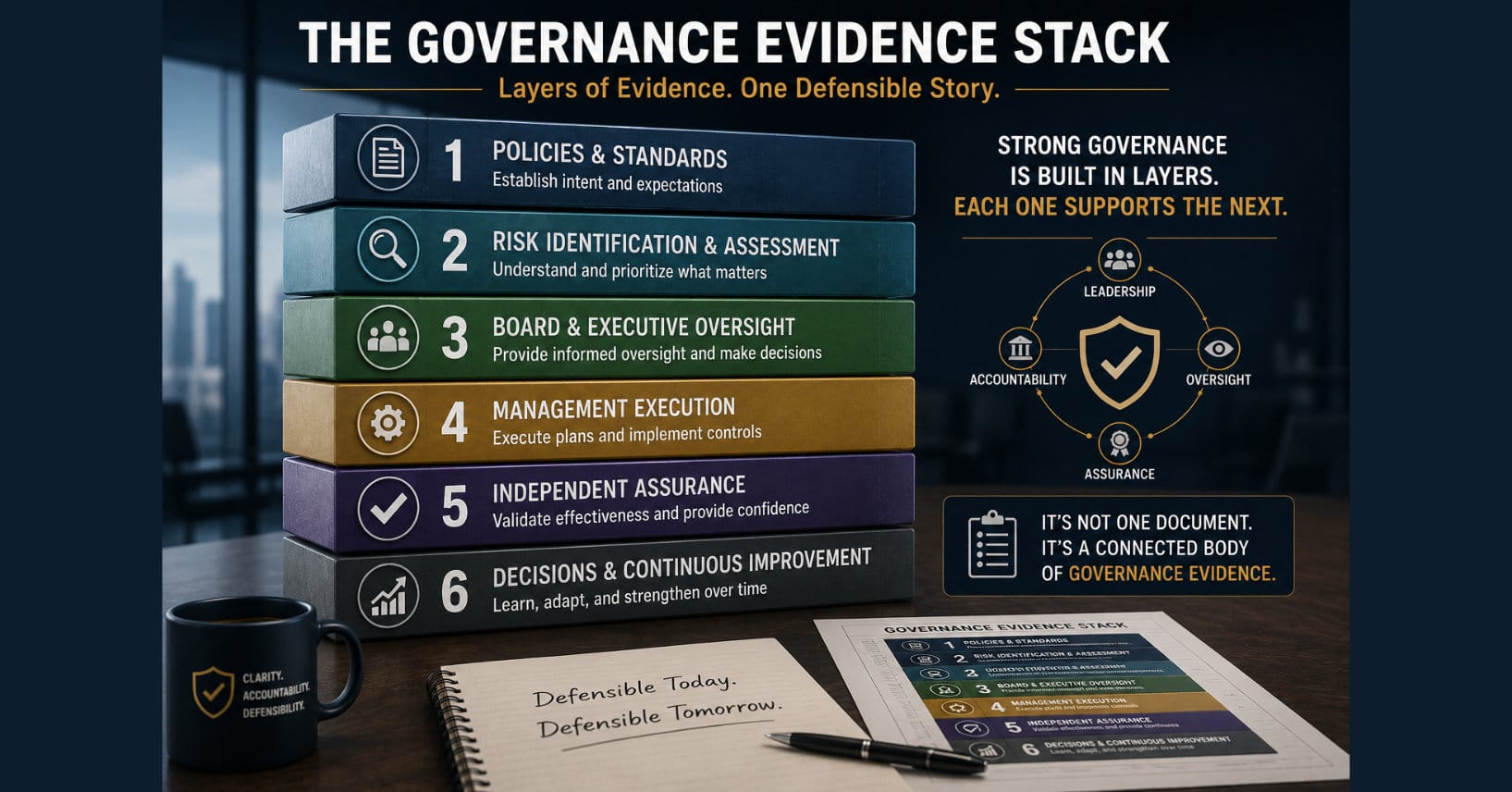
This fourth article in the Evidence-Driven Cybersecurity Governance Series introduces the Governance Evidence Stack, a layered model that organizes governance evidence from foundational policies through independent assurance and continuous improvement. Each layer reinforces the others, creating a coherent evidentiary narrative that demonstrates leadership’s oversight, accountability, and informed decision-making.
By viewing governance evidence as an architecture instead of isolated documents, organizations can strengthen board oversight, improve regulatory readiness, and build a defensible record of governance before it is ever needed.
The layers of evidence that transform governance into defensible oversight.
Defensible governance is rarely proven by a single document. It is demonstrated through a connected body of evidence.
One of the biggest mistakes organizations make is searching for the document that proves good governance.
It doesn’t exist.
Governance is not evidenced by a single policy, board presentation, or committee meeting. It is demonstrated through a collection of interconnected artifacts that tell a consistent story of leadership, oversight, accountability, and continuous improvement.
This collection is what I call the Governance Evidence Stack.
Rather than viewing governance evidence as isolated documents, the Governance Evidence Stack organizes evidence into layers that reinforce one another. Individually, each layer provides value. Together, they establish a defensible record of governance.
Layer 1—Policies and Standards
Every governance program begins with expectations.
Policies define authority.
Standards establish organizational requirements.
Together, they answer fundamental questions:
- What has leadership required?
- What responsibilities have been assigned?
- What governance structure has been established?
Without documented policies and standards, organizations struggle to demonstrate that governance expectations were clearly communicated.
Policies establish intent.
Layer 2—Risk Identification and Assessment
Governance requires more than establishing expectations.
Leadership must understand the risks facing the organization.
Risk assessments identify material cyber threats.
Risk registers prioritize those threats.
Business impact analyses connect technical risks to operational and strategic consequences.
This layer demonstrates that leadership understood what required oversight.
Risk establishes context.
Layer 3—Board and Executive Oversight
Oversight transforms awareness into governance.
Executive reporting.
Board presentations.
Committee briefings.
Management dashboards.
Decision records.
These artifacts demonstrate that leadership received relevant information, discussed material risks, allocated resources, and exercised informed judgment.
Oversight establishes accountability.
Layer 4—Management Execution
Governance without execution is merely intention.
Management action plans…
Project updates…
Remediation tracking…
Risk treatment activities…
Operational metrics…
This layer demonstrates that leadership’s decisions resulted in meaningful organizational action.
Execution establishes follow-through.
Layer 5—Independent Assurance
Effective governance requires verification.
Internal audit.
Independent assessments.
Penetration testing.
Control validations.
Maturity assessments.
Third-party reviews.
These activities provide objective confirmation that governance functions as intended.
Assurance establishes confidence.
Layer 6—Decisions and Continuous Improvement
Governance is never static.
Organizations continuously evaluate results.
Lessons learned are incorporated.
Policies evolve.
Risks change.
Reporting improves.
Resources are adjusted.
Decision records, improvement initiatives, post-incident reviews, and governance maturity assessments demonstrate that leadership continuously strengthens oversight.
Improvement establishes resilience.
The Power of Connected Evidence
Each layer tells only part of the governance story.
Policies explain expectations.
Risk assessments explain priorities.
Board oversight explains leadership.
Management execution explains action.
Assurance explains validation.
Continuous improvement explains organizational learning.
Together, these layers create something far more valuable than individual documents.
They create a coherent evidentiary narrative.
An investigator reviewing the Governance Evidence Stack should be able to trace leadership’s governance journey—from establishing expectations through validating outcomes—without relying on assumptions or reconstructed timelines.
That is what makes governance defensible.
Evidence Is an Architecture
Organizations often think about governance documentation one document at a time.
The Defensible Evidence Framework™ encourages a different perspective.
Governance evidence is an architecture.
Each artifact supports another.
Each governance activity reinforces the next.
The resulting body of evidence demonstrates not only that governance occurred, but that it occurred systematically, consistently, and responsibly.
The strongest organizations do not simply maintain governance documents.
They build governance evidence systems.
From the Framework
This article is adapted from The Defensible Evidence Framework™ White Paper, which explores how organizations can create defensible governance evidence naturally through disciplined oversight rather than attempting to reconstruct it after a crisis.
The complete white paper is available for download here.
Coming Next
Article 5: The Dangerous Myth of Perfect Documentation
Many organizations believe that more documentation automatically creates stronger governance. In the next article, we’ll examine why documentation created after an incident often carries less evidentiary value than records created naturally as governance occurs—and why attempting to reconstruct history can undermine organizational credibility.