When a cybersecurity incident occurs, the immediate focus is operational:
Contain the threat.
Restore systems.
Communicate impact.
But as the situation stabilizes, a second process begins.
It is quieter. More deliberate. And far more consequential.
The investigation.
At this stage, the organization is no longer evaluated on how quickly it responded alone. It is evaluated on how it governed risk before and during the event.
This is where the evidentiary model becomes real.
The Shift from Incident to Inquiry
After a breach, multiple parties may become involved:
- regulators
- legal counsel and litigators
- insurers
- internal audit and independent investigators
Each brings a different mandate.
But their questions converge.
They are not primarily technical.
They are evidentiary.
They seek to understand not just what happened—but whether leadership exercised responsible oversight.
The Questions That Define the Investigation
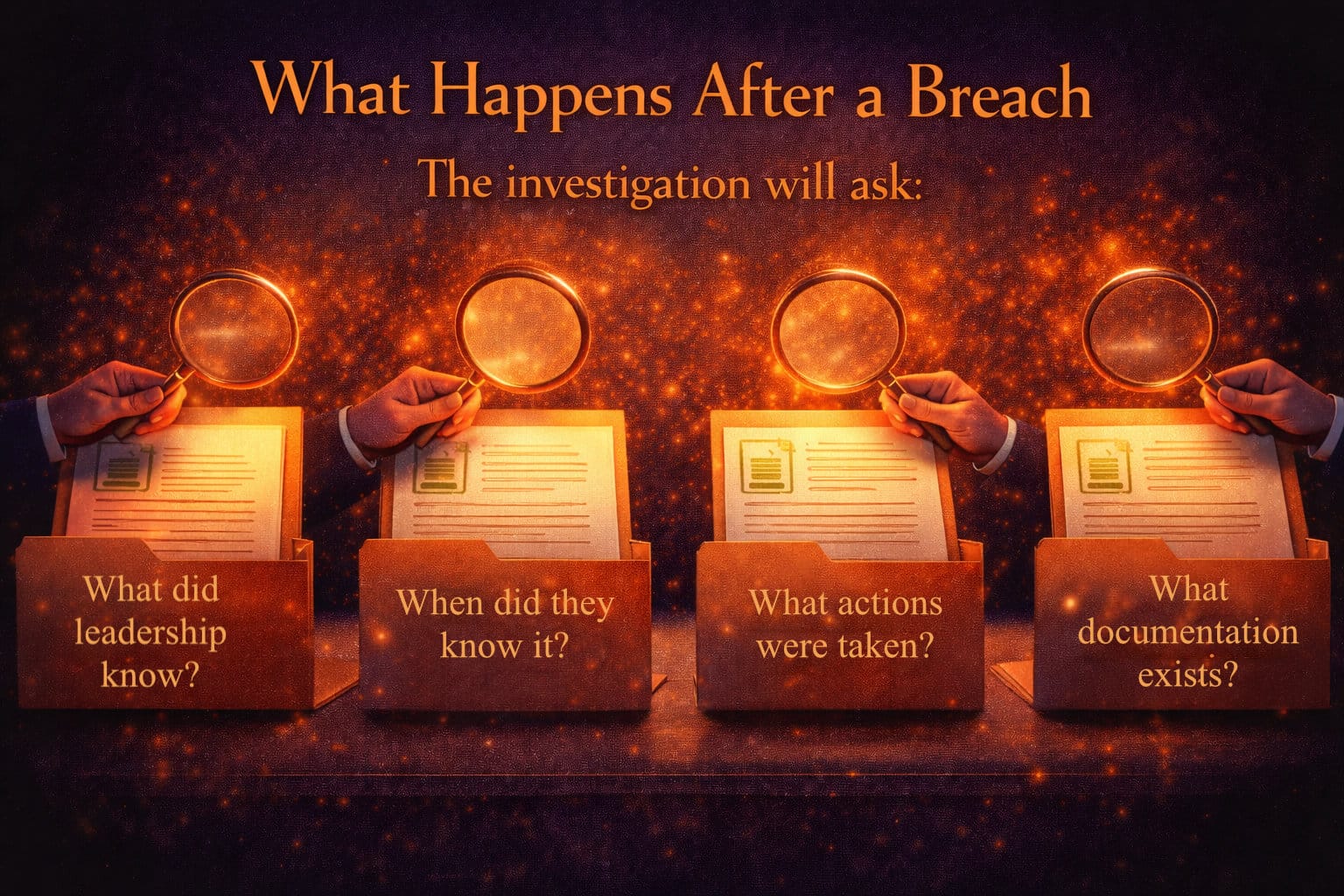
Across investigations, four questions consistently emerge:
What did leadership know?
Investigators begin by establishing awareness.
They examine:
- risk registers and threat assessments
- cybersecurity briefings to leadership
- documented identification of relevant risks
The objective is clear:
Was the risk known—or should it have been?
If risk recognition cannot be demonstrated, governance is immediately weakened.
When did they know it?
Timing matters.
Investigators reconstruct the sequence of events:
- when risks were identified
- when they were communicated
- when leadership was informed
This establishes whether awareness occurred in time for action.
Delayed recognition or communication introduces questions of diligence and responsiveness.
What actions were taken?
Awareness alone is insufficient.
Investigators examine the organization’s response:
- policies adopted and controls implemented
- decisions made regarding risk mitigation or acceptance
- actions taken in response to emerging threats
They are looking for evidence that leadership did not simply know—but acted.
And that those actions were deliberate and aligned to risk.
What documentation exists?
This is where the investigation ultimately converges.
Every claim—awareness, timing, action—must be supported by evidence.
Investigators review:
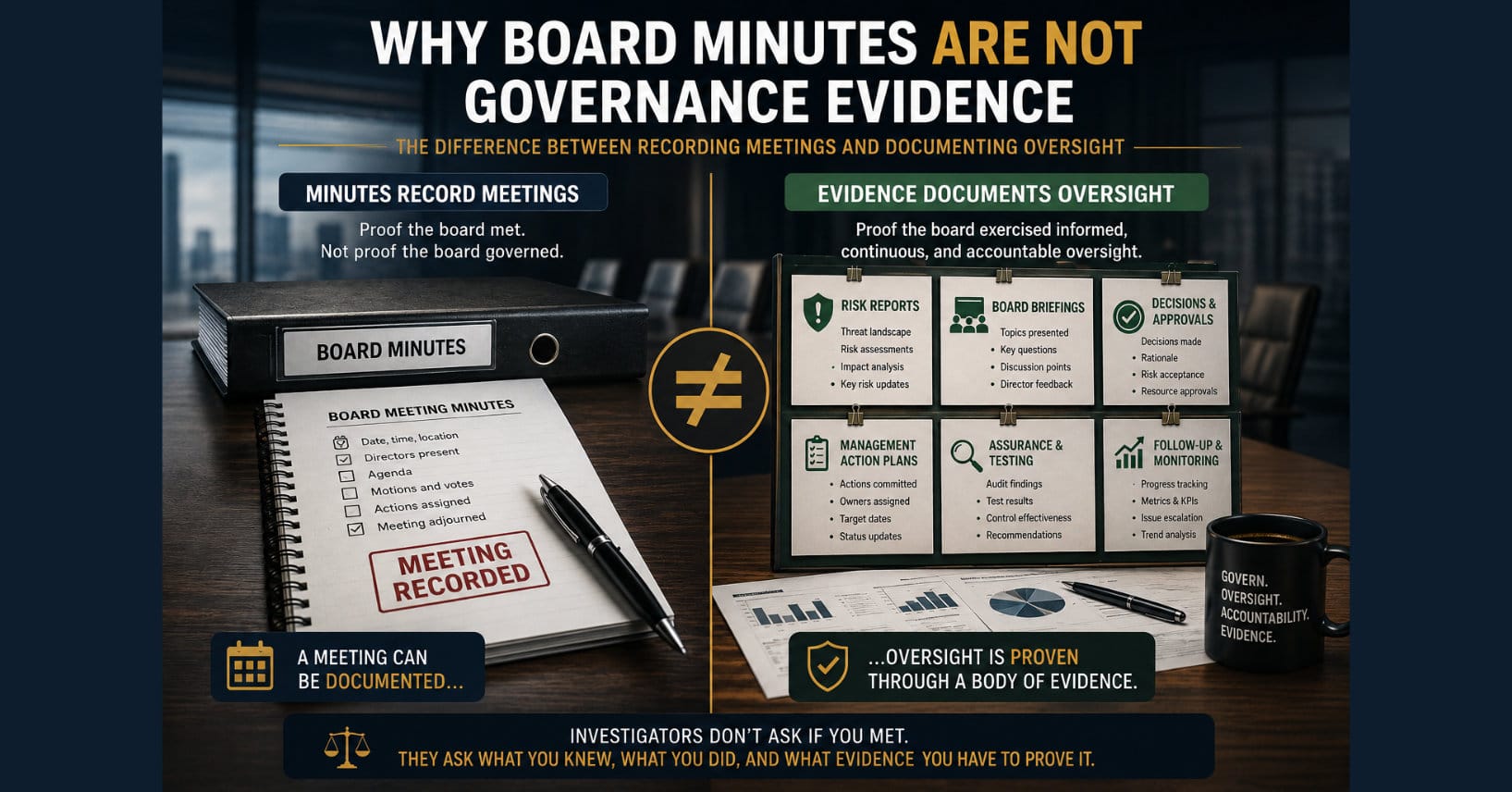
- board and committee minutes
- decision records and approvals
- operational logs and remediation actions
- preserved reports and audit trails
Without documentation, the narrative collapses.
With it, the narrative becomes defensible.
Reconstructing the Story
An investigation is, in essence, a reconstruction.
It attempts to answer a simple question:
Can the organization’s governance story be clearly and credibly told?
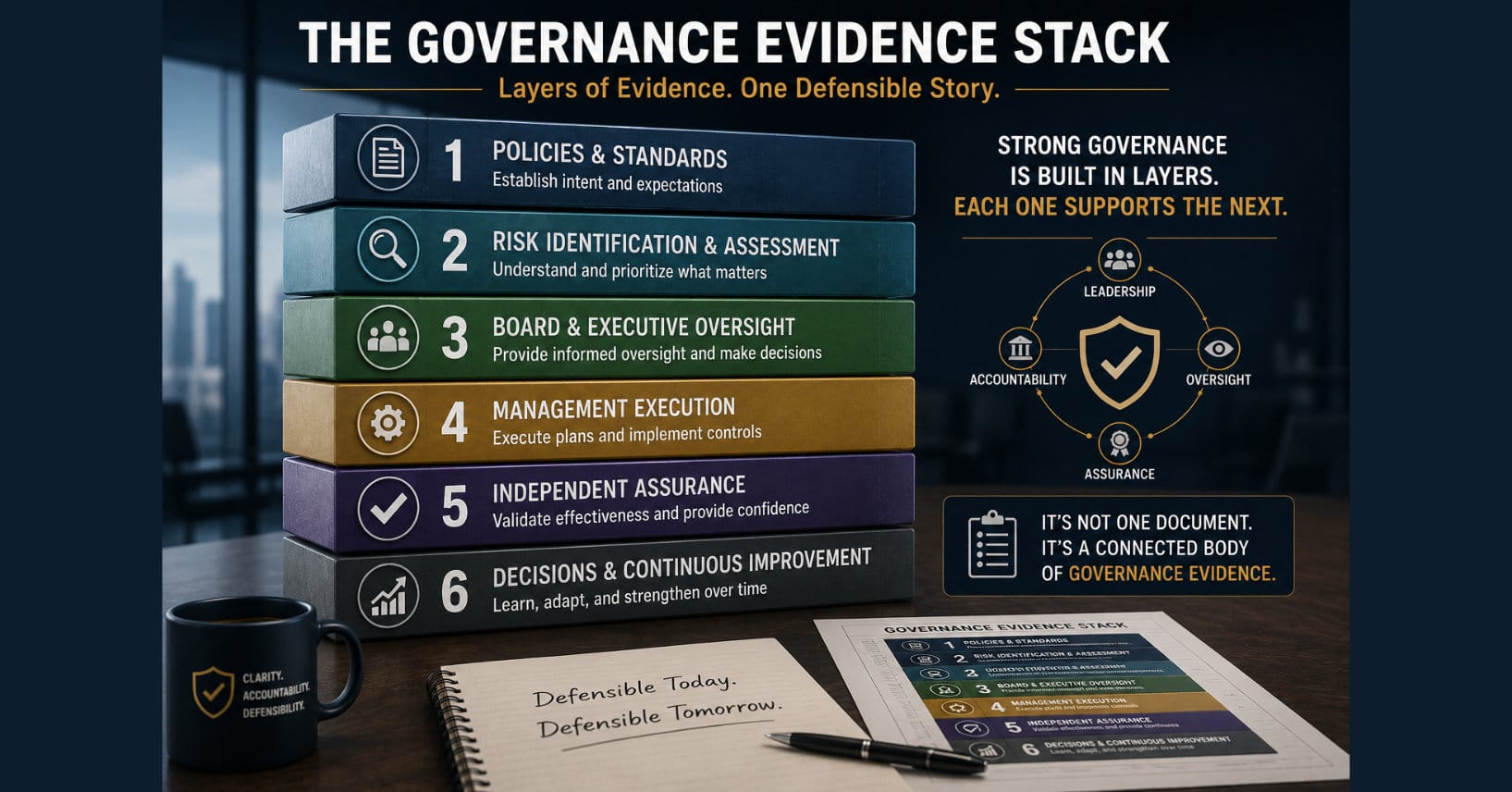
This requires a continuous evidentiary chain:
- risk recognition establishes awareness
- control decisions establish response
- oversight records establish engagement
- execution artifacts establish follow-through
- preserved evidence establishes durability
If any link in this chain is weak or missing, the story becomes fragmented.
And in a fragmented story, doubt emerges.
The Role of Governance Evidence
Governance evidence does not prevent incidents.
It does something different—and equally important.
It protects leadership.
It demonstrates that:
- risks were identified and understood
- decisions were made based on available information
- oversight was exercised in a disciplined manner
- actions were taken in alignment with governance expectations
This is the standard of reasonableness.
It is the standard against which leadership is judged.
The Difference Between Outcome and Accountability
One of the most important distinctions in post-breach evaluation is this:
Organizations are not judged solely on outcomes.
They are judged on accountability.
A breach may occur despite strong governance.
But if leadership can demonstrate:
- awareness of risk
- deliberate decision-making
- active oversight
- aligned execution
the evaluation shifts.
From failure… to defensibility.
Without that evidence, even a well-intentioned organization can appear negligent.
The Risk of an Incomplete Record
Many organizations enter an investigation believing they governed effectively.
But belief is not evidence.
If documentation is incomplete, inconsistent, or difficult to produce:
- timelines become unclear
- decisions appear unsubstantiated
- oversight appears minimal
- actions appear reactive
This creates exposure—not just operational, but legal and regulatory.
Governance as Protection
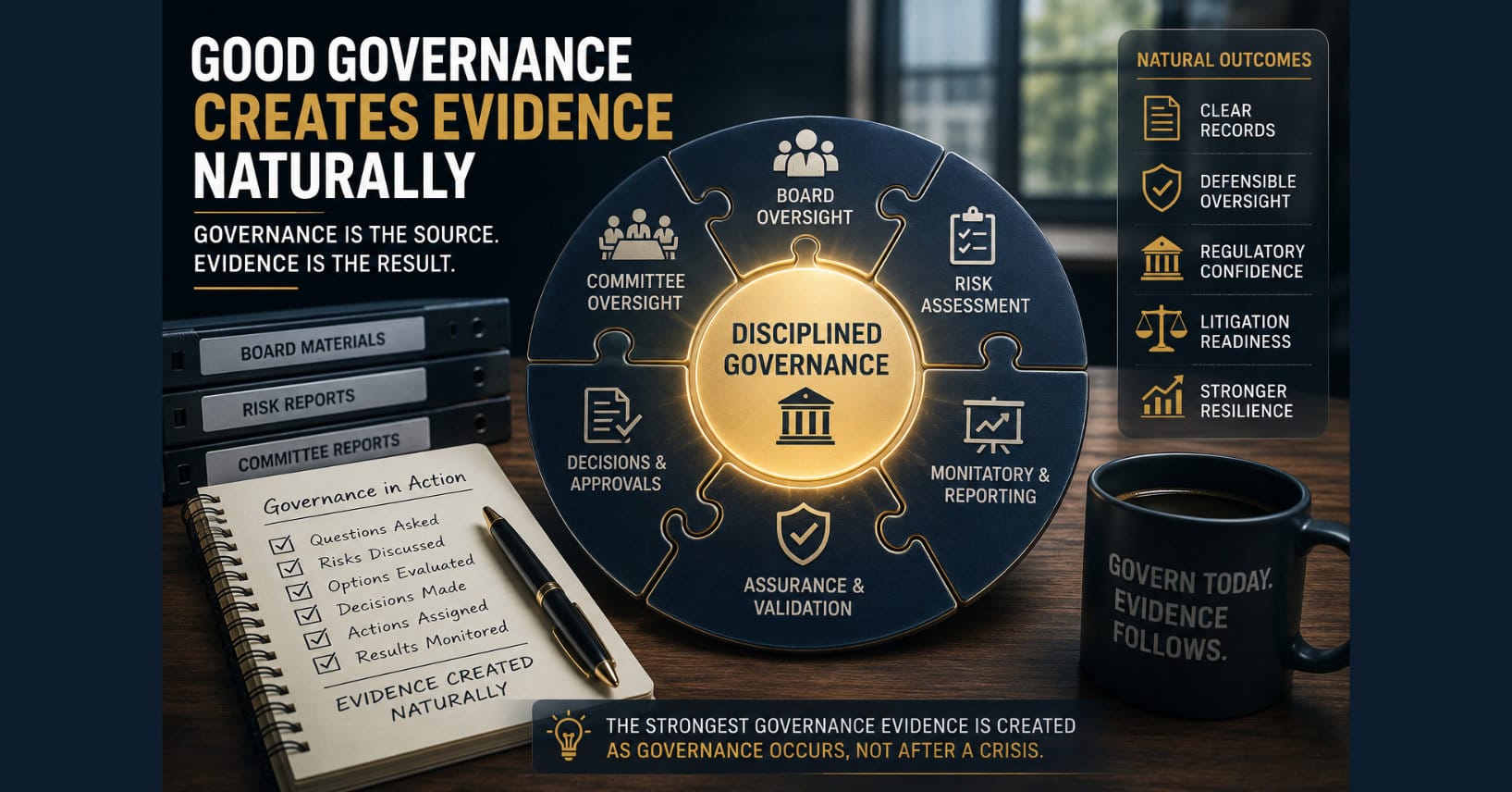
The purpose of governance evidence is not to create paperwork.
It is to create protection.
Protection for:
- the organization’s credibility
- the board’s fiduciary position
- executive leadership’s accountability
It provides a structured, documented record that demonstrates reasonableness under scrutiny.
The Reality of Post-Incident Evaluation
In the aftermath of a breach, the environment changes.
Assumptions are replaced with evidence.
Intent is replaced with documentation.
Narratives are tested against records.
And in that environment, one principle governs the outcome:
If it cannot be demonstrated, it does not exist.
The Final Standard
This article brings the Cyber Governance Evidence Series into sharp focus.
Because it answers the question every organization must ultimately face:
What happens when governance is tested?
The answer is not found in systems or tools.
It is found in evidence.
Evidence that shows what leadership knew.
When they knew it.
What they did.
And how they documented it.
Because in the end, governance is not judged by what was intended.
It is judged by what can be proven.