
Evidentiary Architecture™ Series | Article 14 of 20
Building the Defensible Enterprise through Governance Evidence
Creating governance evidence is only the first step. Its true value depends on its quality. This article introduces the five characteristics of high-quality governance evidence: completeness, integrity, timeliness, traceability, and defensibility. Together, these principles provide a practical framework for evaluating whether governance evidence can withstand scrutiny from boards, regulators, auditors, insurers, and courts. Organizations that measure evidence quality strengthen decision-making, improve accountability, preserve institutional knowledge, and build a more defensible enterprise.
Creating governance evidence is only the beginning.
Not all evidence has equal value.
A meeting minute that omits the rationale behind a decision provides far less value than one that documents the alternatives considered, the risks discussed, and the accountability assigned.
A policy that exists but has not been reviewed in five years tells a different story than one that is actively maintained and linked to current governance decisions.
The question is no longer simply:
“Do we have evidence?”
It becomes:
“Is our evidence any good?”
That is where evidence quality becomes essential.
Evidence Must Be Fit for Purpose
High-quality governance evidence should support confident decision-making long before it is needed for an audit, investigation, or lawsuit.
Poor-quality evidence creates uncertainty.
Incomplete evidence forces assumptions.
Disconnected evidence hides accountability.
Outdated evidence undermines credibility.
Strong governance requires more than collecting information.
It requires creating evidence that leadership, regulators, auditors, insurers, and courts can trust.
Five Characteristics of High-Quality Evidence
Evidentiary Architecture™ evaluates governance evidence using five foundational characteristics:
- Completeness
- Integrity
- Timeliness
- Traceability
- Defensibility
Together, these characteristics provide a practical framework for assessing evidence quality across the enterprise.
Completeness
Evidence should tell the whole governance story.
A governance decision should include:
- The originating risk.
- Information reviewed.
- Alternatives considered.
- Decision rationale.
- Decision authority.
- Accountability assignments.
- Expected outcomes.
- Follow-up activities.
When critical elements are missing, the governance record becomes incomplete.
Questions remain unanswered.
Confidence decreases.
Integrity
Evidence must be trustworthy.
Leadership should know:
Who created it?
When was it created?
Has it been modified?
Can its authenticity be demonstrated?
Integrity protects evidence from becoming merely another document.
Without integrity, even complete evidence can lose credibility.
Timeliness
Governance evidence should be created as decisions occur.
Not weeks later.
Not after memories fade.
Not during an investigation.
Evidence created contemporaneously preserves context that retrospective documentation often loses.
Timeliness strengthens confidence because it captures governance while it is still fresh.
Traceability
Good evidence should never exist in isolation.
Leadership should be able to trace every governance decision back to:
- The originating risk.
- Supporting analysis.
- Executive recommendations.
- Board oversight.
- Implementation.
- Validation.
- Future reviews.
Traceability transforms disconnected documentation into evidence lineage.
It explains relationships.
Not merely records.
Defensibility
Ultimately, governance evidence exists to withstand scrutiny.
Can leadership explain why the decision was made?
Can accountability be demonstrated?
Can the evidence survive regulatory review?
Would it support an insurance claim?
Would it withstand litigation?
Defensibility is the outcome produced when completeness, integrity, timeliness, and traceability work together.
Measuring What Matters
Many organizations measure the quantity of documentation they produce.
How many policies exist?
How many controls were tested?
How many audits were completed?
Evidence quality asks different questions.
Are governance decisions complete?
Are relationships preserved?
Is accountability visible?
Can leadership explain its reasoning?
Quality matters far more than volume.
Evidence Quality Improves Governance
Evidence quality is not simply about creating stronger records.
It improves governance itself.
Leaders make better decisions when previous decisions remain understandable.
Boards ask better questions when accountability is visible.
Executives avoid repeating mistakes because evidence preserves organizational learning.
High-quality evidence strengthens governance before anyone asks to see it.
An Architectural Perspective
Enterprise architects evaluate system quality.
Security architects evaluate control effectiveness.
Data architects evaluate information quality.
Evidentiary Architecture™ evaluates governance evidence quality.
That distinction matters.
Evidence is not simply another document repository.
It is an enterprise asset that deserves the same discipline applied to every other critical organizational capability.

From Evidence to Trust
Every organization possesses documentation.
The organizations that become truly defensible possess trustworthy evidence.
The difference lies in quality.
Not quantity.
High-quality governance evidence builds confidence.
It strengthens oversight.
It preserves institutional knowledge.
It supports accountability.
Most importantly, it enables leadership to demonstrate not only what decisions were made, but that those decisions were informed, deliberate, and responsibly governed.
That is the standard Evidentiary Architecture™ seeks to achieve.
Governance Takeaway
High-quality governance evidence is complete, trustworthy, timely, traceable, and defensible. These five characteristics provide a practical framework for evaluating whether governance evidence merely exists—or whether it can genuinely support informed leadership, board oversight, regulatory confidence, and organizational resilience.
Coming Next
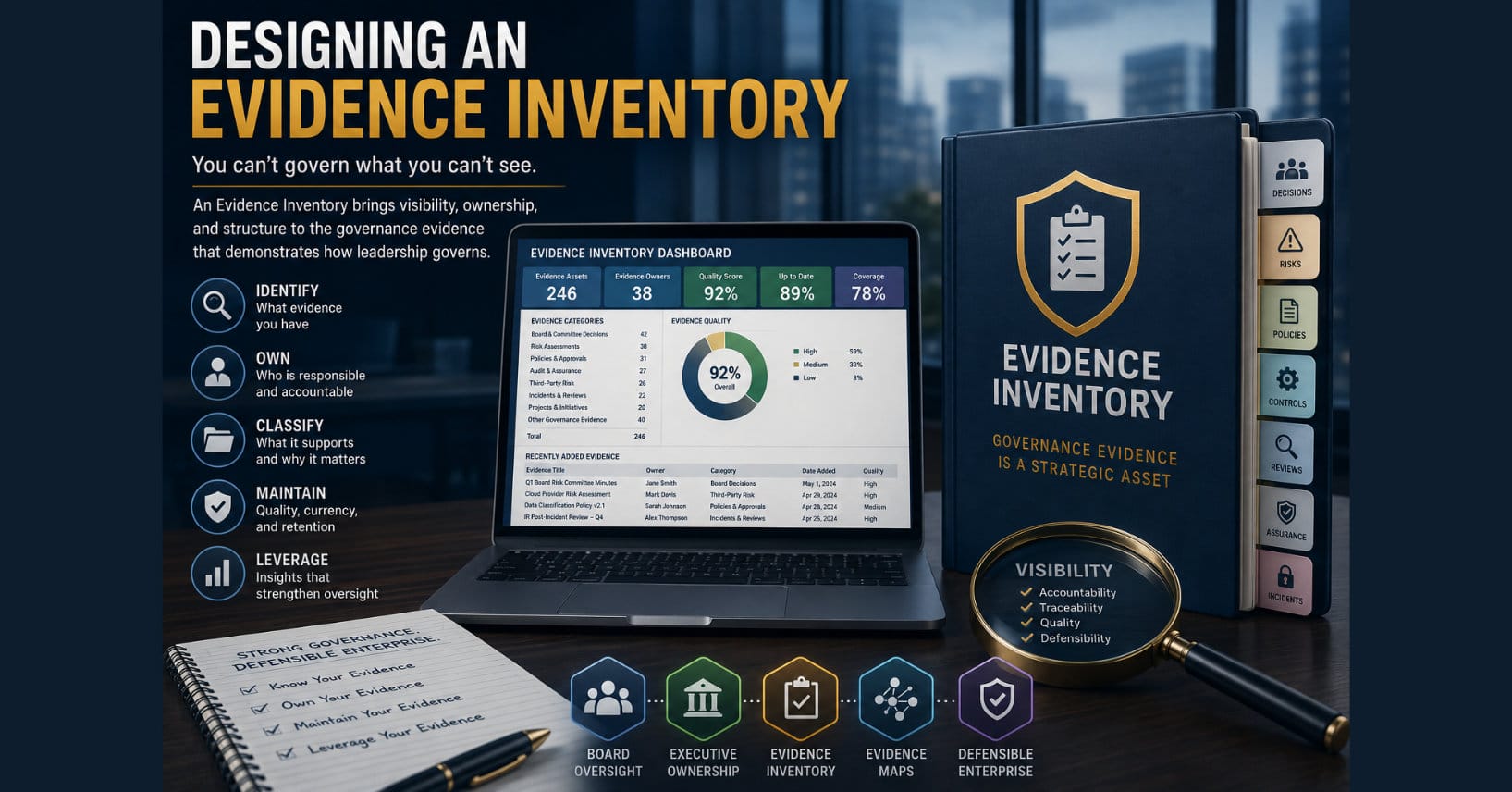
Designing an Evidence Inventory
Organizations routinely inventory hardware, software, data, and information assets. Yet few inventory their governance evidence. In the next article, we’ll explore how to design an Evidence Inventory that identifies, classifies, and manages governance evidence as a strategic enterprise asset, giving boards greater visibility into the evidence that supports their oversight responsibilities.