Uber’s third-party data breach raises a governance question that extends beyond compromised credentials: Can an organization demonstrate why its AI infrastructure providers can access sensitive personal information—and whether that access is appropriately controlled?
An organization can maintain sophisticated cybersecurity defenses, establish comprehensive privacy policies, and invest heavily in artificial intelligence governance.
Then a vendor’s credentials are compromised.
Suddenly, the organization’s most consequential security decisions may be those made months or years earlier, when someone approved a third party’s access to sensitive information.
That is the governance question emerging from the latest data breach involving Uber.
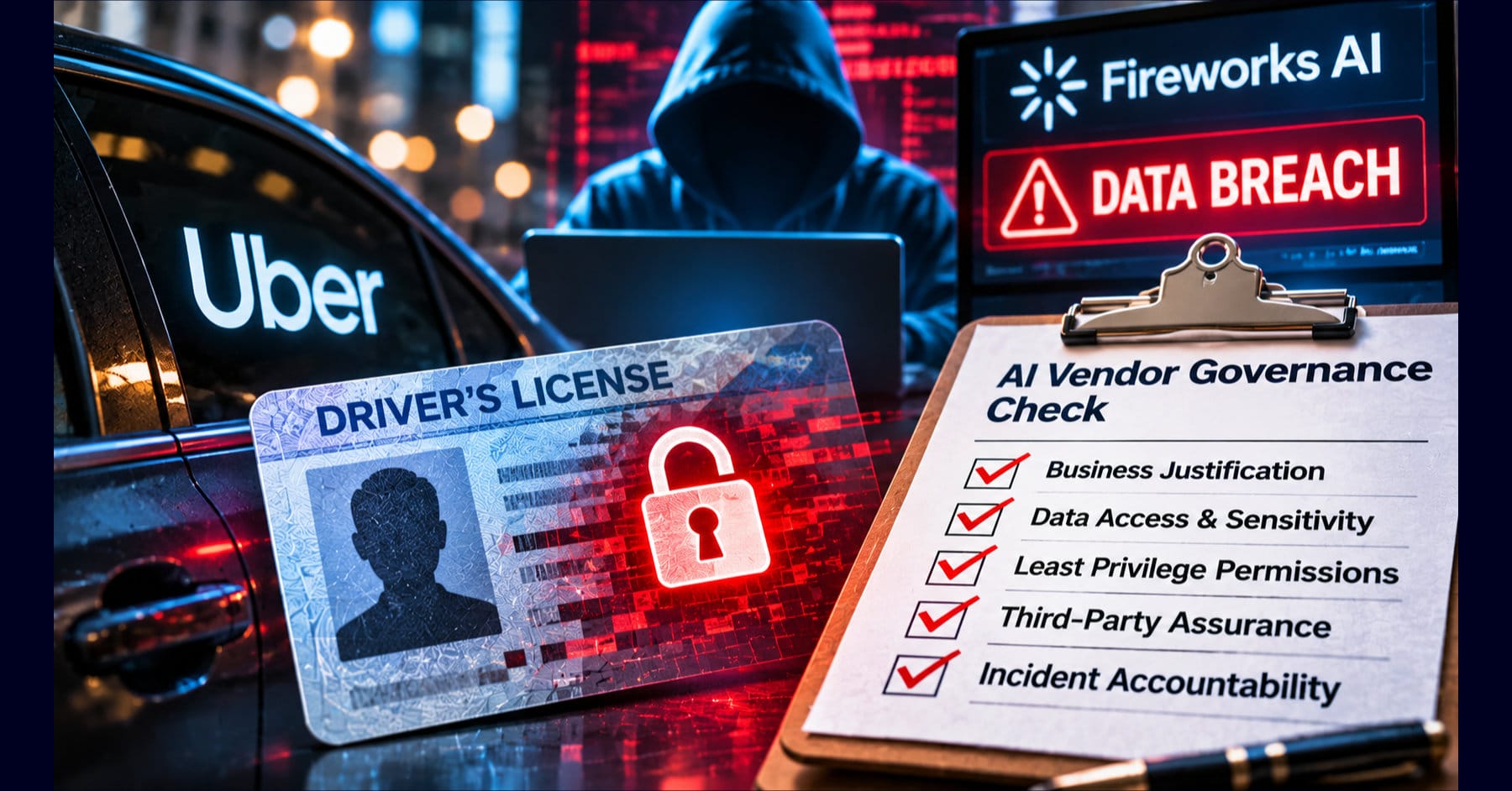
In November 2026, reports surfaced that personal information belonging to thousands of Uber drivers had been exposed through compromised credentials associated with Fireworks AI, an external AI infrastructure provider.
The incident reportedly involved drivers’ license information and other personal data. Uber disconnected the provider after receiving notification of the compromise and initiated an investigation.
The publicly reported figures establish that thousands of individuals were affected across several states, although the complete national scope had not been established in the initial reporting.
There was no public indication, at the time of the initial notifications, that the exposed information had been misused.
Those facts are important.
But the larger governance question is not simply how an attacker obtained access.
It is why an external AI infrastructure provider had access to the affected information, what legitimate business purpose required that access, and whether the permissions were proportionate to that purpose.
The existence of an authorized vendor relationship does not answer those questions.
Neither does a signed contract.
A vendor can be properly approved, contractually authorized, and still possess access that creates more exposure than the organization intended to accept.
That is where this incident becomes a governance story.
The AI Supply Chain Is Becoming Part of the Enterprise Security Boundary
Organizations increasingly depend on external AI infrastructure to develop, deploy, operate, and scale intelligent applications.
These providers may supply model inference, application hosting, orchestration, data processing, monitoring, or other supporting capabilities.
The arrangement can accelerate development and reduce the need to maintain specialized infrastructure internally.
But it also introduces another layer of technical and organizational dependency.
Sensitive information may move through systems that the customer does not directly operate.
Credentials may provide access to customer environments or services.
Application integrations may establish persistent permissions.
Operational logs may contain information that was not originally intended for long-term retention.
And the distinction between a company’s internal security boundary and its external service ecosystem becomes increasingly difficult to maintain.
This is not inherently a failure of outsourcing.
Third-party services are essential to modern enterprise operations.
The governance problem emerges when organizations approve these relationships without maintaining a sufficiently detailed understanding of the information, permissions, and operational dependencies involved.
An AI infrastructure provider is not merely a procurement relationship.
It can become part of the organization’s effective security architecture.
That means vendor governance must extend beyond financial viability, contractual commitments, and general security certifications.
It must address the actual technical authority granted to the provider.
What information can the provider access?
Under what circumstances?
Through which credentials?
For how long?
Can the provider retain copies?
Can access be restricted to specific services or datasets?
And can the organization independently verify that those restrictions are operating?
These questions belong in the governance process before sensitive information becomes accessible.
The Question Is Not Whether the Vendor Was Trusted
Trust is frequently treated as a prerequisite for granting a third party access to enterprise systems.
The vendor undergoes due diligence.
Security documentation is reviewed.
Contracts are executed.
Access is provisioned.
The relationship moves into production.
But trust should not be confused with unrestricted technical authority.
A vendor’s security posture can change.
Credentials can be compromised.
Employees can make mistakes.
Software vulnerabilities can emerge.
Service configurations can drift.
And previously appropriate permissions can become excessive as business requirements evolve.
A mature governance framework assumes that an approved vendor may eventually experience a security incident.
It therefore limits the consequences of that incident through architectural and operational controls.
This is the principle of least privilege applied to the enterprise supply chain.
A provider should receive only the access necessary to perform its authorized functions.
That access should be constrained by scope, purpose, duration, and sensitivity.
Where possible, sensitive data should be minimized, transformed, or excluded from external processing.
Permissions should be reviewed when business requirements change.
And credentials should be subject to appropriate protection, monitoring, rotation, and revocation procedures.
The objective is not to eliminate all third-party risk.
It is to prevent a compromise of one provider from becoming an unnecessarily broad compromise of the customer’s information.
The governance question is not whether leadership trusted the vendor. It is whether the organization designed its architecture to limit the consequences if that trust was violated.
Why Would an AI Infrastructure Provider Need Driver Identity Information?
The reported exposure of drivers’ license information introduces a particularly important question.
What operational function required an AI infrastructure provider to have access to this category of information?
There may be legitimate explanations.
An AI-enabled application could support identity verification, document processing, customer service, fraud detection, or other workflows involving driver records.
A provider might process information directly, support an application that accesses it, or possess credentials that inadvertently permit broader access than a specific service requires.
The publicly reported information does not establish which explanation applies to this incident.
Nor does it establish that Fireworks AI was authorized to use drivers’ license information for model training or that the information was incorporated into AI models.
Those distinctions must be preserved.
The reported involvement of an AI infrastructure provider does not, by itself, establish that the breach involved model training, inference prompts, retrieval-augmented generation, or an AI-specific vulnerability.
The known concern is compromised access through a third-party relationship.
Nevertheless, the incident exposes a governance requirement that is becoming increasingly important.
Organizations must be able to explain why sensitive information enters an AI-related processing environment and what controls govern its presence there.
That explanation should exist before a breach.
For each material AI integration, the organization should understand the business purpose, data categories, processing activities, retention requirements, access permissions, and responsible decision-makers.
Where identity information is involved, the justification should be particularly rigorous.
Drivers’ license information can create persistent exposure because it may contain identifiers that cannot be changed as easily as a password.
The sensitivity of that information makes data minimization and access limitation especially important.
A governing body should not need a security incident to discover which external providers can access it.
Credential Compromise Is an Access Governance Problem
The initial reporting indicates that compromised credentials were used to access Uber’s account through the third-party provider.
That raises questions about credential protection.
But the governance implications extend further.
Credentials are mechanisms through which technical authority is exercised.
A credential may permit a system, application, employee, or service provider to perform actions within a defined environment.
The security consequences of a compromised credential depend heavily on the authority associated with it.
A credential restricted to a narrow function may produce a limited exposure.
A credential with broad access to sensitive information may create substantially greater consequences.
Therefore, evaluating the incident requires more than determining how the credential was compromised.
Investigators must establish what the credential permitted, which resources were accessible, what activity occurred, and whether the granted permissions exceeded the provider’s operational requirements.
The organization should also determine whether the compromised access could be revoked promptly and whether revocation was sufficient to prevent continued unauthorized activity.
This introduces a critical distinction.
Credential security attempts to prevent unauthorized use. Access governance determines how much damage unauthorized use can cause.
Both are necessary.
An organization that focuses exclusively on credential protection may overlook the exposure created by excessive permissions.
And an organization that reviews permissions only during initial onboarding may fail to recognize how access expands over time.
AI integrations can make that problem more consequential because new workflows, data sources, and automated capabilities may be introduced rapidly.
Every expansion of access should represent an explicit governance decision.
Not merely a technical configuration change.
Third-Party Risk Assessments Are Not Enough
Most mature enterprises maintain some form of third-party risk management program.
Vendors are classified.
Questionnaires are completed.
Security certifications are reviewed.
Contracts establish obligations.
Periodic reassessments are scheduled.
These activities can provide valuable information.
But they do not necessarily demonstrate that the organization’s actual exposure is controlled.
A vendor may possess a recognized security certification while a customer integration grants excessive permissions.
A contract may prohibit unnecessary data retention while the customer lacks technical evidence of what information is retained.
An annual assessment may confirm that a provider maintains security policies without establishing whether a particular integration is configured securely.
This is the distinction between evaluating the vendor and governing the relationship.
Vendor assessments examine the provider’s capabilities and controls.
Relationship governance examines the specific authority, information flows, dependencies, and residual risks created by the customer’s use of that provider.
The two activities should reinforce each other.
Neither substitutes for the other.
For AI infrastructure relationships, governing bodies should expect evidence that sensitive data access is necessary, documented, technically constrained, monitored, and periodically reassessed.
They should also expect clear ownership of the decision to accept any remaining exposure.
The cybersecurity team may assess the technical risks.
The privacy function may evaluate data protection obligations.
Procurement may negotiate contractual requirements.
Legal counsel may address notification and liability provisions.
But someone in the business must remain accountable for the purpose and scope of the relationship.
Outsourcing a technical capability does not outsource accountability for the information entrusted to it.
The Breach Notification Timeline Is Part of the Governance Record
The reported sequence of events provides another important area for examination.
Fireworks AI reportedly notified Uber of the compromised access on October 9.
Uber subsequently determined that personal information had been accessed and issued breach notifications in November.
The precise sequence of investigation, confirmation, containment, legal assessment, and notification decisions matters.
But elapsed time alone does not establish that an organization acted improperly.
Breach investigations often require time to determine which systems were affected, what information was accessed, whether unauthorized activity continued, and which notification obligations apply.
Different jurisdictions may impose different reporting requirements and triggering conditions.
The governance question is whether the organization can reconstruct and justify its decisions throughout that process.
When did the provider first detect suspicious activity?
When did it notify the customer?
What information was available at that point?
When did the customer establish that personal information was involved?
Who determined the scope of the investigation?
What evidence supported containment?
How were notification obligations assessed?
And who approved the final disclosure decisions?
These questions should be answerable through contemporaneous records.
A well-governed incident response process does not require investigators to reconstruct every material decision from emails, recollections, and fragmented technical logs.
It produces an evidence trail as the response unfolds.
That is particularly important when multiple organizations participate in the same incident.
The vendor may possess one set of logs.
The customer may possess another.
Cloud providers, identity systems, and supporting services may hold additional evidence.
Without coordinated evidence preservation and clearly assigned responsibilities, the organizations may struggle to establish a complete account of what occurred.
Evidentiary Architecture™ and the AI Vendor Accountability Chain
The Uber incident provides a useful illustration of why Evidentiary Architecture™ must extend beyond the enterprise’s directly operated systems.
An organization’s governance evidence is incomplete if it cannot account for material decisions and activities occurring across its external technology relationships.
For an AI infrastructure integration, the evidentiary record should establish five things.
First, the business justification.
Why was the provider engaged, what function was authorized, and who approved the relationship?
Second, the data authorization.
Which categories of information could the provider access or process, and why were those categories necessary?
Third, the technical authority.
Which identities, credentials, permissions, interfaces, and services enabled the provider to exercise that access?
Fourth, the operational assurance.
What monitoring, access reviews, testing, and control verification demonstrated that the relationship remained within its approved boundaries?
Fifth, the incident accountability.
If the provider was compromised, could the organization establish what was exposed, which controls operated, what decisions were made, and what residual risks remained?
These elements form an accountability chain.
The business purpose authorizes the relationship.
The data authorization establishes what information may be involved.
The technical permissions implement that authority.
The operational controls provide assurance.
And the incident evidence demonstrates whether the relationship remained governable when something went wrong.
A gap anywhere in that chain can create uncertainty.
The organization may know that a vendor was approved without being able to explain why it had access to particular information.
It may know that permissions existed without being able to establish when they changed.
It may know that access was revoked without being able to prove that unauthorized activity stopped.
That is not merely an incident response problem.
It is an evidentiary governance problem.
Five Questions Every Board Should Ask About Its AI Vendors
The incident presents five questions that directors and executive risk committees should consider across their own AI ecosystems.
1. Do we know which AI providers can access sensitive information?
The inventory should include not only direct vendors but also relevant subprocessors, integrations, service accounts, and supporting infrastructure.
2. Can we demonstrate why each category of sensitive information is necessary?
Business justification should be connected to specific data permissions rather than broad assumptions about what a provider might need.
3. Are vendor credentials restricted to the minimum operational authority?
Leadership should expect evidence of scoped permissions, access reviews, credential controls, and timely revocation capabilities.
4. Can we reconstruct a vendor-related security incident across organizational boundaries?
Contracts and operating procedures should address notification, evidence preservation, investigation cooperation, and access to relevant records.
5. Who owns the residual risk when an AI integration exposes sensitive data?
Technical teams can implement controls, but business leadership must remain accountable for the decisions that create and sustain the exposure.
These are not questions that should first appear on the agenda after a vendor announces a breach.
They belong in the approval and oversight processes governing AI adoption.
The Next AI Governance Failure May Arrive Through an Approved Vendor
AI governance discussions frequently focus on model behavior.
Organizations debate hallucinations, bias, explainability, autonomous decision-making, and the appropriate limits of machine authority.
Those concerns are legitimate.
But the security architecture surrounding AI adoption deserves equal attention.
An AI application can operate exactly as designed while its supporting infrastructure introduces unacceptable data exposure.
A model can produce accurate results while the credentials supporting its integration possess excessive permissions.
A vendor can satisfy procurement requirements while the customer lacks a defensible explanation for why sensitive information is accessible through the relationship.
And a breach can occur without exploiting the AI model itself.
This is why AI governance cannot be separated from data governance, identity and access management, third-party risk management, and enterprise architecture.
The boundaries between these disciplines are becoming increasingly artificial.
The organization’s exposure does not respect those boundaries.
Neither will the consequences of a security incident.
Boardroom Takeaway
The reported Uber driver data breach involving Fireworks AI illustrates an increasingly consequential governance challenge.
Organizations are extending their operating environments through AI infrastructure providers, application integrations, and external services.
Every extension can create new paths to sensitive information.
The immediate incident may involve compromised credentials.
But the larger governance issue concerns the decisions that determine what those credentials can access.
A vendor’s approval does not establish that its permissions are appropriate.
A security certification does not prove that a particular integration is properly constrained.
And a contractual commitment does not replace the need for technical evidence that sensitive information is protected.
Governing bodies must be able to connect business purpose, data authorization, technical permissions, operational assurance, and incident accountability.
That connection should exist before a breach.
The question is not simply whether your AI vendor can be trusted. It is whether your organization can demonstrate that a compromise of that vendor would expose only the information necessary for its authorized function.
If one of your AI infrastructure providers were compromised tomorrow, could your organization identify every category of sensitive information it could access—and produce the evidence explaining why that access was necessary?
Or would the breach become the first time anyone asked?