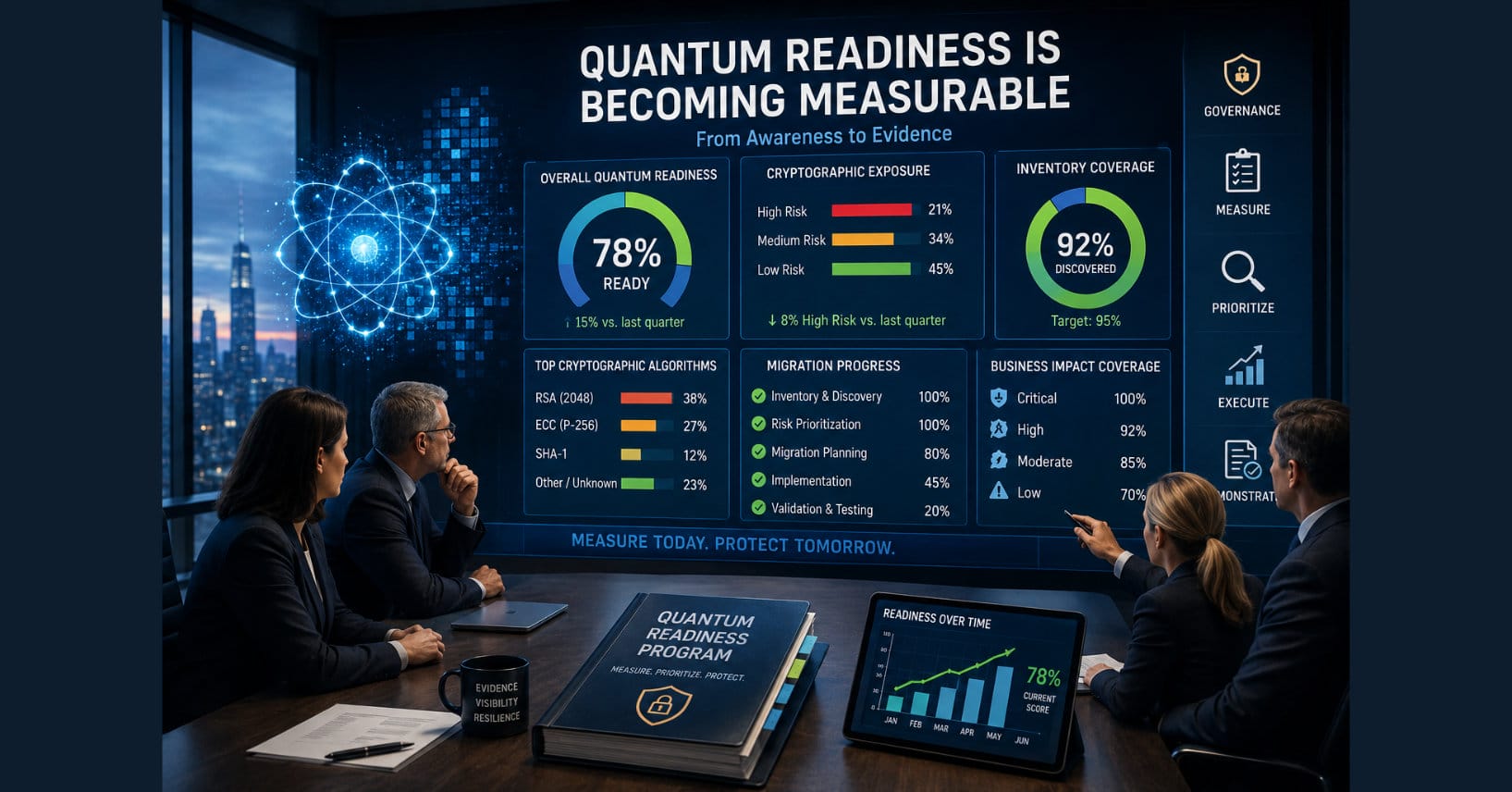
As quantum computing moves closer to practical reality, organizations must shift from discussing preparedness to demonstrating it. This article explores why quantum readiness is becoming measurable through continuous discovery, cryptographic inventories, risk prioritization, and evidence-based reporting. It also highlights how objective evidence helps boards govern cyber risk, supports regulatory and customer confidence, and can even influence cyber insurance outcomes. The future of cybersecurity governance belongs to organizations that can prove—not merely claim—their readiness.
Executive Brief
For years, organizations assessed cybersecurity readiness through policies, frameworks, and periodic risk assessments. While those remain important, boards, regulators, insurers, and customers are increasingly asking a different question:
“Can you prove it?”
Quantum readiness is following the same path. Awareness is no longer enough. Organizations must now demonstrate that they understand their cryptographic exposure, have prioritized their risks, and are executing a measurable transition to post-quantum security.
The future of quantum readiness is evidence.
The Business Reality
The transition to post-quantum cryptography is often described as a technology project. In reality, it is an enterprise transformation.
Organizations must identify vulnerable cryptographic algorithms across thousands of applications, cloud services, embedded systems, digital certificates, APIs, and third-party products. They must prioritize which systems present the greatest business risk, coordinate migration efforts across multiple technology teams, and document progress over what may become a multi-year initiative.
That creates a new challenge.
How do executives demonstrate that progress is actually being made?
Historically, organizations relied on status reports, spreadsheets, and periodic assessments. Those approaches quickly become outdated as environments change.
Increasingly, organizations are turning to continuous discovery and evidence-based measurement to answer fundamental governance questions:
- Where are our quantum-vulnerable assets?
- Which business systems represent the highest priority?
- How has our exposure changed since the last assessment?
- Can we demonstrate measurable improvement over time?
These questions require objective evidence, not assumptions.
What Leadership Often Misses
Many organizations view quantum readiness as a future compliance exercise.
In reality, it is becoming a competitive differentiator.
Boards want confidence that management understands the organization’s cryptographic exposure.
Regulators increasingly expect organizations to demonstrate due diligence.
Customers are asking how sensitive information will remain protected over the coming decade.
Cyber insurers are beginning to evaluate long-term resilience alongside traditional cybersecurity controls.
Evidence provides the common language for all of these stakeholders.
Organizations that can demonstrate visibility into their cryptographic environment, prioritize risks objectively, and document measurable progress will be better positioned than those relying solely on policy statements or future plans.
A Market Leader in Quantum Readiness
One company helping organizations make quantum readiness measurable is Qtonic Quantum.
Qtonic Quantum has developed a platform that discovers cryptographic exposure, assesses quantum-related vulnerabilities, and produces objective evidence organizations can use to prioritize migration efforts and demonstrate preparedness. Rather than treating post-quantum cryptography as a theoretical discussion, the company’s approach enables leadership to understand where vulnerable cryptography exists and how risk changes over time.
Its evidence-driven approach has also demonstrated measurable business value. During a recent discussion with the company’s leadership, they shared an example in which a customer’s reduction in cyber insurance premiums exceeded the cost of the quantum readiness engagement itself. While individual results will vary, the example illustrates an important point: demonstrating measurable cyber resilience can create tangible business benefits.
Today, Qtonic Quantum stands among the world’s leaders in quantum cybersecurity readiness, helping organizations move beyond awareness to evidence-based action.
Questions Every Executive Should Ask
- Can we objectively measure our quantum readiness today?
- How do we demonstrate progress to our board and executive leadership?
- Are we continuously identifying new cryptographic exposure as our environment changes?
- Would our cyber insurer consider our quantum preparedness during risk evaluation?
- Can we produce evidence of readiness if a regulator or major customer asked for it tomorrow?
Governance Takeaway
Cybersecurity is steadily moving from a discipline built on trust to one built on evidence.
Quantum readiness is following the same path.
Organizations that simply announce they are preparing for the post-quantum era will eventually be asked to prove it. Those that can produce objective, defensible evidence of their cryptographic posture, migration strategy, and measurable progress will be better positioned to earn the confidence of boards, customers, regulators, and insurers alike.
In cybersecurity, what can be measured can be governed.
And what can be governed can be defended.