AI Governance Series | Article 7 of 20
Governing Intelligence Before It Governs You
Summary: Many organizations believe they have AI governance because they have published AI policies. In reality, policies establish expectations but do not ensure they are followed. This article explains why governance requires decision rights, accountability, oversight, monitoring, and evidence—not just written rules. Boards should evaluate whether AI policies are supported by governance processes that demonstrate compliance, manage risk, and produce measurable evidence of oversight.
Many organizations believe they have addressed AI governance because they have written an AI policy.
The policy may be comprehensive.
It may define acceptable use, ethical principles, security requirements, privacy protections, and employee responsibilities.
All of that is valuable.
None of it, by itself, governs AI.
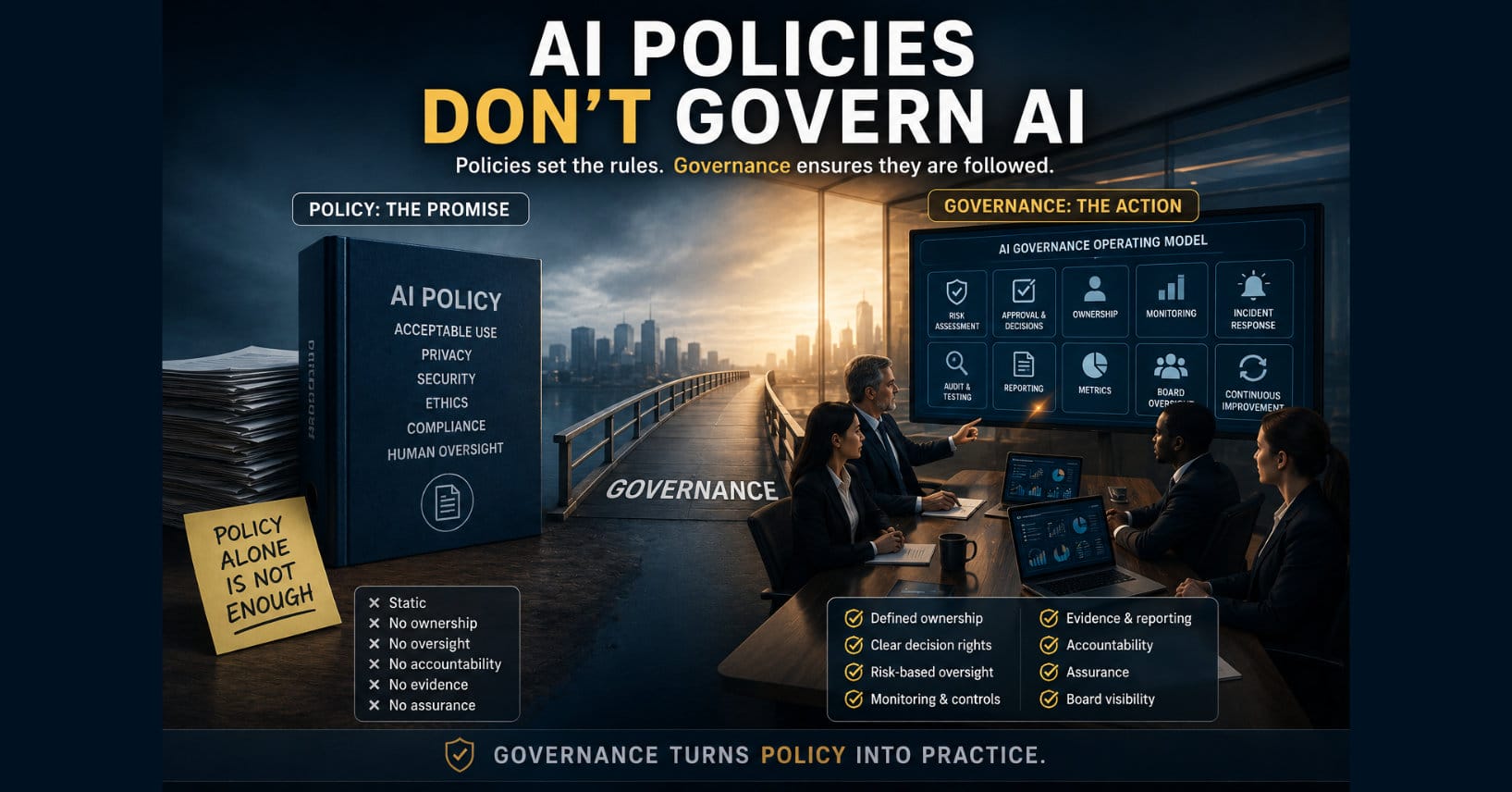
Policies establish expectations.
Governance ensures those expectations are followed.
The difference matters.
Policies Tell People What Should Happen
Governance Determines What Actually Happens
A policy might state:
- AI systems must undergo risk assessments.
- High-risk deployments require approval.
- Human oversight must be maintained.
- Sensitive data must be protected.
- AI outputs must be validated.
Those statements define organizational intent.
They do not prove the organization actually performs those activities.
A beautifully written policy provides no evidence that governance occurred.
Policies Are Static
AI Is Dynamic
Policies are often reviewed annually.
AI changes weekly.
New models emerge.
Business units adopt new tools.
Vendors release new capabilities.
Regulations evolve.
Risks change.
Governance adapts continuously.
Policies alone cannot keep pace with the speed of AI adoption.
Organizations need governance processes that evaluate, approve, monitor, and adjust as technology evolves.
Governance Requires Decisions
Policies rarely answer questions such as:
Who approves a new AI system?
Who determines whether an application is high risk?
Who accepts residual risk?
Who reports significant AI incidents?
Who informs executive leadership?
Who updates the Board?
Those are governance decisions.
Without defined decision rights, even the strongest policy becomes difficult to enforce consistently.
Accountability Cannot Be Written Into Existence
Many AI policies declare that “management is responsible.”
Responsible for what?
Who specifically?
The CIO?
The Chief Data Officer?
The Chief Risk Officer?
The business unit leader?
The AI Governance Committee?
Shared accountability often becomes no accountability.
Effective governance assigns named decision owners for significant activities.
When responsibilities are explicit, accountability becomes measurable.
Governance Produces Evidence
Suppose a regulator asks:
“Show us how your organization approved this AI system.”
Providing a policy manual is only the beginning.
Investigators will likely ask for evidence such as:
- Risk assessments
- Approval records
- Meeting decisions
- Control testing
- Monitoring reports
- Incident logs
- Audit results
- Board reporting
Policies explain what the organization intended to do.
Evidence demonstrates what the organization actually did.
That distinction often determines whether governance appears credible.
Policies Without Oversight Become Shelfware
Organizations frequently invest months developing AI policies.
Then they publish them.
Employees acknowledge reading them.
The documents are stored.
Nothing changes operationally.
No governance committee meets.
No reporting occurs.
No inventory is maintained.
No metrics are reviewed.
No evidence is collected.
The policy exists.
Governance does not.
Effective governance requires ongoing oversight—not simply documented expectations.
Governance Is an Operating Model
Policies are one component of governance.
They work alongside:
- Decision rights
- Risk management
- Executive oversight
- Board reporting
- Control monitoring
- Accountability
- Evidence collection
- Continuous improvement
Removing policies weakens governance.
But relying on policies alone leaves governance incomplete.
Governance is something an organization does every day—not something it publishes once a year.
Boards Should Ask Different Questions
Instead of asking:
“Do we have an AI policy?”
Boards should ask:
Who owns AI governance?
How are new AI systems approved?
How is compliance monitored?
What evidence demonstrates the policy is being followed?
How are exceptions documented?
How often are governance controls reviewed?
Those questions reveal whether governance exists beyond the written document.
Boardroom Takeaway
Policies establish expectations. Governance creates accountability. Organizations become governable not because they publish AI policies, but because they consistently make decisions, assign ownership, monitor outcomes, and generate evidence that those policies are being followed.
Coming Next
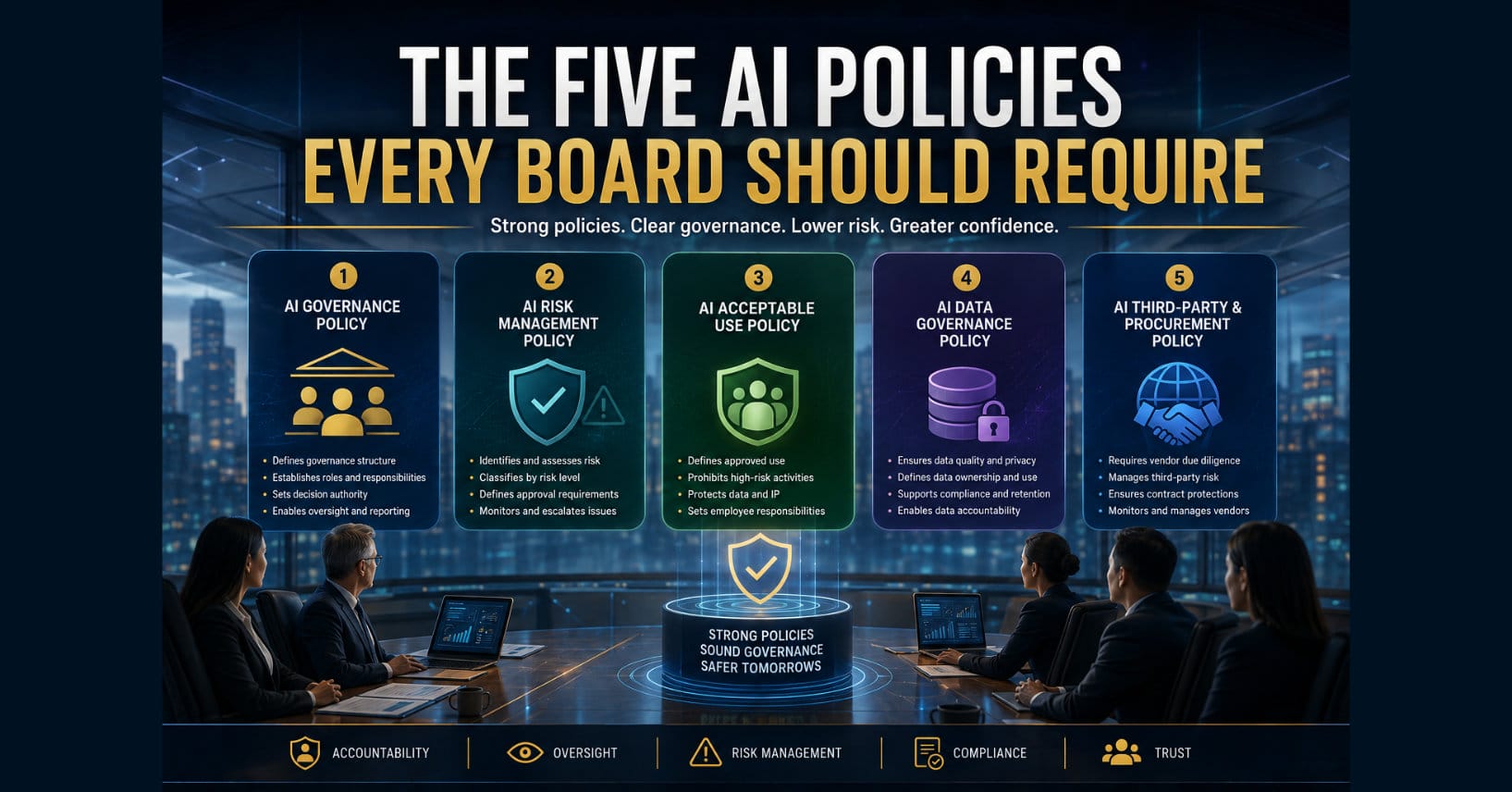
The Five AI Policies Every Board Should Require
Not all AI policies carry equal governance value. The next article identifies the five foundational AI policies every board should require to establish accountability, reduce enterprise risk, and support effective oversight.