Evidentiary Architecture™ Series | Article 11 of 20
Building the Defensible Enterprise through Governance Evidence
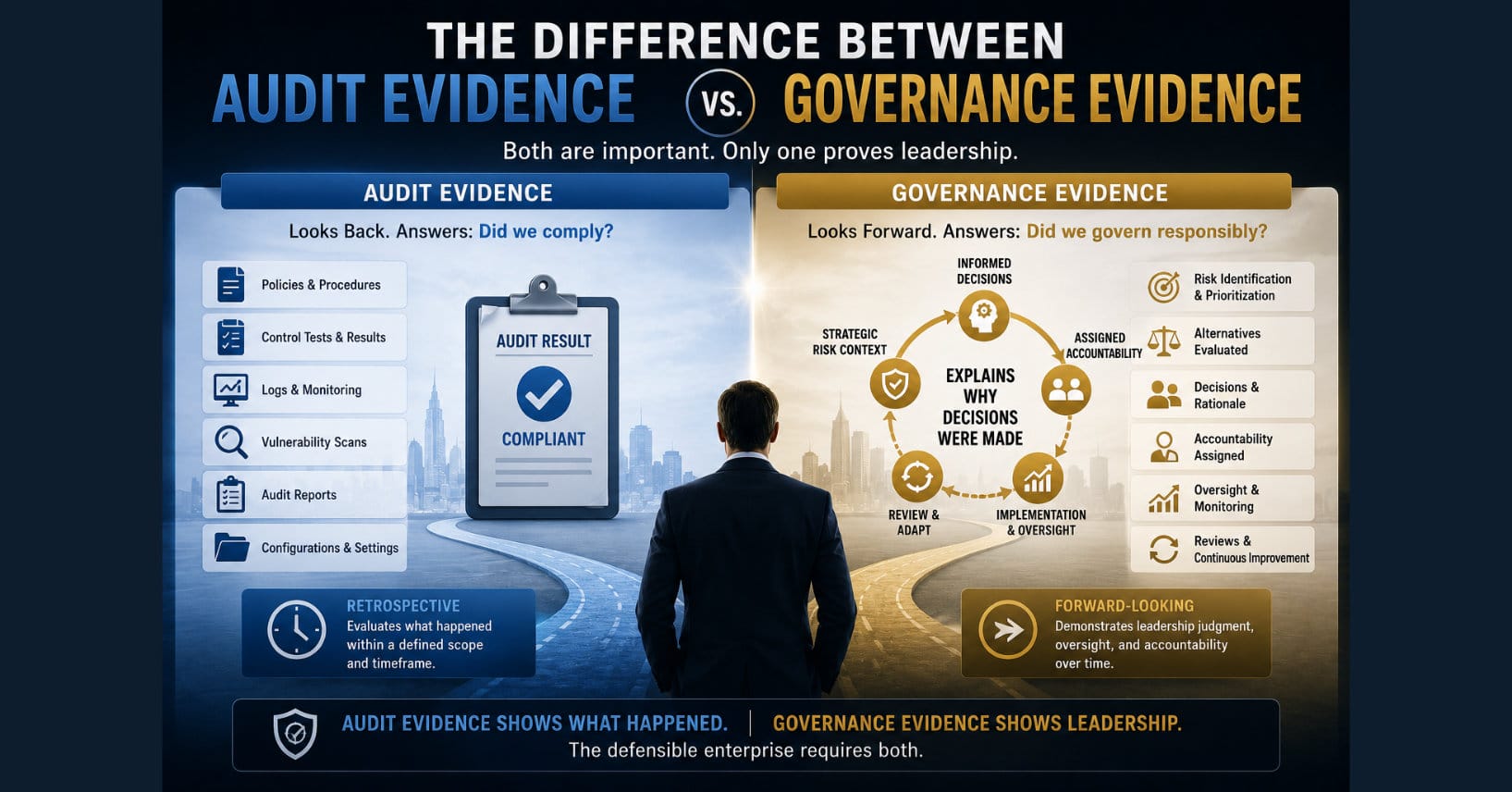
Audit evidence and governance evidence are often treated as interchangeable, but they answer fundamentally different questions. Audit evidence demonstrates whether controls operated effectively within a defined scope and timeframe. Governance evidence explains how leadership identified risk, evaluated alternatives, made decisions, assigned accountability, and exercised ongoing oversight. This article introduces one of the defining concepts of Evidentiary Architecture™: audit evidence supports governance, but governance evidence demonstrates responsible leadership and builds a truly defensible enterprise.
One of the biggest misconceptions in cybersecurity governance is that audit evidence and governance evidence are the same thing.
They are not.
The distinction may seem subtle at first.
In practice, it changes how organizations prepare for audits, respond to regulators, defend litigation, satisfy cyber insurers, and demonstrate board accountability.
Understanding this difference is one of the defining principles of Evidentiary Architecture™.
Audit Evidence Looks Back
Audit evidence exists to answer a specific question:
Did the organization comply with established requirements?
Auditors examine policies.
Control documentation.
System configurations.
Test results.
Sampling.
Logs.
Reports.
Their objective is straightforward.
Determine whether controls operated as expected during a defined period.
Audit evidence is retrospective.
It evaluates what occurred.
Governance Evidence Explains Why
Governance evidence answers a different question.
Did leadership exercise informed, accountable oversight?
That question extends beyond technical controls.
It asks:
- What risks were identified?
- What alternatives were evaluated?
- Why was one decision selected?
- Who possessed decision authority?
- What assumptions influenced leadership?
- How was accountability assigned?
- How was the decision monitored over time?
Governance evidence is not limited to operational effectiveness.
It demonstrates leadership judgment.
Compliance Is Not Governance
Many organizations unintentionally confuse compliance with governance.
A successful audit becomes proof of good governance.
A clean assessment becomes evidence of board oversight.
Neither conclusion is necessarily true.
An organization may comply with every applicable control requirement while making poor governance decisions.
Likewise, leadership may exercise excellent governance while confronting significant technical deficiencies that are actively being addressed.
Compliance measures conformity.
Governance measures leadership.
Those are different disciplines.
An Example
Imagine two organizations.
Both experience the same ransomware attack.
Both maintained identical security controls.
Both pass the same compliance assessment.
After the incident, regulators begin asking questions.
The first organization produces:
- Policies.
- Audit reports.
- Vulnerability scans.
- Control testing results.
The second organization produces all of those materials.
It also demonstrates:
- Why leadership prioritized certain investments.
- Which risks were knowingly accepted.
- How alternative strategies were evaluated.
- How board oversight evolved over time.
- Why resources were allocated where they were.
- How governance decisions were reviewed after implementation.
Both organizations possess audit evidence.
Only one possesses governance evidence.
Audits Have Boundaries
Every audit has scope.
A defined objective.
A defined timeframe.
A defined control population.
A defined testing methodology.
Audit evidence exists within those boundaries.
Governance rarely does.
Governance is continuous.
Boards govern before audits.
During audits.
After audits.
Governance decisions often span years rather than audit cycles.
That is why governance evidence cannot depend solely upon audit evidence.
It must exist independently.
Governance Is About Judgment
Technology can automate many security controls.
It cannot automate leadership judgment.
Only governance determines:
Whether residual risk is acceptable.
Whether investments align with organizational priorities.
Whether accountability has been appropriately assigned.
Whether competing risks were balanced responsibly.
These decisions define governance.
Evidence explaining those decisions becomes governance evidence.
Different Stakeholders Ask Different Questions
Internal auditors ask:
Did the control operate?
Regulators ask:
Did leadership exercise reasonable oversight?
Cyber insurers ask:
Did governance reduce organizational risk?
Courts ask:
Did directors fulfill their fiduciary responsibilities?
Investors ask:
Can leadership demonstrate disciplined risk governance?
Although each stakeholder examines different issues, governance evidence provides the common thread.
It explains the decisions behind the controls.
Governance Evidence Includes Audit Evidence
One important point deserves emphasis.
Governance evidence does not replace audit evidence.
It incorporates it.
Audit findings become one input into governance.
Audit recommendations influence future decisions.
Management responses become governance activities.
Board oversight follows implementation.
Validation confirms effectiveness.
The audit becomes one stage within the broader Governance-to-Evidence Pipeline.
That relationship is critical.
Audit evidence supports governance.
It does not define it.
A Different Standard of Readiness
Organizations often spend enormous effort preparing for audits.
Documentation is organized.
Evidence is collected.
Control owners are briefed.
Testing begins.
That preparation is important.
But governance demands a higher standard.
Leadership should be prepared to explain not only whether controls operated effectively, but why governance decisions were made, how accountability was assigned, and how oversight evolved over time.
That requires governance evidence.
Not merely audit evidence.
The Future of Cyber Governance
As cybersecurity governance continues to mature, organizations will increasingly discover that passing audits is only part of the challenge.
Stakeholders are asking broader questions.
Not simply:
“Did you comply?”
But:
“Can you demonstrate that leadership governed responsibly?”
Those questions require a different kind of evidence.
They require evidence that preserves reasoning.
Judgment.
Accountability.
Oversight.
That is precisely why Evidentiary Architecture™ distinguishes governance evidence from audit evidence.
One demonstrates operational effectiveness.
The other demonstrates responsible leadership.
Modern organizations need both.
Governance Takeaway
Audit evidence demonstrates whether controls operated as intended within a defined scope and timeframe. Governance evidence demonstrates whether leadership exercised informed, accountable oversight before, during, and after those controls were evaluated. Audit evidence supports governance. Governance evidence explains it.
Coming Next
Why Evidence Readiness Beats Compliance Readiness
Many organizations proudly describe themselves as “compliance ready.” But compliance is only one moment in time. In the next article, we’ll explore why evidence readiness is a more durable objective—one that prepares organizations not only for audits, but also for cyber incidents, regulatory inquiries, insurance claims, litigation, and board accountability.