
Executive Brief
A cyberattack against a refrigerated warehouse may never involve stolen customer records, encrypted databases, or a ransom demand.
The attacker may simply change a temperature setting.
A freezer begins warming. A refrigeration controller enters an extended defrost cycle. Temperature monitoring becomes unreliable. Food deteriorates. Medical supplies may become unusable. Equipment may sustain damage.
By the time the organization restores its systems, the most consequential losses may already be irreversible.
On November 5, five U.S. federal agencies issued a joint warning about malicious cyber activity targeting industrial refrigeration and cold-chain monitoring systems worldwide.
The Cybersecurity and Infrastructure Security Agency (CISA), FBI, Department of Health and Human Services, Department of Agriculture, and Department of Transportation warned that attackers are exploiting weaknesses in internet-accessible and unpatched refrigeration controllers.
The affected technologies support food distribution, healthcare, transportation, chemical operations, and other critical infrastructure activities.
The warning follows reported attacks against commercial refrigeration equipment in Europe, where supermarkets experienced temperature manipulation and inventory losses.
But the larger issue extends beyond refrigeration.
When cybersecurity systems control physical processes, a successful cyberattack can produce consequences that technical recovery cannot reverse.
That changes the governance equation.
It also raises an uncomfortable question for boards:
Who is accountable for protecting physical safety when the systems controlling it are vulnerable to cyberattack?
The Attack Surface Is No Longer Confined to IT
Industrial refrigeration systems are not simply appliances connected to electrical power.
Modern installations frequently depend on programmable controllers, remote monitoring platforms, sensors, network connectivity, and centralized management software.
These capabilities improve operational efficiency.
A retailer can monitor refrigeration temperatures across hundreds of stores.
A pharmaceutical distributor can track storage conditions throughout its supply chain.
A hospital can maintain continuous records of temperature-sensitive medical inventory.
A logistics provider can monitor refrigerated transportation equipment remotely.
These are legitimate business capabilities.
But connectivity also introduces cybersecurity exposure.
A controller accessible through the internet may become reachable by unauthorized parties.
Weak authentication can allow attackers to manipulate operating parameters.
Unsupported equipment may contain vulnerabilities that cannot be corrected through ordinary software updates.
Compromised remote-access credentials may provide entry into systems that were never designed to withstand deliberate cyberattacks.
The November 5 federal advisory specifically identifies threats involving electronic temperature controllers and commercial refrigeration controllers.
Attackers may attempt to manipulate temperatures, interfere with defrost cycles, or disrupt the organization’s visibility into actual operating conditions.
The consequences are not limited to information systems.
They can affect the physical environment.
And that is where conventional cybersecurity governance becomes inadequate.
When a Cybersecurity Incident Becomes a Physical Event
Reuters reported that cyberattacks against European supermarkets in early November affected refrigeration and freezer systems across multiple countries.
Affected retailers included operations associated with ICA, Coop, Ahold Delhaize, and Colruyt.
In some locations, refrigeration temperatures increased substantially, forcing businesses to discard affected inventory.
Ireland’s SuperValu also reported a cyber incident affecting refrigeration systems in 13 stores.
These incidents illustrate a critical distinction.
A compromised customer database creates confidentiality and privacy concerns.
A ransomware attack can interrupt business operations.
A manipulated refrigeration system can destroy physical assets while the attack is still underway.
Restoring a controller to its proper operating temperature does not restore spoiled food.
Rebuilding a monitoring platform does not establish that temperature-sensitive pharmaceuticals remained within acceptable storage conditions.
Recovering access to a compromised system does not necessarily eliminate the need to inspect or replace damaged equipment.
The cyber incident may be technically contained while the physical consequences continue.
System restoration and consequence recovery are two different governance obligations.
Boards need visibility into both.
The Physical-Safety Accountability Gap
Consider a refrigerated distribution facility.
The chief information security officer is responsible for cybersecurity.
The chief operating officer is responsible for operational continuity.
The facilities team maintains refrigeration equipment.
A third-party contractor services the controllers.
A separate technology provider operates the remote monitoring platform.
Quality assurance determines whether temperature-sensitive inventory remains suitable for distribution.
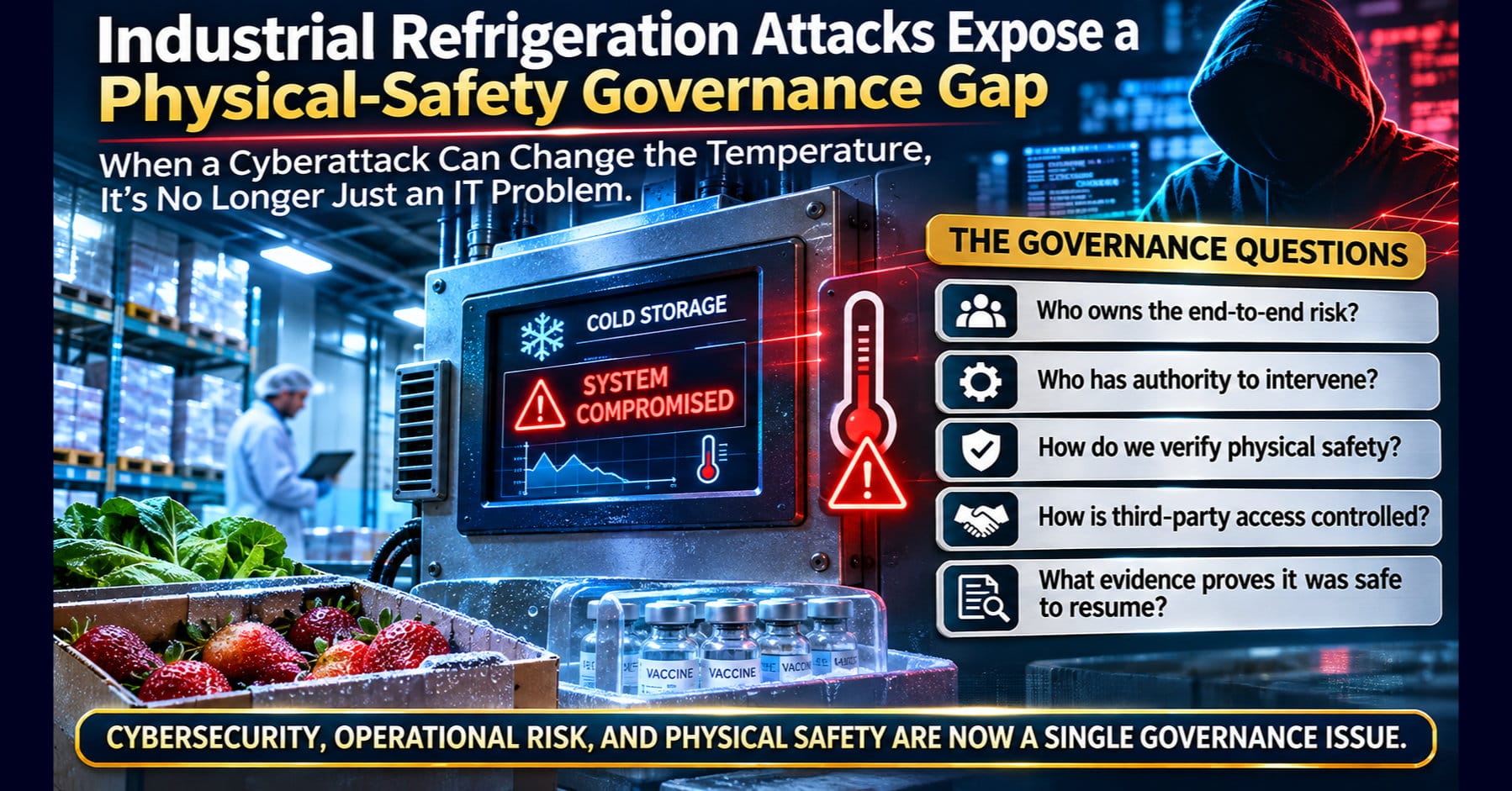
Who owns the cybersecurity risk associated with the refrigeration system?
The answer may depend on whom the organization asks.
The security team may consider the controller an operational technology asset outside its direct management.
Facilities personnel may view cybersecurity as an IT responsibility.
The equipment supplier may consider network security the customer’s obligation.
The monitoring provider may assume that the customer is responsible for securing remote access.
Quality assurance may focus on temperature compliance rather than cybersecurity threats.
Every function has a legitimate responsibility.
Yet the complete risk may remain unowned.
This is a familiar governance failure.
Responsibilities are distributed across organizational boundaries, but accountability for the resulting enterprise exposure has not been clearly established.
The problem becomes especially serious when the affected equipment supports public health, food safety, or critical infrastructure.
A risk does not become someone else’s responsibility merely because the technology crosses an organizational boundary.
Boards should require management to identify who owns the end-to-end risk—not simply who maintains each component.
The Difference Between Availability and Safety
Traditional cybersecurity resilience emphasizes availability.
Can the organization restore the affected system?
How quickly can operations resume?
Were recovery time objectives achieved?
Did the organization successfully restore its backups?
Those questions remain important.
But operational technology introduces additional requirements.
The organization must determine whether the physical process remained safe during the disruption.
A refrigeration controller might be restored within an hour.
Yet the products stored inside may have exceeded allowable temperature limits.
A monitoring system might return to service.
But the organization may lack reliable temperature records for the period during which the system was compromised.
A warehouse may resume normal operation.
But equipment damage or inventory contamination may remain undiscovered.
The appropriate recovery decision therefore requires more than confirmation that the technology works again.
It may require independent temperature verification, inventory inspection, quality-assurance review, equipment testing, and documented authorization to resume distribution.
The governing question is not simply whether the system is available.
It is whether the organization can demonstrate that the physical operation is safe.
A green system-status indicator is not evidence that the products inside the freezer are safe to use.
That distinction should appear explicitly in enterprise resilience reporting.
Why Cybersecurity Standing Orders Need Physical-Safety Guardrails
Earlier this week, I examined how emergency medical services evolved from requiring real-time physician authorization toward standing orders that permit qualified paramedics to act within predefined clinical protocols.
The cybersecurity application is straightforward.
Organizations can establish preauthorized interventions that allow qualified responders to contain known threats without waiting for new executive approval during every incident.
But operational technology introduces an essential complication.
The intervention itself can create physical consequences.
Disconnecting an ordinary office workstation may be relatively straightforward.
Disconnecting an industrial controller could interrupt a critical process.
Disabling a remote-access connection might prevent unauthorized manipulation.
But an indiscriminate network shutdown could also interfere with legitimate monitoring or operational coordination.
The organization must therefore distinguish between interventions that can be safely preauthorized and interventions that require additional operational assessment.
For refrigeration systems, standing cybersecurity orders might authorize immediate revocation of compromised remote-access credentials.
They might permit blocking unauthorized external connections while preserving necessary local control.
They might require automatic escalation when temperature readings exceed defined thresholds or monitoring integrity becomes uncertain.
But any action that could interrupt refrigeration, defeat safety functions, or compromise temperature monitoring must be evaluated against the equipment’s operational requirements.
Those requirements cannot be established by the cybersecurity team alone.
They require participation from operations, engineering, facilities, quality assurance, safety personnel, and relevant equipment suppliers.
The resulting authority model must answer three questions:
What can cybersecurity personnel do immediately?
What requires coordination with operational personnel?
What conditions require an emergency safety response regardless of the cyber incident’s technical status?
That is how standing orders become an instrument of controlled intervention rather than unrestricted automation.
The Monitoring Problem: What Happens When the Temperature Reading Cannot Be Trusted?
The federal warning identifies another particularly important threat: attackers may interfere with visibility into refrigeration conditions.
This creates a problem that ordinary cybersecurity dashboards may not adequately represent.
Suppose the monitoring platform reports that a freezer remains within its approved operating range.
But the controller has been compromised.
Can the organization trust the reported temperature?
What if the attacker has altered the setpoint, manipulated the sensor readings, or disrupted the transmission of monitoring data?
The absence of an alert may no longer demonstrate the absence of a problem.
The organization may need independent means of determining the actual physical condition.
That could include separate temperature sensors, local instrumentation, manual inspection, redundant monitoring, or other controls appropriate to the environment.
The governance implication is significant.
When the system responsible for reporting operational conditions is itself compromised, management cannot rely exclusively on that system to establish safety.
Boards should expect critical infrastructure operators to identify which measurements require independent verification.
This is especially important where an incorrect reading can lead to irreversible loss.
Third-Party Access Is a Physical-Safety Dependency
Industrial equipment frequently requires external maintenance.
Manufacturers and service providers may need remote access to diagnose faults, install updates, adjust operating parameters, or provide emergency support.
These arrangements can be operationally valuable.
They also create dependencies that conventional vendor-risk assessments may underestimate.
A supplier with remote access to a refrigeration controller may possess the technical ability to alter physical operating conditions.
A maintenance account may remain active long after the original service engagement.
A legacy controller may depend on a remote management platform that no longer receives security updates.
An organization may be unable to revoke supplier access without disrupting essential maintenance capabilities.
These are not merely procurement concerns.
They are operational risk and safety concerns.
The relevant governance questions include:
Who authorizes remote access?
Which operating parameters can the supplier change?
How is that access monitored?
Can the organization immediately revoke it?
What happens if the supplier is unavailable during an incident?
Can local personnel safely operate the equipment without the remote service?
And can management demonstrate that revocation actually terminates the supplier’s ability to control the system?
A contract stating that the supplier must protect its systems does not establish that the customer’s physical operations are protected.
Third-party cybersecurity governance must extend to the physical consequences of delegated technical access.
The Insurance Question Boards Should Not Overlook
Industrial refrigeration attacks also introduce complicated financial exposure.
The immediate losses may include spoiled inventory, damaged equipment, business interruption, emergency transportation, replacement supplies, and contractual penalties.
Additional consequences may involve product recalls, regulatory obligations, customer claims, or physical injury.
Boards should not assume that a conventional cyber insurance policy will respond uniformly to all these losses.
Coverage depends on policy wording, applicable exclusions, endorsements, the nature of the incident, and the circumstances of the loss.
Some losses may implicate cyber coverage.
Others may involve property insurance, equipment breakdown coverage, business interruption provisions, or specialized policies.
Physical damage and bodily injury exclusions can be particularly consequential.
The governance responsibility is to understand the relationship between plausible cyber-physical loss scenarios and the organization’s actual insurance arrangements.
Management should evaluate not merely whether the enterprise has cyber insurance, but whether its coverage structure addresses the physical consequences of compromised operational technology.
The board should also understand the organization’s capacity to absorb losses that are excluded, disputed, or exceed policy limits.
Insurance may transfer some financial consequences.
It cannot restore unsafe inventory or reverse every physical outcome.
Evidentiary Architecture™: Proving the Physical Consequences Were Controlled
Cyber-physical incidents require an expanded evidentiary model.
Traditional incident documentation may establish when an intrusion occurred, which accounts were compromised, what systems were affected, and how the threat was contained.
Those records remain necessary.
But they are not sufficient to demonstrate physical safety.
A defensible evidence chain must connect cybersecurity events to operational conditions and verified outcomes.
Cybersecurity Event → Physical Exposure → Intervention Authority → Operational Response → Safety Verification → Disposition Decision → Evidence of Outcome
Consider what each stage must establish.
Cybersecurity Event: What evidence demonstrates that the controller, monitoring platform, or remote-access capability was compromised?
Physical Exposure: Which equipment, inventory, facilities, or processes may have been affected?
Intervention Authority: Who possessed authority to isolate the compromised system, change operating conditions, or initiate emergency procedures?
Operational Response: What actions were performed to contain the threat and protect the physical process?
Safety Verification: What independent measurements, inspections, or tests establish the actual condition of the equipment and affected materials?
Disposition Decision: Who authorized the release, disposal, quarantine, repair, or continued use of affected assets?
Evidence of Outcome: What records demonstrate that the consequences were addressed and the operation could safely resume?
This model prevents an important governance mistake.
Closing the cybersecurity incident does not automatically close the operational risk.
The organization may need to maintain separate but connected records for technical containment, product disposition, equipment integrity, regulatory compliance, and financial loss.
Those records should support a complete reconstruction of the incident.
Not merely what happened to the network.
But what happened to the physical operation the network controlled.
Five Questions Every Board Should Ask
1. Which connected systems can create physical consequences if compromised?
Management should identify operational technology assets whose manipulation could affect safety, inventory integrity, equipment, essential services, or the environment.
2. Who owns the end-to-end risk associated with those systems?
The board should understand how cybersecurity, operations, engineering, facilities, quality assurance, and suppliers share responsibilities—and who is accountable for resolving conflicts.
3. Can the organization intervene without making the physical situation worse?
Management should demonstrate that emergency containment procedures account for operational dependencies, safety constraints, and the consequences of disconnecting or disabling equipment.
4. How does the organization verify physical safety when monitoring systems cannot be trusted?
Boards should require evidence of independent monitoring, inspection, and validation capabilities appropriate to the potential consequences.
5. What evidence is required before affected operations can resume?
Management should establish clear authority for determining when equipment, inventory, and physical processes are safe to return to normal use.
Governance Takeaway: The Physical Consequence Is the Enterprise Risk
The November 5 federal warning is about industrial refrigeration.
But its governance implications extend across the modern enterprise.
Connected systems increasingly control physical processes.
They regulate temperatures, manage energy, operate manufacturing equipment, monitor medical environments, and coordinate transportation infrastructure.
Cybersecurity failures involving these systems can produce consequences that do not disappear when the network is restored.
A damaged machine remains damaged.
Spoiled inventory remains spoiled.
A compromised temperature record may remain unreliable.
An unsafe product does not become safe because the incident response team has closed its ticket.
Boards must therefore expand their understanding of cybersecurity resilience.
The relevant question is not simply whether the organization can recover its technology.
It is whether the organization can prevent, contain, and account for the physical consequences of technological compromise.
That requires clearly assigned risk ownership, operationally informed intervention authority, tested safety procedures, and evidence connecting cybersecurity decisions to verified physical outcomes.
Cybersecurity governance cannot stop at the boundary between digital systems and physical operations.
When technology controls the physical environment, that boundary no longer separates cybersecurity risk from enterprise responsibility.
And when a cyberattack can change the temperature inside a freezer, the board must understand far more than whether the firewall worked.
It must understand who was responsible for keeping the contents safe—and what evidence proves that responsibility was fulfilled.
Sources and Editorial Note
Primary government advisory
Cybersecurity and Infrastructure Security Agency, FBI, Department of Health and Human Services, Department of Agriculture, and Department of Transportation, November 5, 2026.
Additional reporting
Reuters: U.S. Warns of Ongoing Cyber Threat to Industrial Refrigeration Systems
Reuters: New Cyberattack on Supermarket Fridges Sweeps Across Europe
Editorial note: Federal agencies have confirmed ongoing malicious activity targeting refrigeration and cold-chain technologies. The potential consequences identified in the advisory include inventory loss, equipment damage, and fire hazards. References to medical inventory, physical-safety decisions, and governance scenarios illustrate the broader risk implications; they should not be interpreted as claims that every described consequence occurred in the reported attacks. Attribution remains unresolved in the federal advisory.