

Evidentiary Architecture™ Series | Article 4 of 20
Building the Defensible Enterprise through Governance Evidence
Organizations intentionally design enterprise, security, application, and data architectures, yet few have ever designed an architecture for governance evidence. This article introduces the architectural gap at the heart of modern cybersecurity governance and explains why disconnected policies, records, artifacts, and governance activities cannot demonstrate reasonable oversight without an intentional evidence architecture. It lays the foundation for Evidentiary Architecture™ as the next evolution in governance.
Organizations have spent decades designing architecture.
Enterprise architecture aligns business strategy with technology.
Security architecture protects information assets.
Data architecture governs the flow and quality of information.
Cloud architecture optimizes scalability and resilience.
Application architecture defines how software systems interact.
Each discipline answers a fundamental question:
How should this capability be intentionally designed?
Yet one critical capability is almost always missing.
No one designs an architecture for governance evidence.
Instead, organizations assume it will emerge naturally through policies, meeting minutes, audit reports, emails, and countless other documents.
As we’ve seen throughout this series, it usually doesn’t.
That missing discipline is what I call Evidentiary Architecture™.
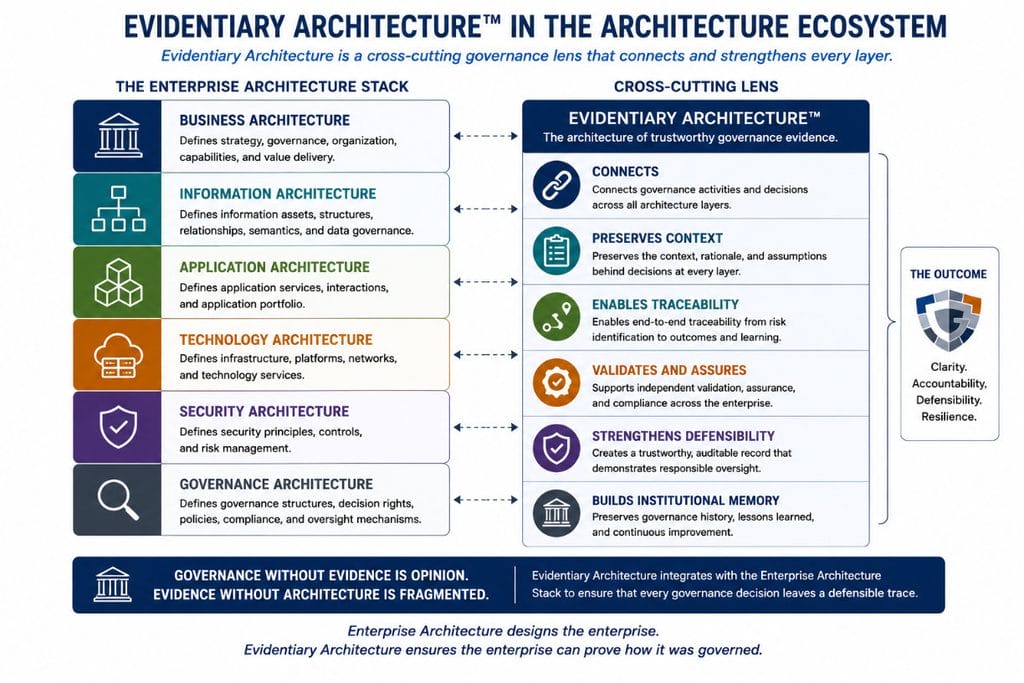
Governance Already Has an Architecture Problem
Most organizations believe governance is a collection of activities.
Board meetings.
Committee reports.
Policies.
Risk reviews.
Compliance assessments.
Internal audits.
These activities are important, but they are not architecture.
Architecture concerns relationships.
It defines how components work together to achieve an intended outcome.
Without architecture, organizations create isolated governance activities rather than an integrated governance system.
The result is predictable.
Good decisions become disconnected from the evidence needed to demonstrate them.
We Designed the Systems—Not the Evidence
Consider a typical cybersecurity program.
The vulnerability management platform generates scan results.
The governance, risk, and compliance (GRC) platform tracks issues.
The ticketing system records remediation work.
The security information and event management (SIEM) platform collects logs.
The board receives quarterly cyber briefings.
Each system performs its intended function.
Each creates documentation, records, or technical artifacts.
But very few organizations ask a much more important question:
How do these systems collectively demonstrate governance?
Most cannot answer.
Not because governance failed.
Because no architecture exists to connect the evidence.
Islands of Information
Imagine looking down from an airplane at an island chain.
Each island is valuable.
Each has people, resources, and infrastructure.
But without bridges, they remain isolated.
The same thing happens inside organizations.
Policies exist in one repository.
Board minutes reside somewhere else.
Risk assessments live in a GRC platform.
Audit reports occupy another system.
Email discussions remain scattered across mailboxes.
Technical artifacts fill security platforms.
Each repository contains valuable information.
Very few are intentionally connected.
Investigators must build the bridges after an incident.
That is an architectural failure.
The Missing Layer
Earlier in this series, we distinguished between documentation, records, artifacts, and governance evidence.
Those distinctions remain important.
Documentation communicates intent.
Records capture events.
Artifacts demonstrate activity.
Governance evidence demonstrates informed, accountable oversight.
The challenge is that these four layers rarely exist within a common design.
Organizations manage them independently.
Documentation teams focus on policies.
Records managers focus on retention.
Security teams manage technical artifacts.
Legal teams preserve discoverable information.
Boards oversee governance.
Everyone performs their individual responsibilities.
Almost no one designs how these components become connected evidence.
That missing design layer is architecture.
Architecture Creates Predictability
Well-designed architecture produces consistent outcomes.
Every payroll cycle generates financial records.
Every customer order produces invoices.
Every accounting transaction creates an audit trail.
These outcomes occur because the systems were intentionally designed to produce them.
Governance should operate the same way.
Every significant governance decision should naturally generate evidence of:
- Decision authority
- Risk evaluation
- Alternatives considered
- Accountability assigned
- Resources allocated
- Review expectations
- Ongoing oversight
If producing those elements depends on someone remembering to save an email or write detailed meeting minutes, the process is not architected.
It is improvised.
Governance Should Not Depend on Memory
One of the greatest weaknesses in post-incident investigations is the reliance on human recollection.
Executives are interviewed.
Board members are questioned.
Committee chairs attempt to remember discussions that occurred months earlier.
Memory is imperfect.
Evidence should not depend upon it.
Well-designed architecture reduces dependence on memory because the evidence already exists.
It was produced when governance occurred.
Not reconstructed afterward.
Beyond Compliance
This is where Evidentiary Architecture™ differs from traditional governance frameworks.
Most governance frameworks describe what organizations should do.
They recommend policies.
They define controls.
They establish responsibilities.
They encourage oversight.
These are valuable objectives.
But they rarely explain how governance should continuously generate defensible evidence as a natural output of the governance process itself.
In other words, they define governance.
They do not architect evidence.
The Next Evolution of Governance
Cybersecurity governance is evolving.
The conversation is moving beyond policies and compliance.
Boards increasingly need to demonstrate that governance functioned as intended.
Regulators expect accountability.
Insurers expect documentation that tells a coherent story.
Investors expect disciplined oversight.
Courts increasingly examine governance decisions—not merely technical failures.
Meeting these expectations requires more than better documentation.
It requires intentional design.
Organizations must begin treating governance evidence as an enterprise asset that deserves the same architectural discipline applied to applications, infrastructure, security, and data.
That discipline is not another compliance framework.
It is a new architectural layer that connects governance activities into a traceable, explainable, and defensible system of evidence.
That is the purpose of Evidentiary Architecture™.
Governance Takeaway
Modern organizations have invested heavily in enterprise, security, application, and data architecture, yet few have designed an architecture for governance evidence. Without that missing layer, documentation, records, artifacts, and governance decisions remain disconnected. A defensible enterprise requires more than governance activities—it requires an intentional architecture that transforms those activities into trustworthy, traceable evidence.
Coming Next
What Is Evidentiary Architecture™?
We’ve established that governance evidence should be created intentionally and that today’s organizations lack an architectural approach for doing so. In the next article, we’ll formally define Evidentiary Architecture™, explore its core principles, and explain how it transforms governance evidence from a collection of disconnected documents into a strategic enterprise capability.