Summary
Continuous cybersecurity testing is transforming enterprise security assurance from periodic assessments into more frequent validation of control effectiveness. Technologies such as breach and attack simulation (BAS), continuous automated red teaming (CART), and exposure validation can identify weaknesses as enterprise environments change.
However, greater visibility creates a corresponding governance responsibility.
When an organization repeatedly detects a control failure, it must determine the business consequences, assign accountability, authorize an appropriate response, and validate the outcome. A finding that remains unresolved without an authorized risk decision can become evidence of a governance deficiency rather than merely an operational backlog item.
The article examines how continuous testing changes the relationship between organizational knowledge and accountability. It distinguishes technical remediation from risk acceptance, explains why recurring control failures may indicate systemic weaknesses, and addresses the limitations of continuous assurance.
It also explores the governance implications of third-party controls, remediation backlogs, intervention authority, and decision latency.
Drawing on NIST’s continuous monitoring guidance, the article introduces the Cyber Governance Center’s Evidentiary Architecture™ progression:
Control Obligation → Continuous Test → Finding → Risk Assessment → Decision Authority → Disposition → Remediation → Validation → Evidence
The central argument is that continuous testing should not simply generate more findings or improve dashboard metrics. It should strengthen the organization’s ability to make timely, authorized, and reconstructable risk decisions.
Continuous testing creates continuous accountability because organizations must govern the risks they now have the capability to detect.
A cybersecurity assessment identifies a critical weakness.
The finding is documented.
Management assigns remediation responsibility.
The responsible team implements a corrective action.
A subsequent assessment confirms that the weakness has been addressed.
The issue is closed.
Six months later, a configuration change reintroduces the same exposure.
Nobody notices.
The organization continues operating under the assumption that the control remains effective.
Then an incident occurs.
Investigators discover that the previously remediated weakness had returned.
The organization produces its earlier assessment report.
It demonstrates that the weakness was identified.
It demonstrates that corrective action was taken.
It demonstrates that the control passed a subsequent test.
But it cannot establish when the control became ineffective again.
It cannot demonstrate whether the failure was detected.
It cannot explain why the condition remained unresolved.
And it cannot identify who possessed authority to accept the resulting exposure.
The earlier assessment was accurate.
The organization’s current understanding of its cybersecurity posture was not.
A control that passed yesterday’s test is not necessarily effective today.
This distinction is becoming increasingly important as cybersecurity testing evolves from periodic assessments toward continuous validation.
Automated attack simulation, exposure validation, security control testing, and other continuous assurance capabilities can identify weaknesses as enterprise environments change.
But they also introduce a consequential governance question.
When an organization can continuously discover that a control is ineffective, what responsibility does it have to act on that knowledge?
The answer extends beyond cybersecurity operations.
Continuous testing creates continuous evidence.
Continuous evidence creates recurring opportunities for risk decisions.
And those decisions require identifiable authority, accountability, and defensible outcomes.
The End of Point-in-Time Assurance
Traditional cybersecurity assurance frequently relies on periodic activities.
An annual penetration test.
A quarterly vulnerability assessment.
A scheduled control review.
A compliance audit.
A red-team exercise.
A third-party security assessment.
These activities provide valuable information.
They can identify weaknesses, validate assumptions, and support regulatory or contractual requirements.
But they share an inherent limitation.
They evaluate the environment within a defined scope and period.
The organization may change immediately afterward.
New applications are deployed.
Cloud configurations are modified.
Employees receive additional permissions.
Vendors establish new integrations.
Security tools are updated.
Infrastructure is retired or replaced.
AI agents receive expanded authority.
And vulnerabilities emerge in previously trusted components.
A point-in-time assessment cannot establish that every relevant control remains effective indefinitely.
That does not make periodic assessments obsolete.
It means their findings must be interpreted within the boundaries of what was actually tested.
A penetration test completed in March may provide strong evidence concerning the systems and attack paths examined in March.
It does not automatically establish the effectiveness of those controls in October.
The governance problem arises when organizations treat historical assurance as proof of current control effectiveness.
An assessment report is evidence of what was tested. It is not a permanent certification of the environment.
Continuous Testing Changes the Evidence Available to Management
Continuous cybersecurity testing takes several forms.
Some technologies repeatedly validate whether known vulnerabilities are exploitable.
Others simulate attacker techniques against security controls.
Some evaluate potential attack paths across enterprise infrastructure.
Others test identity configurations, endpoint defenses, cloud security controls, or network segmentation.
The terminology varies.
Breach and attack simulation, commonly abbreviated BAS, generally refers to technologies that emulate attacker behaviors to evaluate whether security controls detect or prevent them.
Continuous automated red teaming, or CART, extends automated adversarial testing across selected attack scenarios.
Continuous Threat Exposure Management, or CTEM, describes a broader risk management approach involving scoping, discovery, prioritization, validation, and mobilization.
These approaches are related, but they are not interchangeable.
CTEM is a management process rather than simply a testing product.
BAS and automated red teaming provide specific technical validation capabilities.
Exposure validation helps determine whether identified weaknesses create meaningful attack opportunities.
Together, these capabilities can provide more frequent evidence about the organization’s actual security posture.
The important development is not that testing becomes automated.
It is that management may receive evidence of control failure much closer to the moment the failure occurs.
That changes the relationship between detection and accountability.
When an organization conducts an annual assessment, a weakness may remain undiscovered for months.
When the same organization conducts frequent automated validation, a comparable weakness may be detected much sooner.
The availability of that information creates an opportunity to respond.
It also creates a record of what management knew.
The Dashboard Becomes an Evidence Repository
Consider a company using continuous security validation to evaluate its identity infrastructure.
On Monday, automated testing confirms that a privileged-access control prevents an unauthorized escalation path.
On Tuesday, an administrator modifies a configuration to support a legitimate operational requirement.
On Wednesday, automated testing identifies that the change has created a path to privileged access.
The system records the failed test.
It identifies the affected control.
It assigns a severity rating.
It generates an alert.
The security team receives the finding.
The organization now possesses evidence that a previously effective control is no longer operating as intended.
That evidence may become consequential.
If the condition remains unresolved and an incident subsequently exploits the weakness, investigators may examine the original alert.
They may ask when the exposure was identified.
Who received the notification?
Was the finding validated?
Who owned the affected system?
Was remediation initiated?
Did management understand the business consequences?
Was the risk formally accepted?
And was the control retested after corrective action?
The dashboard that originally served as an operational monitoring tool may become evidence of organizational knowledge.
Continuous testing does not merely increase visibility. It creates a more detailed chronology of what the organization knew about its security weaknesses.
That chronology can strengthen governance when the organization responds appropriately.
It can also expose governance deficiencies when findings remain unresolved.
Discovery Is Not Remediation
One of the most important distinctions in cybersecurity governance is the difference between identifying a weakness and resolving the associated risk.
Continuous testing can make discovery more efficient.
It cannot independently guarantee remediation.
An automated platform may identify hundreds of weaknesses.
Some may be technically severe but have limited business consequences.
Others may appear moderate yet expose critical business processes.
Some may require immediate correction.
Others may require architectural changes, compensating controls, or formally accepted residual risk.
The organization must determine what matters.
That requires more than a technical severity score.
It requires understanding the affected asset, the business process it supports, the relevant threat scenario, existing controls, potential consequences, and available response options.
Suppose continuous testing identifies a weakness in an internal development environment.
The finding receives a high severity rating.
The environment is isolated, contains no production data, and has limited connectivity.
Now suppose the same testing identifies a moderate-severity weakness in a system supporting payment processing.
The second finding may create greater enterprise exposure despite its lower technical rating.
The governance process must distinguish technical severity from business risk.
It must also identify who possesses authority to make the resulting disposition decision.
Continuous testing can tell management that a control failed. It cannot independently determine whether the organization should remediate, mitigate, suspend operations, or accept the risk.
Those remain governance decisions.
The Remediation Backlog Becomes a Governance Record
Every organization has competing priorities.
Cybersecurity teams cannot necessarily remediate every finding immediately.
Some corrective actions require system downtime.
Others depend on vendors.
Some involve legacy infrastructure.
Others require substantial investment.
The existence of a remediation backlog is not inherently evidence of governance failure.
The problem arises when the backlog contains significant exposures without clear ownership, authorized disposition, or meaningful reassessment.
Continuous testing makes that distinction more visible.
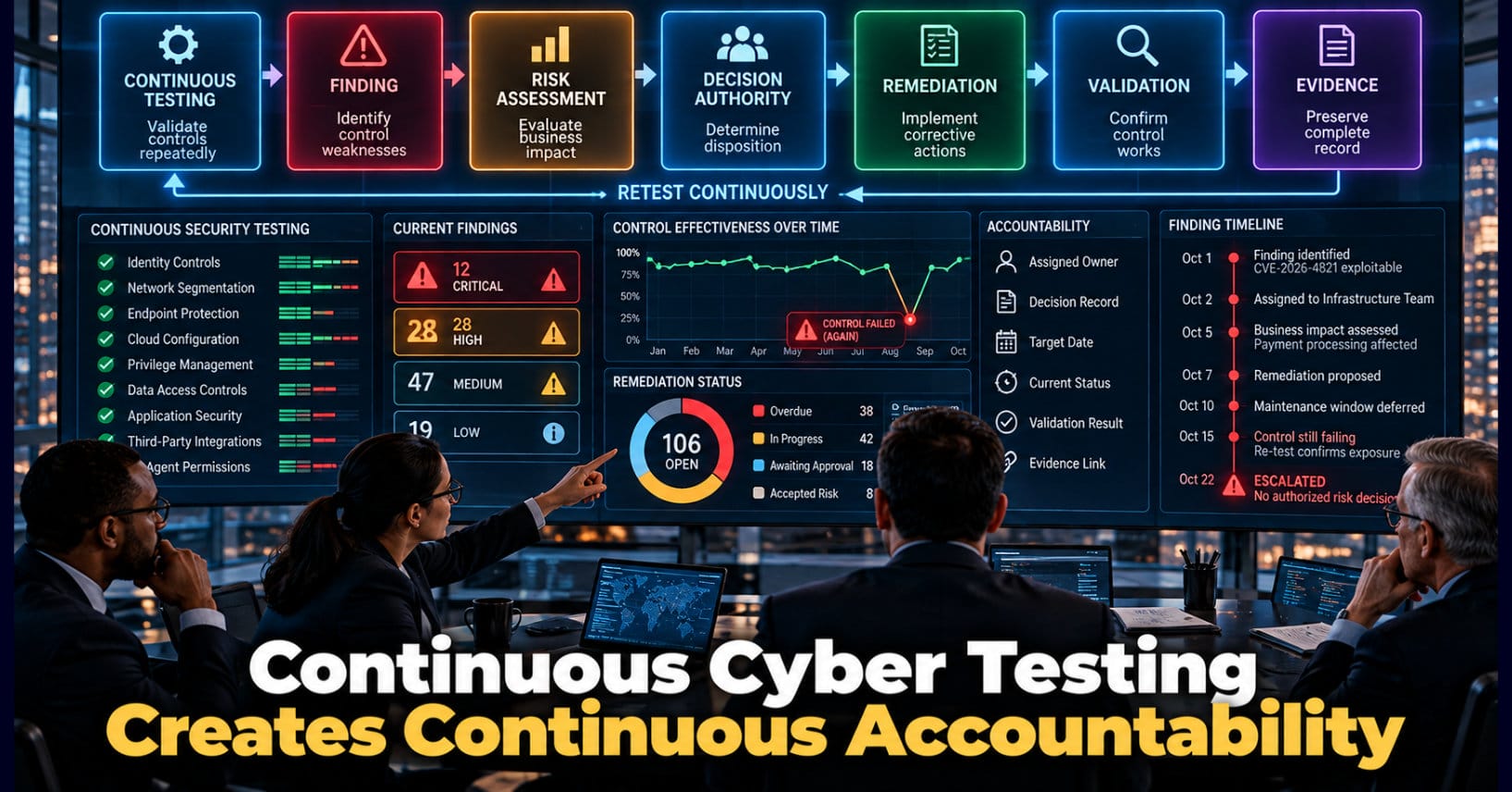
Imagine an organization that identifies a critical exposure on October 1.
The finding is assigned to an infrastructure team.
On October 3, the team determines that remediation will require a major application upgrade.
On October 5, the business owner rejects the proposed maintenance window.
On October 8, security testing confirms that the weakness remains exploitable.
On October 12, another test produces the same result.
By October 20, the condition remains unresolved.
The organization has not simply accumulated a technical finding.
It has accumulated a sequence of evidence.
The exposure was discovered.
The technical consequence was validated.
Remediation was proposed.
A business constraint prevented corrective action.
Repeated testing confirmed that the weakness persisted.
At what point should the decision move beyond the technical team?
Who has authority to accept the continued exposure?
What compensating controls are required?
When must the decision be reconsidered?
And what evidence demonstrates that the organization made a deliberate risk decision rather than allowing the finding to remain unresolved through organizational inertia?
This is where continuous testing becomes continuous accountability.
The backlog is no longer merely a list of technical tasks.
It is a record of unresolved enterprise risk decisions.
The Governance Problem Is Not the Number of Findings
Continuous testing can produce substantial volumes of technical evidence.
That creates a risk of confusing activity with effectiveness.
An organization may report that it conducted 50,000 automated tests during the quarter.
It may demonstrate that 98 percent of tested controls passed.
It may report that thousands of findings were automatically assigned to remediation teams.
These metrics can be useful.
But they do not independently establish effective governance.
A 98 percent success rate may conceal a failed control protecting the organization’s most critical business process.
Thousands of assigned findings may remain unresolved.
Automated ticket creation may demonstrate workflow activity without establishing that anyone evaluated the resulting risk.
And a control may pass repeated tests while remaining vulnerable to attack techniques outside the testing program’s scope.
Boards should therefore distinguish testing activity from governance outcomes.
The relevant questions are not simply how many tests were performed or how many findings were generated.
They include whether consequential weaknesses were identified, whether the organization understood their business implications, whether authorized decisions followed, and whether corrective actions achieved the intended results.
Continuous testing should improve the quality and timeliness of risk decisions, not merely increase the volume of cybersecurity reporting.
Continuous Does Not Mean Comprehensive
There is another important limitation.
Continuous testing is not equivalent to comprehensive assurance.
Every testing program operates within a defined scope.
It evaluates particular systems, configurations, controls, attack techniques, and assumptions.
A successful test establishes something about the condition tested.
It does not establish that every possible failure mode has been eliminated.
Consider an organization using automated attack simulation.
The platform repeatedly validates that endpoint protection blocks a defined set of malicious behaviors.
That is valuable evidence.
But it may not establish whether the organization can detect a novel attack technique, whether its incident response team can coordinate effectively under pressure, or whether a critical third-party dependency can be restored following a major disruption.
Similarly, an automated network segmentation test may establish that a prohibited connection was blocked.
It does not necessarily establish that privileged identities are appropriately governed or that recovery procedures will function during a crisis.
Testing coverage therefore requires governance.
Management should understand what is being tested, what is excluded, how frequently testing occurs, and which assumptions limit the conclusions.
It should also determine whether significant changes in the enterprise require changes to the testing program.
An organization that continuously tests an incomplete control population may develop a false sense of assurance.
Continuous evidence is valuable only when management understands what that evidence does—and does not—establish.
NIST Already Connects Continuous Monitoring to Risk Decisions
The governance relationship between ongoing assessment and organizational accountability is not a new concept.
NIST Special Publication 800-137, Information Security Continuous Monitoring for Federal Information Systems and Organizations, established a framework for maintaining ongoing awareness of security controls, threats, vulnerabilities, and organizational risk.
The publication emphasizes using monitoring information to support timely risk responses when controls prove inadequate.
NIST SP 800-53 similarly addresses continuous monitoring through control CA-7.
The control encompasses ongoing assessment of control effectiveness, analysis of monitoring information, response actions, and reporting to designated organizational officials.
The important point is that monitoring is connected to decision-making.
NIST does not describe continuous monitoring merely as collecting technical data.
Its framework connects monitoring results to organizational risk management.
This distinction is central to the Cyber Governance Center’s perspective.
A continuous testing program that identifies control failures but lacks an effective mechanism for responding to them has not completed the governance process.
The technical assessment may be functioning correctly.
The organizational response may not be.
A Control Can Fail More Than Once
Consider a privileged-access control that repeatedly fails automated validation.
The first failure occurs because of a configuration error.
The responsible team corrects the configuration.
A subsequent test confirms that the control operates as intended.
Three weeks later, a software update reintroduces the weakness.
The control fails again.
Management remediates the condition.
A month later, another operational change produces a similar failure.
At this point, the organization should question more than the individual configuration.
Why does the same control repeatedly become ineffective?
Is the change management process inadequate?
Are configuration standards insufficient?
Does the architecture permit unauthorized changes?
Are compensating controls necessary?
Should the underlying system be redesigned?
Repeated control failure may indicate a systemic governance weakness.
The appropriate response may therefore require more than another remediation ticket.
Management may need to examine the control’s design, ownership, dependencies, and operating environment.
It may also need to reconsider previously accepted risks.
This is where continuous testing becomes particularly valuable.
A periodic assessment might identify each failure as an isolated event.
Continuous evidence can reveal the pattern.
A recurring technical failure may be evidence of a persistent governance deficiency.
The organization should have a mechanism for recognizing when repeated exceptions require escalation beyond routine operations.
Remediation Closure Is Not the Same as Risk Closure
A finding may be marked remediated because a technical team completed its assigned work.
That does not necessarily establish that the associated risk has been resolved.
Suppose automated testing identifies an exploitable path between a development environment and a critical production application.
The infrastructure team modifies a firewall rule.
The remediation ticket is closed.
But no subsequent test validates whether the attack path has been eliminated.
The organization has evidence of a configuration change.
It does not yet have evidence that the intended security outcome was achieved.
Now suppose the control passes the next test.
That provides stronger evidence.
But another question remains.
Did the corrective action address the full exposure, or only one path identified by the testing platform?
Was the relevant business risk reduced to an acceptable level?
Were any compensating controls removed?
Did the remediation introduce new operational dependencies?
These questions demonstrate why remediation closure and risk closure should be distinguished.
The technical team may establish that its assigned corrective action was completed.
The appropriate risk owner must determine whether the resulting exposure is acceptable.
In some organizations, those responsibilities may be exercised through an integrated workflow.
But the underlying authorities remain distinct.
A completed remediation task is not automatically an authorized risk disposition.
Continuous validation should strengthen the connection between corrective action and verified outcome.
It should not eliminate the need for legitimate risk acceptance.
Who Owns a Control That Spans Multiple Organizations?
Modern enterprise controls frequently depend on external services.
Cloud providers.
Managed security service providers.
Software vendors.
Identity platforms.
Network operators.
Business process outsourcers.
An organization may rely on a third party to operate a control that protects its own critical business processes.
Continuous testing can expose weaknesses in those arrangements.
Suppose automated validation identifies that a managed security service is failing to detect a particular attack technique.
The vendor acknowledges the finding and begins remediation.
Two weeks later, the vendor reports that its detection configuration has been updated.
From the vendor’s perspective, the issue may be closed.
But has the customer validated the outcome?
Has the customer evaluated whether the undetected activity created exposure during the period of control failure?
Were compensating measures necessary?
Does the customer need to reassess its own risk acceptance?
The distinction is important:
Vendor Remediation Status ≠ Customer Risk Resolution Status
A vendor can complete corrective action while the customer still has unresolved governance responsibilities.
Continuous testing provides an opportunity to verify that the service actually delivers the intended protection.
But it also creates evidence that the customer must evaluate.
The customer cannot assume that a vendor’s remediation statement independently establishes that its own risk has been resolved.
Continuous Testing Requires Defined Intervention Authority
Some testing findings warrant routine remediation.
Others may indicate conditions requiring immediate intervention.
Consider an automated validation platform that confirms an externally accessible path to a critical financial system.
The exposure is active.
The affected system supports essential business operations.
The responsible technical team cannot immediately eliminate the weakness without disrupting a major customer service.
Who decides what happens next?
Does the organization restrict access?
Does it suspend the affected service?
Does it implement emergency compensating controls?
Does it continue operations while accepting the exposure?
And who possesses authority to make that decision?
A continuous testing platform can identify the condition.
It may even recommend corrective action.
But the organization must establish intervention authority.
This is particularly important when the appropriate response creates competing risks.
Disabling a critical service may reduce cybersecurity exposure while causing substantial operational harm.
Continuing operations may preserve service availability while accepting increased security risk.
The decision requires authorized judgment.
That authority should be defined before the organization confronts the condition.
Otherwise, continuous testing may identify a significant weakness faster than management can determine who is empowered to respond.
Detection without intervention authority is visibility without sufficient governance control.
Continuous Assurance Must Include Decision Latency
Organizations commonly measure how quickly vulnerabilities are remediated.
Mean time to remediate is a useful operational metric.
But it does not reveal every governance delay.
Consider the sequence between discovering a significant exposure and resolving it.
The finding is detected.
It is validated.
The business consequences are assessed.
A decision-maker is identified.
A disposition is authorized.
Corrective action is initiated.
The outcome is verified.
Delays can occur at every stage.
A finding may remain unvalidated.
The technical team may struggle to identify the business owner.
The business owner may lack authority to accept the risk.
A remediation proposal may await funding.
A vendor may delay corrective action.
A completed fix may remain untested.
A single remediation metric can conceal these distinctions.
Continuous testing creates an opportunity to measure decision latency as well as technical remediation time.
Organizations can examine how long significant findings remain without an assigned owner.
How long they await risk assessment.
How long disposition decisions remain pending.
How frequently accepted risks exceed their review dates.
How often remediation is completed without validation.
And how frequently previously closed findings recur.
These measures can reveal governance bottlenecks that traditional vulnerability metrics overlook.
The objective is not to create another executive dashboard filled with operational statistics.
It is to determine whether the organization can make consequential risk decisions at the speed its exposure requires.
The Evidentiary Architecture of Continuous Accountability
The Cyber Governance Center’s Evidentiary Architecture™ provides a structured way to connect continuous testing with governance decisions.
For continuous cyber assurance, the progression becomes:
Control Obligation → Continuous Test → Finding → Risk Assessment → Decision Authority → Disposition → Remediation → Validation → Evidence
Each stage has a distinct purpose.
Control Obligation
The organization establishes why the control exists.
The obligation may arise from law, regulation, contract, policy, enterprise risk requirements, or an authorized management decision.
Continuous Test
The organization evaluates whether the control operates as intended within the defined testing scope.
The test should have an identifiable objective, method, configuration, and execution record.
Finding
The testing process identifies a potential control weakness.
The organization determines whether the finding is valid and relevant.
Risk Assessment
Management evaluates the finding’s business consequences, considering affected assets, dependencies, threat scenarios, existing protections, and potential impact.
Decision Authority
The appropriate individual or governance body determines how the exposure will be addressed.
The decision-maker must possess authority consistent with the nature and magnitude of the risk.
Disposition
The organization records whether the risk will be remediated, mitigated, transferred where appropriate, avoided, or accepted.
The rationale and any conditions should be documented.
Remediation
Responsible teams implement the approved corrective action.
Validation
The organization tests whether the corrective action achieved its intended outcome.
Validation may also identify residual exposure requiring further action.
Evidence
The organization preserves the records necessary to reconstruct the process.
The evidence should connect the original obligation to the test, finding, decision, response, and outcome.
This architecture is not merely a workflow.
It establishes the relationship between operational knowledge and organizational accountability.
The Defensible Evidence Framework™ reinforces the importance of preserving those relationships in a manner that supports independent examination.
A completed ticket is useful evidence.
A complete governance record explains why the ticket existed, what decision authorized the response, and whether the intended result was achieved.
What a Board Should Expect From Continuous Assurance
Boards should not receive every automated testing result.
Nor should directors be expected to interpret individual exploit paths or security tool configurations.
Management remains responsible for operating the cybersecurity program.
The board’s role is to oversee whether the program provides reliable assurance about material enterprise risk.
Continuous testing can improve that assurance.
But only if reporting distinguishes technical activity from governance outcomes.
Directors should understand whether management has defined the scope of continuous testing.
They should know whether critical business processes and their supporting controls receive appropriate coverage.
They should expect significant control failures to be evaluated through established risk authority.
They should understand whether remediation backlogs contain material unresolved exposures.
They should receive information about recurring failures, persistent exceptions, and significant delays in risk disposition.
And they should expect management to demonstrate that corrective actions were validated.
Several questions deserve particular attention.
Can management identify critical controls that repeatedly fail testing?
Are significant findings assigned to accountable business owners?
Does every material unresolved exposure have an authorized disposition?
Can management distinguish findings awaiting remediation from risks deliberately accepted?
Are vendor-controlled weaknesses independently evaluated from the customer’s perspective?
Does the organization know how long significant findings remain without a decision?
And can management reconstruct the complete sequence from detection through validated outcome?
These questions provide a more meaningful basis for board oversight than the number of automated tests conducted.
The Difference Between Continuous Monitoring and Continuous Governance
Continuous monitoring observes conditions.
Continuous testing evaluates whether controls function as intended.
Continuous governance ensures that consequential findings receive appropriate decisions and responses.
These capabilities are related.
They are not identical.
An organization may continuously monitor its environment without validating whether its controls can resist relevant attack techniques.
It may continuously test controls without establishing who must respond to significant failures.
It may automatically remediate certain findings without preserving evidence that the actions were authorized or effective.
And it may maintain extensive evidence without demonstrating that the resulting risk decisions were appropriate.
The mature enterprise connects these capabilities.
Monitoring identifies changes.
Testing evaluates control effectiveness.
Risk assessment establishes significance.
Decision authority determines disposition.
Operational teams implement the response.
Validation establishes the outcome.
Evidence preserves the chain.
The governance objective is not to eliminate human judgment through automation.
It is to ensure that automation provides timely, reliable information to the people and processes responsible for consequential decisions.
Continuous governance does not mean executives make decisions continuously. It means the organization remains capable of making authorized decisions whenever significant new evidence requires them.
The Next Cybersecurity Failure May Be Fully Documented
Imagine a major cybersecurity incident occurring in an organization with mature continuous testing capabilities.
Investigators review the evidence.
They discover that the exploited weakness was identified three months earlier.
The testing platform generated repeated alerts.
The finding appeared in weekly security reports.
A remediation ticket was created.
The responsible team documented an operational dependency.
The proposed corrective action was deferred.
Subsequent testing confirmed that the exposure remained.
No authorized risk acceptance was recorded.
No compensating control was validated.
No executive escalation occurred.
The incident was not caused by an unknown vulnerability.
The organization possessed extensive evidence of the condition.
The failure occurred between knowledge and action.
That is the uncomfortable consequence of continuous testing.
It can make an organization’s cybersecurity weaknesses more visible.
But it can also make failures of accountability more visible.
The evidence may demonstrate that the technical monitoring program worked.
It may simultaneously demonstrate that the governance process did not.
The next major cybersecurity failure may not be a failure to detect a weakness. It may be a failure to govern a weakness that was repeatedly detected.
Continuous Testing Changes the Standard of Accountability
Periodic assessments remain valuable.
They provide structured examinations, independent perspectives, and evidence supporting assurance obligations.
Continuous testing adds another dimension.
It creates a more current understanding of selected controls and exposures.
It identifies changes that may invalidate earlier assumptions.
It reveals recurring weaknesses.
It supports more timely corrective action.
And it provides evidence of how long significant conditions persisted.
But the real governance value emerges only when those findings influence authorized decisions.
An organization should be able to demonstrate what was tested.
What failed.
When the failure became known.
What business risk it created.
Who possessed authority to respond.
What decision was made.
What corrective action followed.
And whether the outcome was validated.
That is the distinction between continuous testing and continuous accountability.
The former produces evidence.
The latter establishes what the organization did with it.
When an enterprise continuously tests its controls, it must be prepared to continuously govern the risks those tests reveal.
The Cyber Governance Center Perspective
Continuous cybersecurity testing is changing the evidence available to enterprise leadership.
Organizations can increasingly identify control failures, validate exposures, and observe recurring weaknesses without waiting for scheduled assessments.
That capability creates an opportunity to improve resilience.
It also creates a stronger evidentiary record of organizational knowledge.
The Cyber Governance Center’s Defensible Evidence Framework™ and Evidentiary Architecture™ connect that knowledge to decision authority, risk disposition, corrective action, and validated outcomes.
The objective is not to require immediate remediation of every finding.
It is to ensure that significant exposures receive timely, authorized, and reconstructable decisions.
A control failure can be discovered automatically.
Its business consequences still require judgment.
Its disposition still requires authority.
And its resolution still requires evidence.
Continuous testing creates continuous accountability because the organization must govern what it now has the capability to know.
Clarity. Accountability. Defensibility.
Sources and Further Reading
National Institute of Standards and Technology — September 2011
Information Security Continuous Monitoring for Federal Information Systems and Organizations (NIST SP 800-137).
Foundational guidance connecting continuous security monitoring with organizational risk tolerance, control effectiveness, and timely risk response.
National Institute of Standards and Technology — SP 800-53, Revision 5
Security and Privacy Controls for Information Systems and Organizations.
Control CA-7 addresses continuous monitoring, including ongoing assessments, analysis of monitoring information, response actions, and reporting to designated organizational officials.
National Institute of Standards and Technology — May 2020
Assessing Information Security Continuous Monitoring Programs (NIST SP 800-137A).
Guidance for evaluating the effectiveness and completeness of organizational continuous monitoring programs.
National Institute of Standards and Technology
Guide for Assessing Security and Privacy Controls in Information Systems and Organizations (NIST SP 800-53A, Revision 5).
Assessment guidance addressing how organizations examine, interview, and test to determine whether security and privacy controls operate as intended.
National Institute of Standards and Technology — February 2024
The NIST Cybersecurity Framework (CSF) 2.0.
Framework connecting cybersecurity governance, identification, protection, detection, response, and recovery with enterprise risk management.
MITRE
MITRE ATT&CK.
Knowledge base documenting adversary tactics and techniques that can inform threat-informed security validation and adversarial testing.