AI Governance Series | Article 5 of 20
Governing Intelligence Before It Governs You
Summary: Many organizations measure AI risk through technical metrics such as accuracy, precision, and model performance. Boards, however, must govern something much broader: enterprise risk. This article explains why AI affects finance, legal, cybersecurity, operations, human resources, reputation, and strategy, making AI governance a business responsibility rather than simply a technology concern. Effective oversight requires understanding the organizational consequences of AI—not just how well the model performs.
When organizations discuss AI risk, the conversation usually begins with the model.
Is it accurate?
Does it hallucinate?
Is it biased?
Can it be manipulated?
These are important questions.
They are not the first questions a board should ask.
Boards do not govern models.
They govern enterprises.
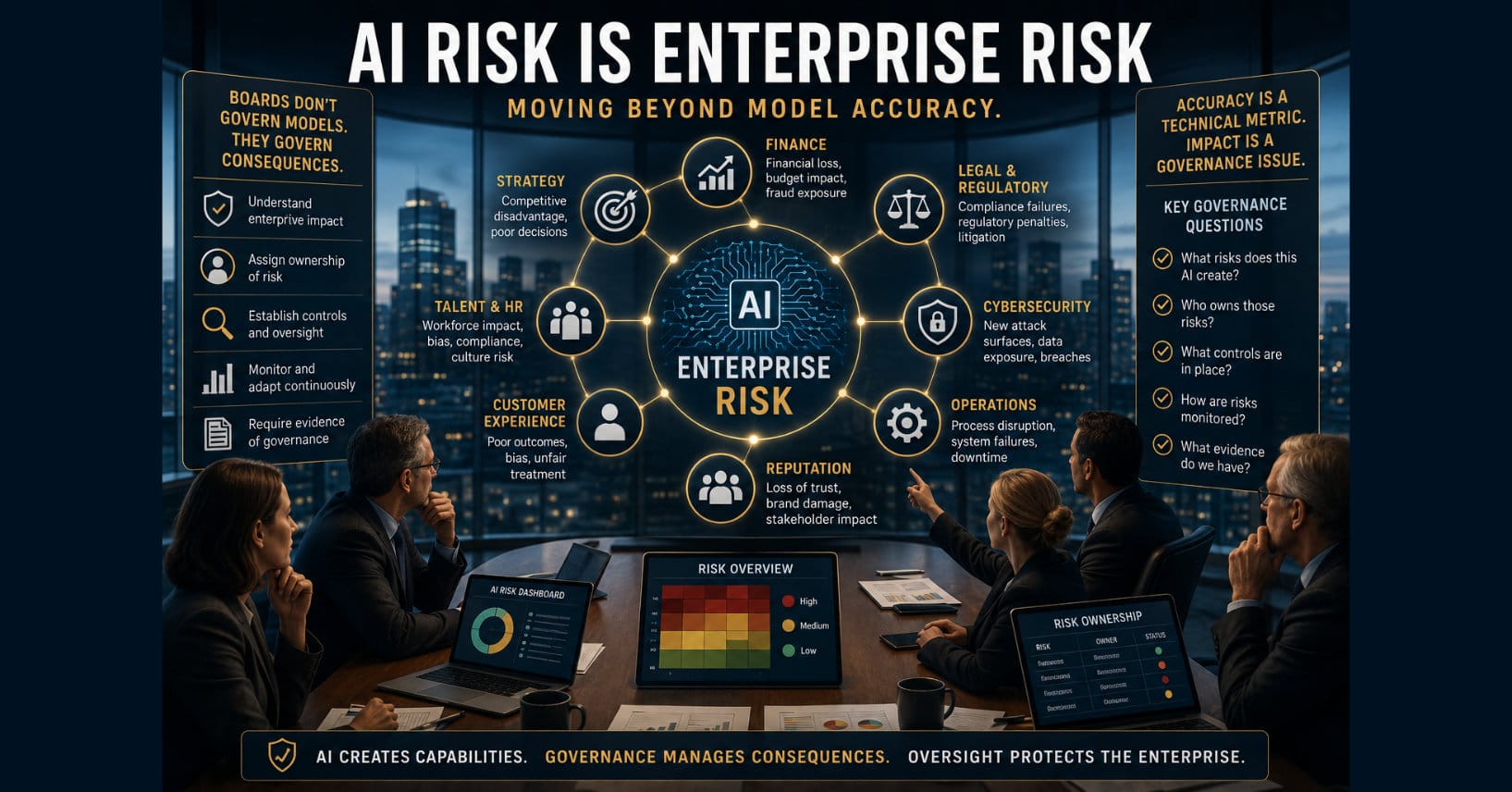
The real governance challenge is not whether an AI model occasionally produces an incorrect answer. The challenge is understanding how AI decisions can create enterprise-wide financial, operational, legal, regulatory, cybersecurity, reputational, and strategic risk.
Model performance is a technical issue.
Enterprise impact is a governance issue.
Good Models Can Still Create Bad Outcomes
An AI system can achieve remarkable technical performance while introducing significant organizational risk.
Imagine an AI-powered procurement system that consistently recommends the lowest-cost supplier.
The recommendations may be technically correct.
Yet they may violate contractual obligations, expose the company to geopolitical risk, or increase dependence on a single vendor.
The model didn’t fail.
Governance did.
Likewise, an AI hiring system may accurately identify high-performing candidates while unintentionally creating regulatory exposure through discriminatory outcomes.
Again, the technical performance is only part of the story.
Governance asks a broader question:
What are the consequences of this decision for the enterprise?
Every Enterprise Function Is Affected
AI risk rarely remains confined to one department.
A single AI decision can affect:
- Finance through unexpected financial losses.
- Legal through regulatory violations or litigation.
- Human Resources through employment practices.
- Cybersecurity through new attack surfaces.
- Operations through automation failures.
- Customer Experience through trust and reputation.
- Investor Relations through market confidence.
- The Board through fiduciary oversight.
This is why AI governance cannot be delegated entirely to IT.
AI has become an enterprise capability.
Its risks are enterprise risks.
Accuracy Is Only One Metric
Many AI programs emphasize technical metrics.
Accuracy.
Precision.
Recall.
Latency.
Drift.
These measurements are essential for engineering teams.
Boards need different metrics.
How many high-risk AI systems are operating?
Which business functions depend on AI?
What enterprise risks does each system create?
Who owns those risks?
How frequently are governance reviews performed?
What evidence demonstrates ongoing oversight?
These questions reveal whether AI is being governed—not simply managed.
Enterprise Risk Begins With Decisions
Every material AI decision has consequences beyond the technology itself.
Approving a new customer-facing chatbot is not merely a software deployment.
It may affect brand reputation.
Deploying AI-assisted underwriting changes organizational risk exposure.
Using generative AI for contract review influences legal outcomes.
Automating healthcare decisions affects patient safety.
Technology creates capabilities.
Governance evaluates consequences.
Risk Ownership Matters
Organizations frequently assign AI risk to technical teams.
That approach ignores the fact that many AI risks originate in business decisions rather than technical failures.
A cybersecurity team cannot own reputational risk.
A data scientist cannot own regulatory compliance.
A software engineer cannot own fiduciary oversight.
Each contributes expertise.
Ownership belongs where business accountability resides.
Governance clarifies who owns enterprise risk—not merely who operates the technology.
Enterprise Risk Evolves
AI governance is not a one-time approval.
Business conditions change.
Regulations evolve.
Threat actors adapt.
Models learn.
Data changes.
Organizational priorities shift.
An acceptable level of risk today may become unacceptable six months from now.
Governance therefore requires continuous oversight rather than periodic approval.
Risk must be monitored as carefully as performance.
Boards Govern Consequences
The board does not need to understand every neural network architecture.
It does need confidence that management understands the enterprise consequences of deploying AI.
Directors should ask:
What risks does this AI create?
How are those risks measured?
Who owns them?
What controls exist?
How do we know those controls remain effective?
Those are governance questions.
And they are rapidly becoming boardroom questions.
AI Risk Is Business Risk
Organizations that continue viewing AI through a purely technical lens will struggle to govern it effectively.
AI changes how organizations make decisions.
It changes customer interactions.
It changes operational processes.
It changes regulatory obligations.
It changes enterprise risk.
Governance succeeds when AI is evaluated not only by how well it performs, but also by how responsibly the organization manages the consequences of using it.
Boardroom Takeaway
AI risk is not limited to model accuracy or technical performance. It is an enterprise governance issue that spans every business function. Effective boards oversee the organizational consequences of AI, ensuring that risk ownership, oversight, and accountability extend well beyond the technology itself.
Coming Next
The Most Dangerous AI Risk Isn’t Hallucination
Most discussions about AI risk focus on technical failures like hallucinations and inaccurate outputs. The next article explores why governance failures—not technology failures—often create the greatest organizational risk, and why boards should pay closer attention to oversight than algorithms.