AI Governance Series | Article 8 of 20
Governing Intelligence Before It Governs You
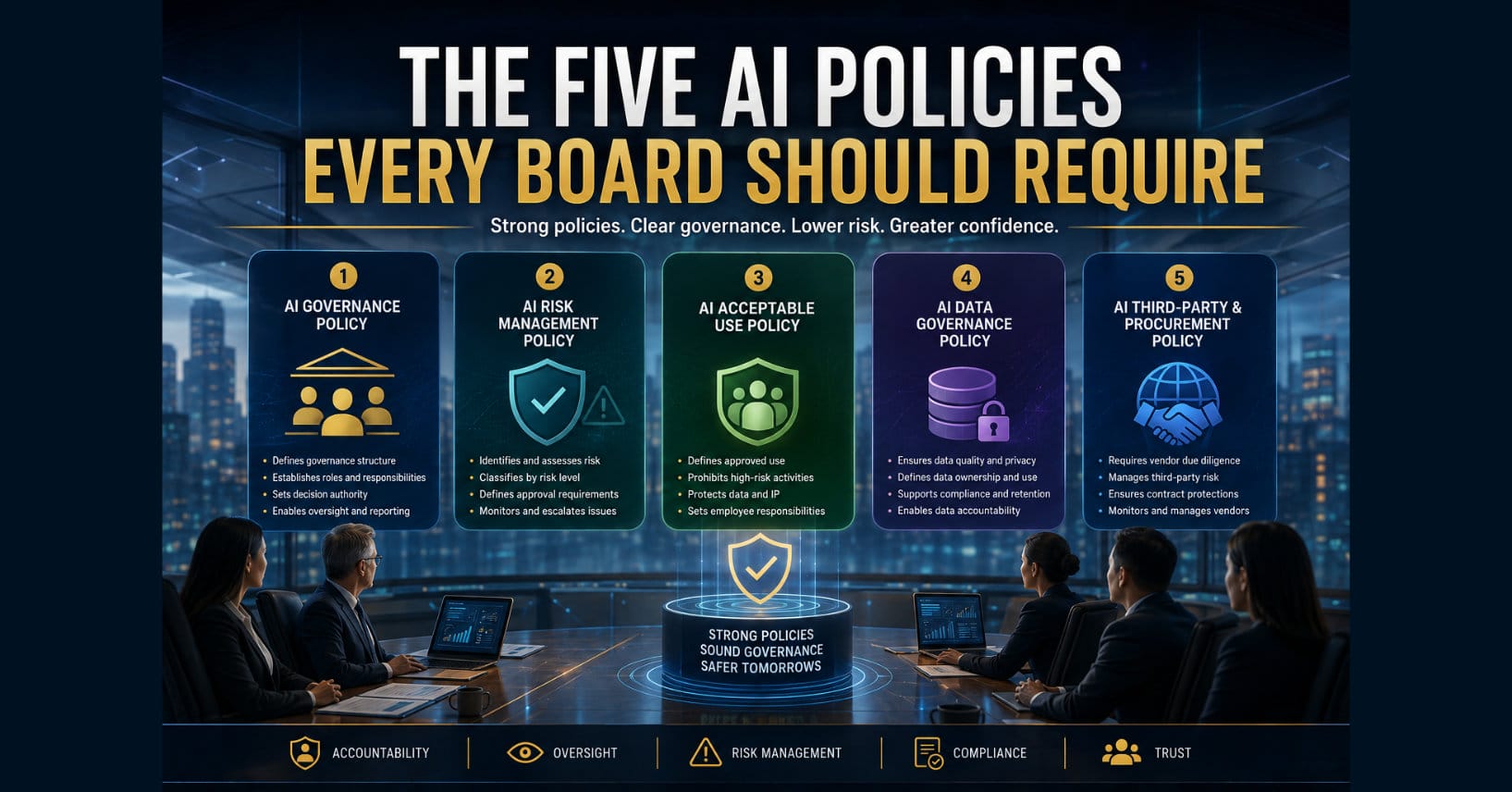
Summary: Not every AI policy carries the same governance value. This article identifies the five foundational policies every board should require: AI Governance, AI Risk Management, AI Acceptable Use, AI Data Governance, and AI Third-Party & Procurement. Together, these policies establish decision rights, accountability, oversight, and enterprise-wide risk management. More importantly, they serve as the starting point for governance—not the end—by driving the processes, evidence, and board reporting needed to govern AI responsibly.
Every organization adopting artificial intelligence needs policies.
The challenge is deciding which ones matter most.
Many organizations begin by drafting a broad AI acceptable use policy. Others create separate documents for ethics, privacy, cybersecurity, or procurement. Before long, dozens of policies exist, each addressing a different aspect of AI.
More policies do not necessarily produce better governance.
Boards should focus on requiring a small set of foundational policies that establish accountability across the enterprise.
The goal isn’t documentation.
The goal is governability.
1. AI Governance Policy
Every AI governance program should begin with a policy that defines how AI is governed—not merely how it is used.
This policy should establish:
- Governance objectives
- Roles and responsibilities
- Decision authorities
- Executive oversight
- Board reporting
- Governance committee responsibilities
- Review cadence
Without this foundation, every other AI policy operates independently, creating inconsistent governance across the organization.
This is the policy that defines who governs AI.
2. AI Risk Management Policy
Every AI initiative introduces some level of enterprise risk.
The Board should require a policy that explains:
- How AI risks are identified
- How risk levels are classified
- Approval requirements based on risk
- Residual risk acceptance
- Monitoring expectations
- Escalation procedures
Not every AI system deserves the same level of scrutiny.
Governance should scale with risk.
3. AI Acceptable Use Policy
Employees need clear guidance on when and how AI may be used.
This policy should address topics such as:
- Approved AI platforms
- Prohibited activities
- Confidential information
- Intellectual property
- Customer information
- Human review requirements
- Employee responsibilities
Acceptable use policies reduce uncertainty while helping employees innovate responsibly.
4. AI Data Governance Policy
AI is only as trustworthy as the data supporting it.
A dedicated policy should define expectations for:
- Data quality
- Data ownership
- Privacy
- Retention
- Classification
- Access controls
- Data lineage
- Regulatory compliance
Poor data governance eventually becomes poor AI governance.
The Board should expect management to treat data as a governed enterprise asset.
5. AI Third-Party and Procurement Policy
Many organizations are deploying AI without building it.
That means governance must extend beyond internally developed systems.
Third-party AI policies should establish requirements for:
- Vendor due diligence
- Security reviews
- Privacy assessments
- Contractual protections
- Regulatory compliance
- Ongoing vendor monitoring
- Exit planning
Organizations inherit many of the risks associated with the AI they purchase.
Governance should recognize that reality.
Policies Should Work Together
These five policies are not independent documents.
They form a governance system.
The AI Governance Policy establishes authority.
The AI Risk Management Policy prioritizes oversight.
The Acceptable Use Policy guides employees.
The Data Governance Policy protects information.
The Third-Party Policy extends governance beyond organizational boundaries.
Together they create a governance framework rather than a collection of isolated documents.
Policies Are Only the Beginning
Even the strongest policy framework cannot govern AI by itself.
Each policy should generate governance activities, including:
- Risk assessments
- Approval records
- Governance meetings
- Monitoring reports
- Exception reviews
- Audit results
- Board reporting
- Evidence of compliance
Policies establish expectations.
Governance demonstrates execution.
What Boards Should Ask
Directors should move beyond asking whether these policies exist.
Instead, they should ask:
Who owns each policy?
How often is it reviewed?
How is compliance measured?
What governance evidence demonstrates implementation?
What metrics are reported to the Board?
Those questions distinguish mature governance from administrative compliance.
Boardroom Takeaway
Every board should require a core set of AI policies, but their true value lies in the governance activities they create. Policies define expectations. Governance assigns ownership, manages risk, produces evidence, and demonstrates that those expectations are consistently being met.
Coming Next
Your AI Dashboard Probably Measures the Wrong Things
Many AI dashboards focus on technical performance—accuracy, latency, uptime, and utilization. The next article explains why boards need governance metrics instead, measuring accountability, oversight, risk, compliance, and evidence rather than simply model performance.