
AI Governance Series | Article 9 of 20
Governing Intelligence Before It Governs You
Summary: Many AI dashboards are designed for engineers, not directors. They report technical metrics such as accuracy, latency, uptime, and throughput, but fail to answer the governance questions boards are responsible for asking. This article explains the difference between operational and governance metrics and identifies the measures that truly matter at the board level, including AI inventory, risk assessments, executive approvals, policy compliance, control effectiveness, board reporting, and evidence completeness. Effective AI governance requires more than knowing how AI performs—it requires knowing whether the organization is governing AI responsibly.
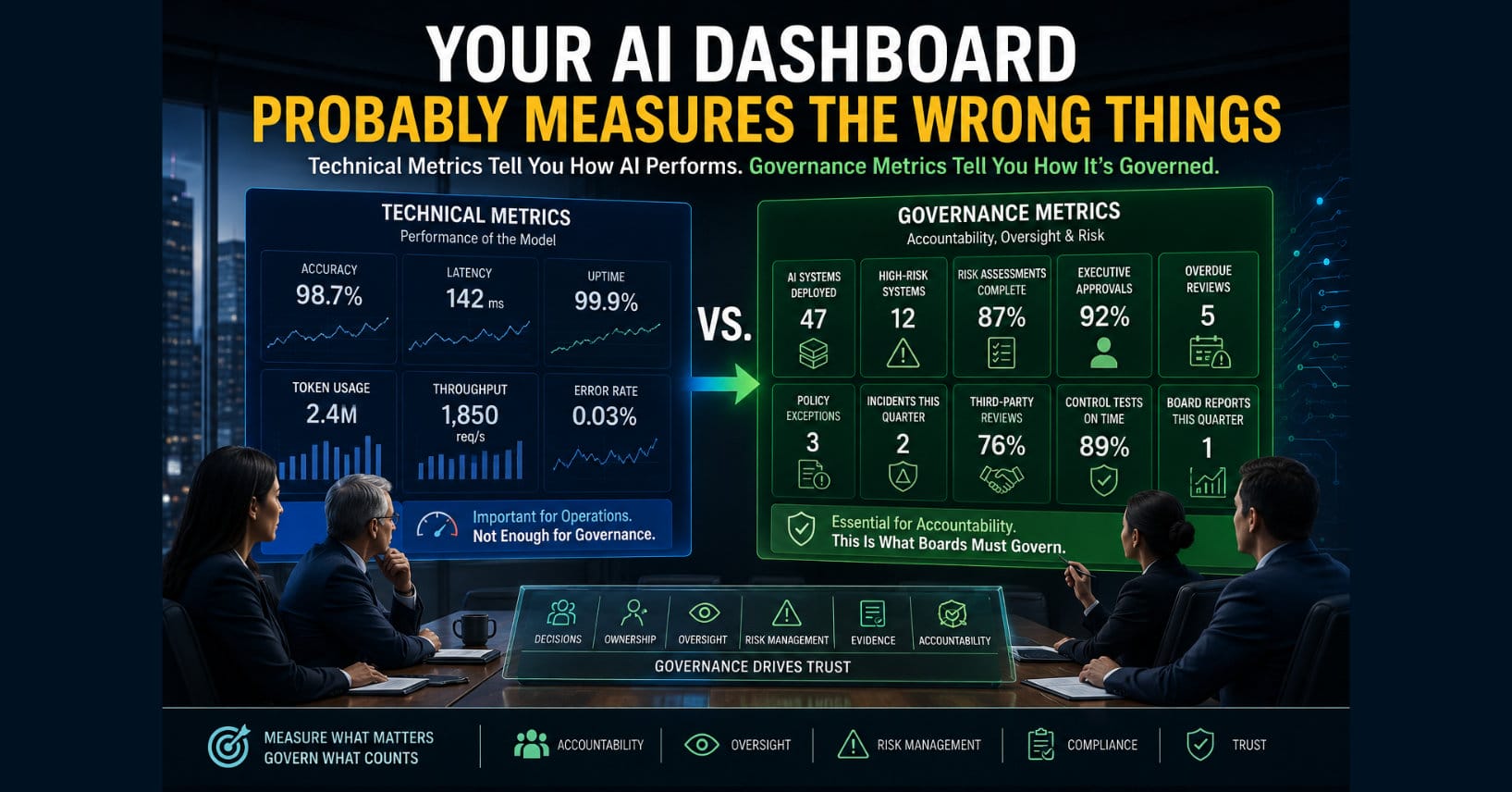
Most AI dashboards are built for engineers.
Boards need dashboards built for governance.
That distinction explains why many executive AI reports are full of impressive numbers that reveal very little about whether the organization is governing AI effectively.
Executives often receive metrics such as:
- Model accuracy
- Precision
- Recall
- Latency
- Uptime
- Token usage
- Inference speed
These are valuable operational metrics.
They are not governance metrics.
A board’s responsibility is not to govern algorithms.
It is to govern the enterprise.
Technical Metrics Measure Performance
Governance Metrics Measure Accountability
An AI model may achieve 99% accuracy.
A board should immediately ask different questions.
Who approved its deployment?
What enterprise risks were identified?
Which controls were implemented?
Who owns the system?
When was the last governance review?
Has the Board been informed of significant changes?
None of those answers appear in model performance statistics.
Technical excellence does not demonstrate governance.
Boards Need Visibility Into Decisions
Good governance dashboards answer questions such as:
- How many AI systems are currently deployed?
- How many are considered high risk?
- Which systems have completed formal risk assessments?
- How many received executive approval?
- Which systems are overdue for governance review?
- How many policy exceptions are active?
- How many AI incidents have occurred this quarter?
Those metrics help directors understand whether governance is functioning—not simply whether AI is functioning.
Governance Metrics Should Predict Risk
Many organizations report metrics only after something goes wrong.
Effective governance identifies developing problems before they become incidents.
Examples include:
- AI systems operating without assigned owners
- Risk assessments awaiting completion
- Expired approvals
- Missing monitoring reports
- Third-party AI vendors awaiting review
- Controls that have not been tested
- Governance meetings not conducted
These indicators reveal weaknesses before they become headlines.
Good governance is predictive, not merely historical.
Every Governance Metric Needs an Owner
A dashboard is only useful if someone is accountable for the numbers it reports.
If twenty AI systems have overdue reviews, someone should own correcting that condition.
If policy exceptions continue increasing, someone should explain why.
If no board reporting has occurred during the past six months, someone should be responsible for restoring governance visibility.
Metrics without ownership become observations.
Metrics with ownership become governance.
Evidence Matters More Than Color
Many executive dashboards rely on traffic-light reporting.
Green.
Yellow.
Red.
Those colors communicate status.
They do not demonstrate governance.
Boards increasingly need supporting evidence.
If a dashboard reports that every high-risk AI deployment completed a risk assessment, directors should be able to ask:
Where is the evidence?
Which executive approved it?
When was it reviewed?
Who accepted any remaining risk?
Evidence transforms dashboard indicators into defensible governance.
A Balanced Dashboard
An effective AI governance dashboard combines operational insight with governance oversight.
Technical metrics may include:
- Accuracy
- Availability
- Response time
- Model drift
- System utilization
Governance metrics should include:
- High-risk AI inventory
- Policy compliance
- Risk assessment completion
- Executive approvals
- Control effectiveness
- Governance review status
- Third-party oversight
- Incident reporting
- Board reporting
- Evidence completeness
Together they provide a complete picture.
Separately, each tells only part of the story.
What Boards Should Really Measure
Directors should continually ask:
Are decisions being made?
Are responsibilities assigned?
Are risks reviewed?
Are controls operating?
Are policies being followed?
Can management demonstrate all of those activities with evidence?
Those questions define governance maturity far more accurately than technical performance alone.
Boardroom Takeaway
Technical dashboards tell boards how AI systems are performing. Governance dashboards tell boards whether the organization is exercising effective oversight. Mature organizations measure both, but they recognize that directors are accountable for governance—not model accuracy.
Coming Next
Assurance Is the Missing Layer in AI Governance
Policies define expectations. Governance manages decisions. But neither guarantees that controls are operating as intended. The next article explores why independent assurance is the missing layer in many AI governance programs—and why boards increasingly depend on it to validate that governance is working as designed.