AI Governance Series | Article 20 of 20
Governing Intelligence Before It Governs You
Summary: The future belongs to organizations that recognize governance as a strategic advantage rather than a compliance exercise. As artificial intelligence reshapes every industry, sustainable success will depend not only on technological innovation, but on the ability to govern AI responsibly through accountability, oversight, assurance, and defensible evidence. This concluding article brings together the central themes of the AI Governance Series, demonstrating why trust, resilience, and adaptive governance will distinguish tomorrow’s market leaders. Organizations that build governance into every AI decision today will be better positioned to innovate confidently, withstand disruption, satisfy regulators, and earn lasting stakeholder trust.
When the history of the AI era is written, the winners will not necessarily be the organizations that built the largest models.
Nor will they be the ones that automated the most processes.
They will be the organizations that learned how to govern intelligence responsibly.
Artificial intelligence is changing how organizations compete.
Governance will determine which ones endure.
The AI Race Is Changing
Much of today’s conversation focuses on technological capability.
Who has the fastest models?
Who has the largest datasets?
Who releases new features first?
Those questions matter.
But they will become less important over time.
Technology advantages rarely remain exclusive.
Governance advantages do.
Competitors can replicate software.
They cannot easily replicate mature governance, trusted leadership, organizational discipline, and evidence-driven decision-making.
Those capabilities become lasting competitive advantages.
Trust Will Outperform Speed
Many organizations believe success belongs to those that move first.
History often tells a different story.
Organizations that consistently earn stakeholder trust outperform those that repeatedly lose it.
Customers forgive honest mistakes.
They rarely forgive organizations that cannot explain what happened, who was accountable, or how leadership responded.
Trust becomes sustainable when governance creates confidence before confidence is demanded.
Governance Enables Innovation
Governance is often portrayed as something that slows innovation.
Well-designed governance does the opposite.
It creates confidence.
Confidence allows leaders to approve new initiatives more quickly.
Confidence enables employees to innovate within clear boundaries.
Confidence allows regulators to see responsible management.
Confidence reassures investors.
Confidence strengthens customer relationships.
Organizations with mature governance do not innovate less.
They innovate with greater confidence.
Defensibility Is Becoming Strategic
Every major AI decision creates future questions.
Why was this model approved?
Who accepted the risks?
What alternatives were considered?
What evidence demonstrates oversight?
Organizations that can answer those questions immediately possess a strategic advantage.
Those that cannot will spend valuable time reconstructing decisions after incidents, audits, or regulatory inquiries.
Defensibility is no longer about preparing for litigation.
It is about operating with confidence every day.
Resilience Is Built Before the Crisis
Every organization will eventually experience an AI failure.
A model will behave unexpectedly.
A vendor will introduce risk.
A regulation will change.
A customer will question a decision.
The difference between resilient organizations and struggling organizations will not be whether incidents occur.
It will be how prepared leadership is when they do.
Resilience is built through:
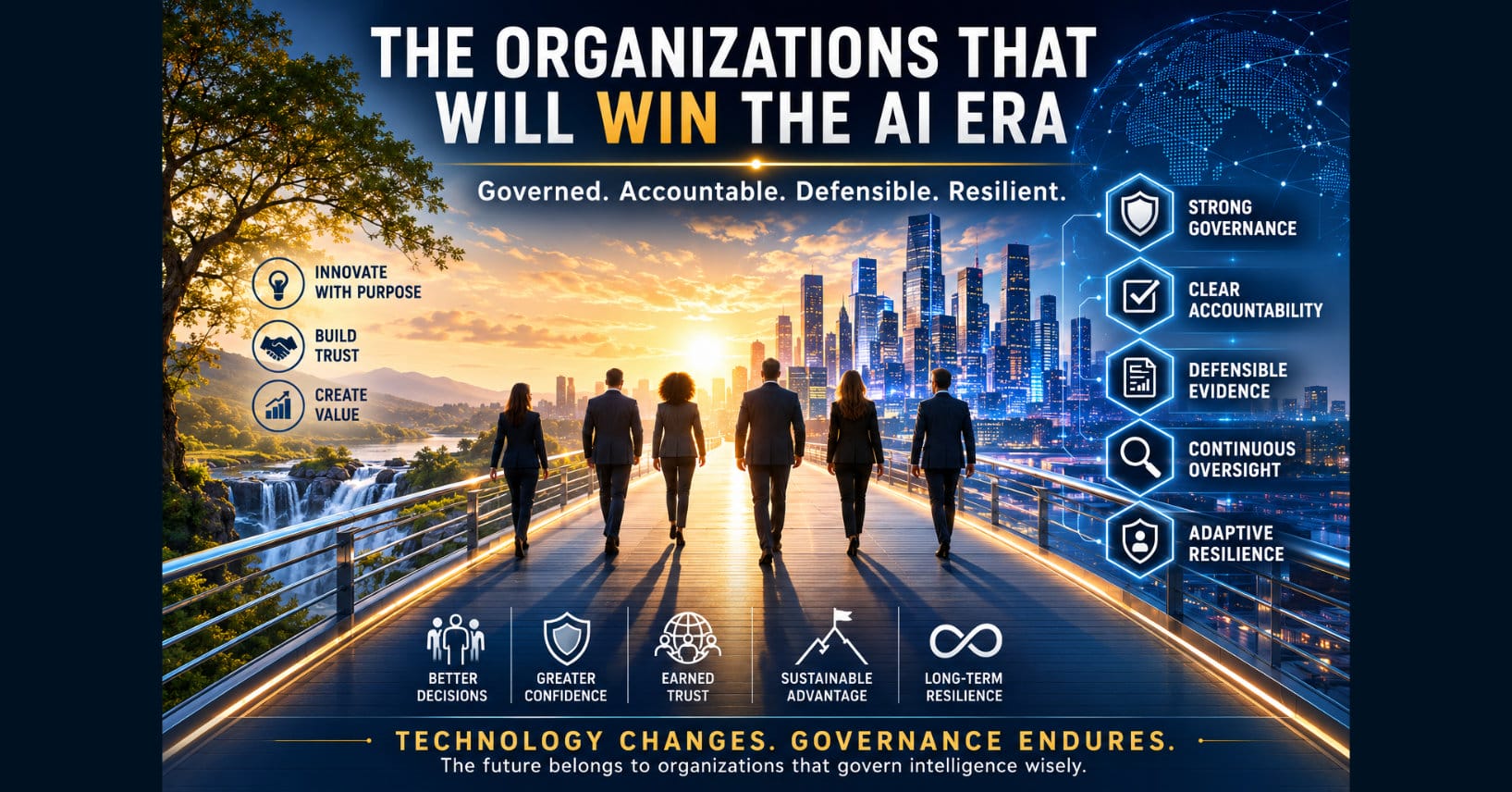
- Clear accountability.
- Continuous oversight.
- Independent assurance.
- Adaptive governance.
- Defensible evidence.
Those capabilities exist before the crisis—not because of it.
The Board’s Greatest Asset
Technology changes rapidly.
Leadership capability compounds.
Boards that consistently ask better questions produce stronger governance.
They challenge assumptions.
Monitor governance health.
Demand evidence.
Clarify accountability.
Encourage transparency.
Adapt continuously.
The greatest asset a board possesses will not be artificial intelligence.
It will be informed judgment.
The Competitive Advantage Few Can See
Many executives search for competitive advantage in technology.
The more enduring advantage often exists elsewhere.
Organizations that consistently govern well:
- Earn trust faster.
- Adapt more quickly.
- Recover sooner.
- Satisfy regulators more effectively.
- Attract stronger partners.
- Retain customer confidence.
- Make better decisions.
These outcomes are not products of better algorithms.
They are products of better governance.
The Future Belongs to Adaptive Organizations
Artificial intelligence will continue evolving.
Regulations will change.
Markets will shift.
New risks will emerge.
Organizations that build governance around today’s technology alone will continually struggle to catch up.
Organizations that build governance capable of adapting to change will remain resilient regardless of what technology comes next.
Adaptability becomes the foundation of long-term success.
This Series Was Never About Artificial Intelligence Alone
Over the past twenty articles, we have explored accountability, ownership, policies, assurance, trust, maturity, governance drift, board oversight, and evidence.
Each topic points toward the same conclusion.
Successful AI governance is not achieved by implementing a framework.
It is achieved by building an organization that consistently makes responsible decisions.
Technology will continue to change.
Good governance principles will not.
The Organizations That Will Lead
The organizations that define the AI era will not simply deploy intelligent systems.
They will build intelligent governance.
They will create cultures where accountability is clear.
Oversight is continuous.
Evidence is produced naturally.
Assurance is independent.
Trust is earned repeatedly.
Resilience is intentional.
Those organizations will not merely survive the AI era.
They will help define it.
Boardroom Takeaway
The organizations that will lead in the AI era are those that recognize governance as a strategic capability rather than a compliance obligation. Long-term success will belong to enterprises that combine innovation with accountability, oversight with adaptability, and ambition with defensible evidence. In an increasingly intelligent world, sustainable competitive advantage will come not from building better AI alone, but from building organizations capable of governing it with confidence.
Series Conclusion
Artificial intelligence may redefine how organizations operate.
Governance will determine how they are remembered.
Technology creates possibility.
Governance creates confidence.
Evidence creates trust.
And together, they create organizations that are prepared not only for the future of AI—but for whatever comes after it.