AI Governance Series | Article 11 of 20
Governing Intelligence Before It Governs You
Summary: Artificial intelligence can make decisions, but it cannot accept responsibility. Organizations own the consequences of AI failures, making accountability a core governance function rather than a technical one. This article explains why responsibility must be clearly assigned before AI systems are deployed, how governance evidence demonstrates who approved, monitored, and accepted risk, and why regulators, customers, and boards evaluate leadership decisions—not algorithms—when incidents occur. Effective AI governance ensures accountability is documented, understood, and defensible before the first crisis.
Every AI system will eventually make a mistake.
It may recommend the wrong medical treatment.
Approve a fraudulent transaction.
Reject a qualified job applicant.
Generate inaccurate financial information.
Expose confidential data.
When that happens, the first question should not be:
What did the AI do?
It should be:
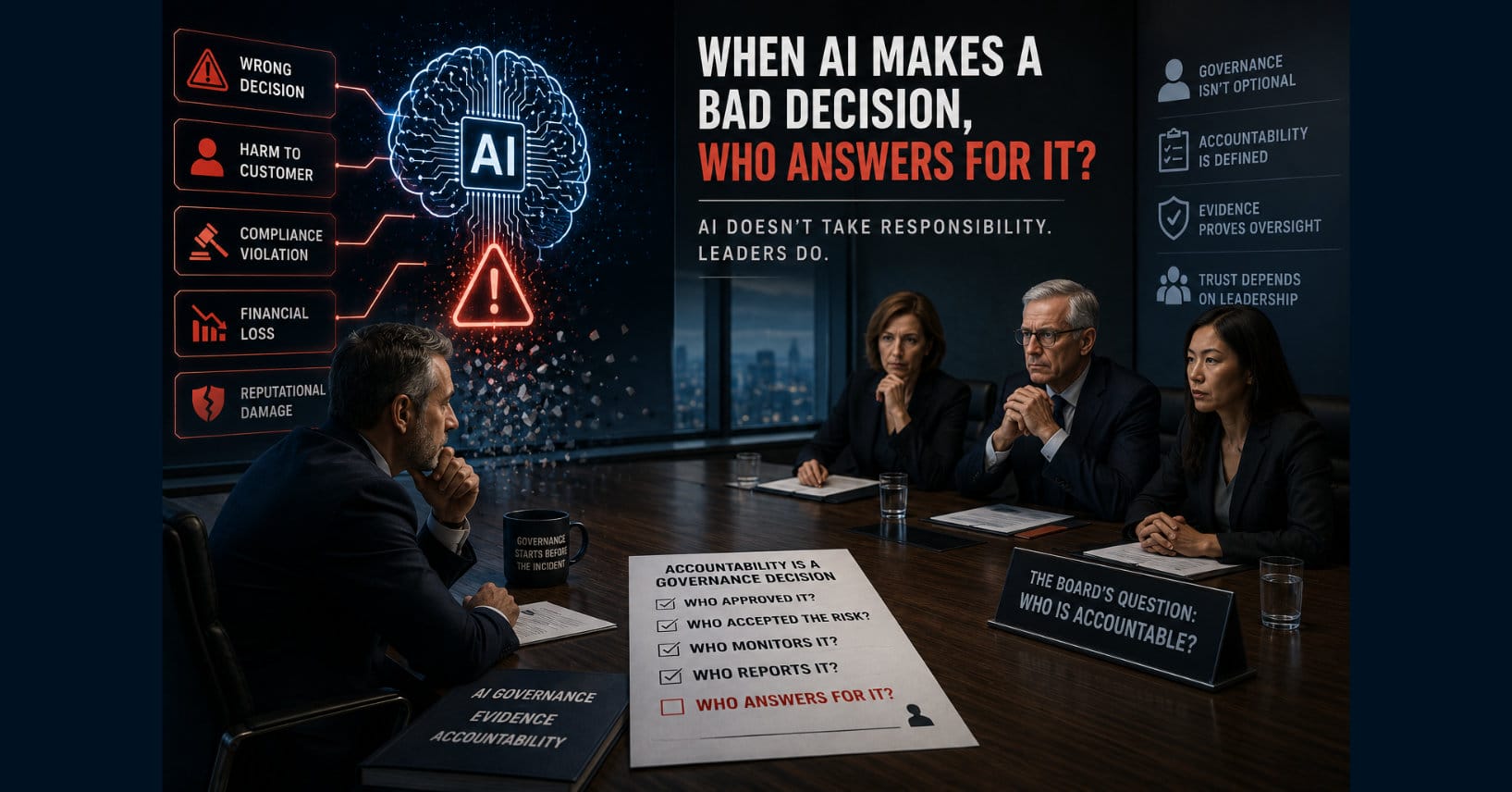
Who was accountable for the decision?
That is the difference between an operational incident and a governance incident.
AI Doesn’t Own Decisions
Organizations Do
Artificial intelligence cannot accept responsibility.
It cannot explain its reasoning to a regulator.
It cannot testify before Congress.
It cannot defend itself in court.
It cannot accept disciplinary action.
Every AI decision ultimately belongs to a human organization.
Someone chose the model.
Someone approved its deployment.
Someone accepted the associated risks.
Someone established the controls.
Someone decided how much human oversight would exist.
Those are governance decisions.
Accountability Must Exist Before Deployment
Many organizations define accountability after something goes wrong.
That is too late.
Before any significant AI system enters production, leadership should already know:
- Who owns the system
- Who approved its deployment
- Who accepts operational risk
- Who monitors performance
- Who reviews exceptions
- Who authorizes significant changes
- Who reports to executive leadership
- Who reports to the board
If those questions cannot be answered immediately, governance is incomplete.
Shared Responsibility Is Not the Same as No Responsibility
AI decisions often involve multiple stakeholders:
- Business leaders
- Data scientists
- IT
- Information security
- Legal
- Compliance
- Privacy
- Internal audit
Each contributes to governance.
None should eliminate accountability.
One individual—or one clearly defined governance function—must ultimately own the decision.
Shared responsibility without defined accountability creates organizational confusion precisely when clarity is needed most.
Every Incident Becomes a Governance Investigation
Following an AI failure, investigators rarely begin by evaluating algorithms.
They begin by reconstructing governance.
Questions often include:
Who approved this AI system?
Were risks identified?
Were controls implemented?
Were policy exceptions documented?
Did required governance reviews occur?
Who accepted the remaining risk?
Was the board informed when required?
Those questions determine whether the organization exercised reasonable oversight.
Technology is examined.
Governance is judged.
Evidence Determines Accountability
Organizations often know who was responsible.
The challenge is proving it.
Governance evidence may include:
- Approval records
- Risk assessments
- Decision logs
- Governance committee minutes
- Control testing results
- Exception approvals
- Monitoring reports
- Executive communications
Together, these records establish how decisions were made and whether governance responsibilities were fulfilled.
Without evidence, accountability becomes difficult to demonstrate.
Incident Governance Begins Before the Incident
Effective organizations don’t wait until something fails to define their response.
They establish incident governance in advance.
That includes:
- Clear escalation procedures
- Defined executive responsibilities
- Board notification criteria
- Regulatory reporting processes
- External communication authority
- Evidence preservation requirements
- Root cause analysis procedures
- Corrective action governance
Preparation reduces confusion when every minute matters.
Boards Should Ask One Critical Question
Directors should periodically ask management:
“If one of our highest-risk AI systems made a harmful decision tomorrow morning, who would answer for it tomorrow afternoon?”
The speed and clarity of the response often reveal the maturity of the organization’s governance program.
Hesitation usually indicates missing accountability.
Confidence supported by documented governance indicates readiness.
Accountability Builds Trust
Stakeholders understand that technology can fail.
What they expect is leadership.
Customers want responsible organizations.
Regulators expect accountable governance.
Investors expect effective oversight.
Boards are ultimately judged not by whether AI made a mistake, but by whether the organization governed AI responsibly before the mistake occurred.
Boardroom Takeaway
AI systems make decisions. Organizations own the consequences. Effective governance establishes accountability before deployment, documents every significant decision, and preserves the evidence needed to demonstrate responsible oversight when AI inevitably makes a mistake.
Coming Next
Every AI Failure Becomes a Governance Test
The first hours after an AI incident reveal more about an organization’s governance than years of policy documents. The next article examines crisis leadership, board oversight, and why every AI failure ultimately becomes a test of governance—not technology.