AI Governance Series | Article 12 of 20
Governing Intelligence Before It Governs You
Summary: AI incidents are inevitable, but governance failures are not. This article explains why every significant AI failure becomes a test of leadership rather than technology alone. It explores crisis governance, executive accountability, board oversight, evidence preservation, and the importance of preparation before an incident occurs. Organizations that define responsibilities, rehearse AI crisis scenarios, and respond with transparency and documented evidence demonstrate governance maturity when stakeholders, regulators, customers, and investors are watching most closely.
Every organization prepares for AI success.
Far fewer prepare for AI failure.
Yet the true measure of AI governance is not how well an organization performs when everything works.
It is how well it responds when something doesn’t.
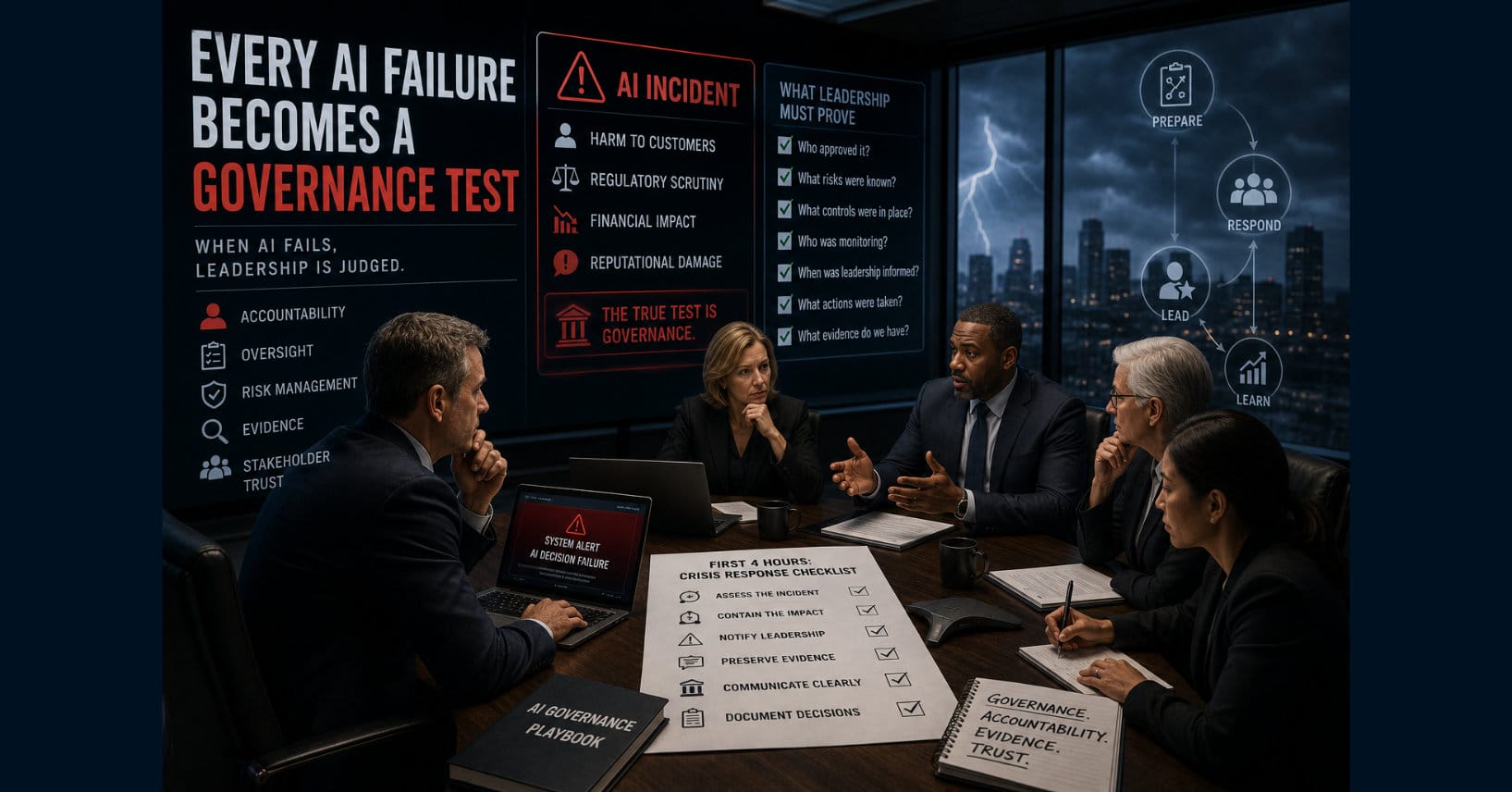
Every AI incident eventually becomes a governance test.
Not because regulators expect perfection.
But because they expect leadership.
The Technology Fails.
Leadership Is Evaluated.
An AI model makes a harmful recommendation.
A customer is denied service.
Confidential information is exposed.
A fraudulent transaction is approved.
The technology created the event.
But almost immediately, attention shifts away from the technology itself.
Questions begin to emerge:
Who knew about the risk?
Who approved deployment?
Who was monitoring the system?
Who decided not to intervene?
Who informed executive leadership?
When was the board notified?
Those are governance questions.
The First Hours Matter Most
Organizations often spend months investigating an AI incident.
Stakeholders form opinions within hours.
The first response demonstrates whether governance exists beyond policy documents.
Strong organizations quickly establish:
- What happened
- Which systems were affected
- Who is accountable
- What controls were already in place
- What actions have been taken
- Whether additional risks remain
- How evidence is being preserved
Weak organizations spend valuable time determining who owns the problem.
Governance maturity becomes immediately visible.
Crisis Leadership Requires Preparation
No crisis is the ideal time to determine responsibilities.
Effective organizations define them long before an incident occurs.
That preparation includes:
- Incident response playbooks
- AI-specific escalation procedures
- Executive decision authorities
- Board notification thresholds
- Regulatory reporting requirements
- Customer communication protocols
- Legal review processes
- Media response coordination
Preparation transforms confusion into coordinated action.
Evidence Shapes the Narrative
Every major AI incident generates two parallel investigations.
One examines the technical failure.
The other examines governance.
Investigators want to understand:
Were required risk assessments completed?
Were approvals properly documented?
Were known limitations communicated?
Were monitoring activities performed?
Were controls operating effectively?
Were warnings ignored?
Evidence answers these questions.
Without evidence, organizations are left defending assumptions rather than demonstrating oversight.
Boards Should Expect Early Notification
AI failures with significant business, regulatory, financial, or reputational impact should never surprise the board days or weeks later.
Directors need timely information to fulfill their oversight responsibilities.
That information should include:
- Nature of the incident
- Business impact
- Customers affected
- Regulatory implications
- Immediate containment actions
- Preliminary root cause
- Leadership decisions
- Next governance milestones
Early notification enables informed oversight rather than retrospective explanation.
Every Crisis Reveals Governance Culture
Policies do not make decisions during a crisis.
People do.
Organizations with mature governance cultures typically demonstrate:
- Clear accountability
- Rapid escalation
- Transparent communication
- Disciplined decision-making
- Reliable evidence collection
- Continuous executive involvement
Organizations with weak governance often exhibit:
- Confusion over ownership
- Delayed reporting
- Conflicting information
- Poor documentation
- Reactive decision-making
- Finger-pointing
Technology may trigger the incident.
Governance determines the response.
The Best Crisis Is the One You Already Practiced
Tabletop exercises have long been used for cybersecurity and business continuity.
AI governance deserves the same discipline.
Leadership teams should regularly rehearse scenarios such as:
- Harmful AI recommendations
- Biased decision outcomes
- Data leakage through AI
- Third-party model failures
- Regulatory investigations
- Public relations crises
Practice exposes governance weaknesses before real events do.
Boards Should Ask One Critical Question
Directors should periodically ask management:
“If one of our most critical AI systems failed publicly tomorrow, what would happen during the first four hours?”
The answer should describe leadership actions—not technical troubleshooting.
Because the board governs organizational response, not software debugging.
Governance Is Most Visible During Failure
Anyone can claim strong AI governance during normal operations.
Crises reveal whether that governance actually exists.
Customers judge transparency.
Regulators examine oversight.
Investors evaluate leadership.
Employees watch accountability.
Every AI failure becomes an opportunity to demonstrate that governance was more than a collection of policies—it was an operational capability that guided decisions under pressure.
Boardroom Takeaway
AI incidents are inevitable. Governance failures are not. Organizations that prepare leadership, define responsibilities, preserve evidence, and practice crisis response will demonstrate accountability when it matters most. Every AI failure becomes a governance test—and boards are ultimately judged by how well that test is managed.
Coming Next
Your Greatest AI Risk May Be Someone Else’s Model
Few organizations build every AI capability themselves. Increasingly, the greatest governance risks originate from third-party AI vendors, embedded models, and external services. The next article explores why governing someone else’s AI may become one of the board’s most important responsibilities.