AI Governance Series | Article 19 of 20
Governing Intelligence Before It Governs You
Summary: Artificial intelligence is transforming the responsibilities of corporate boards. By 2030, AI governance will be woven into every significant board decision, requiring directors to oversee accountability, enterprise risk, trust, assurance, and evidence with the same rigor applied to financial oversight. This article explores how board competencies, committee structures, reporting expectations, and governance practices are likely to evolve as AI becomes integral to every business function. Organizations that begin building evidence-driven governance today will be best prepared for future regulation, technological change, and long-term organizational resilience.
The boardrooms of 2030 will not simply discuss artificial intelligence.
They will govern it.
Today, many boards receive periodic updates on AI initiatives.
By the end of the decade, AI oversight will become as fundamental as financial oversight, cybersecurity, and enterprise risk management.
The question is no longer whether AI belongs in the boardroom.
The question is whether boards will evolve quickly enough to govern it effectively.
Every Board Decision Will Involve AI
Artificial intelligence is becoming embedded throughout the enterprise.
Strategic planning.
Customer engagement.
Supply chains.
Human resources.
Finance.
Legal.
Cybersecurity.
Product development.
Mergers and acquisitions.
As AI becomes part of every major business process, every board decision becomes, in part, an AI governance decision.
AI will no longer be a standing agenda item.
It will become part of nearly every agenda item.
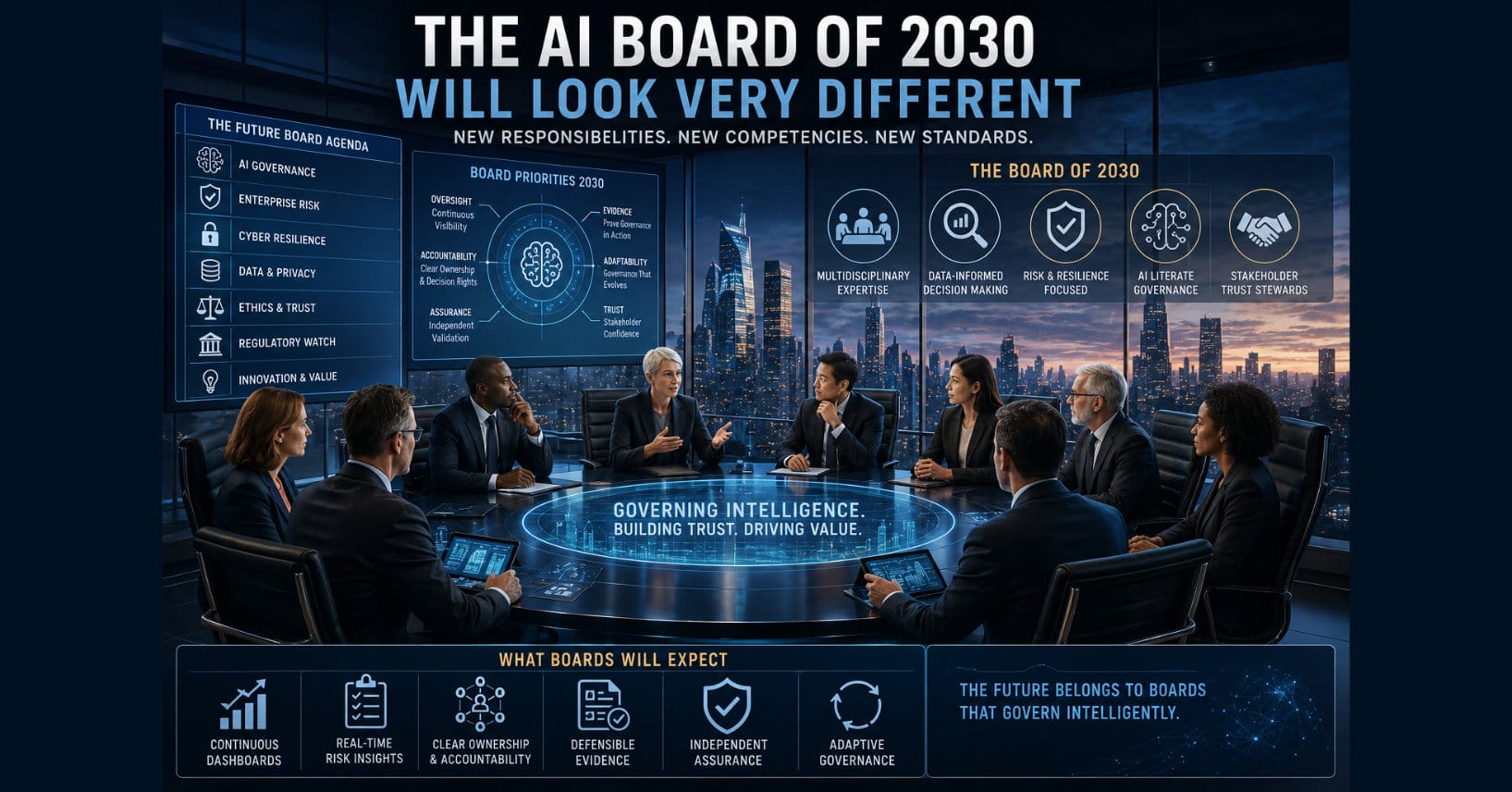
Directors Will Need New Competencies
Boards have traditionally relied on directors with expertise in finance, operations, legal affairs, and industry knowledge.
Those capabilities remain essential.
But boards will increasingly require directors who understand:
- AI governance
- Digital risk
- Data governance
- Cybersecurity
- Regulatory compliance
- Technology assurance
- Organizational resilience
- Evidence-based oversight
The future board will not necessarily include AI engineers.
It will include directors capable of asking the right governance questions.
Oversight Will Become Continuous
Quarterly reporting made sense when business moved more slowly.
Artificial intelligence evolves continuously.
Boards will increasingly expect:
- Continuous governance dashboards.
- Real-time risk indicators.
- Current AI inventories.
- Active policy exception reporting.
- Ongoing assurance activities.
- Evidence of operational governance.
Oversight will shift from periodic review to continuous visibility.
Governance Will Become Evidence-Driven
Historically, organizations demonstrated governance through policies, meeting minutes, and presentations.
Future boards will expect operational evidence.
They will ask:
Can we demonstrate who approved this AI system?
Can we show how risks were evaluated?
Can we trace significant AI decisions?
Can we prove controls are operating?
Can we demonstrate ongoing oversight?
Evidence—not explanation—will increasingly become the language of governance.
Regulation Will Continue to Expand
Governments around the world are establishing expectations for responsible AI.
Those expectations will continue to evolve.
Boards should not attempt to govern toward today’s regulations alone.
They should build governance systems capable of adapting to tomorrow’s requirements.
Organizations that continuously produce governance evidence will adapt far more easily than those rebuilding documentation after every regulatory change.
Board Committees Will Evolve
Many organizations currently assign AI oversight to existing committees.
Risk.
Audit.
Technology.
Cybersecurity.
Over time, committee responsibilities will become more integrated.
AI will influence financial reporting.
Operational resilience.
Privacy.
Cybersecurity.
Compliance.
Ethics.
Third-party risk.
No single committee will own every AI issue.
Every committee will govern some aspect of AI.
Assurance Will Become Strategic
Independent assurance has traditionally focused on financial reporting.
That model is expanding.
Boards will increasingly expect independent assurance over:
- AI governance
- Model lifecycle management
- Data governance
- Vendor oversight
- Regulatory compliance
- Evidence quality
- Governance effectiveness
Assurance will become a strategic capability rather than a compliance exercise.
Trust Will Become a Board Metric
Organizations already measure:
Revenue.
Profitability.
Growth.
Operational performance.
Cyber resilience.
Boards will increasingly measure trust as well.
Not as a marketing metric.
As a governance metric.
Trust reflects whether stakeholders believe leadership is governing AI responsibly.
That confidence will increasingly influence:
Customer retention.
Investor confidence.
Regulatory relationships.
Strategic partnerships.
Employee engagement.
Corporate reputation.
Trust will become an enterprise asset that boards actively protect.
The Board of 2030 Will Govern Adaptation
Perhaps the greatest change will not be technological.
It will be organizational.
Future boards will spend less time approving static policies.
They will spend more time ensuring governance evolves as rapidly as technology.
Their role will become one of continuous adaptation.
Continuously reviewing.
Continuously learning.
Continuously improving.
Continuously validating.
Continuously producing evidence.
Governance will become an operational capability rather than an annual governance exercise.
The Boards That Prepare Today Will Lead Tomorrow
No board can predict every technological breakthrough.
They do not need to.
Their responsibility is to create governance systems capable of adapting to whatever comes next.
The organizations that succeed in the AI era will not be those that guessed the future correctly.
They will be those that built governance capable of evolving with it.
That capability begins today.
Boardroom Takeaway
The board of 2030 will be defined less by its technical expertise than by its governance capability. Directors will be expected to oversee AI with the same rigor they apply to financial reporting and enterprise risk. Organizations that invest now in continuous oversight, evidence-driven governance, independent assurance, and adaptive decision-making will be prepared not only for future regulation, but for the accelerating pace of AI innovation itself.
Coming Next
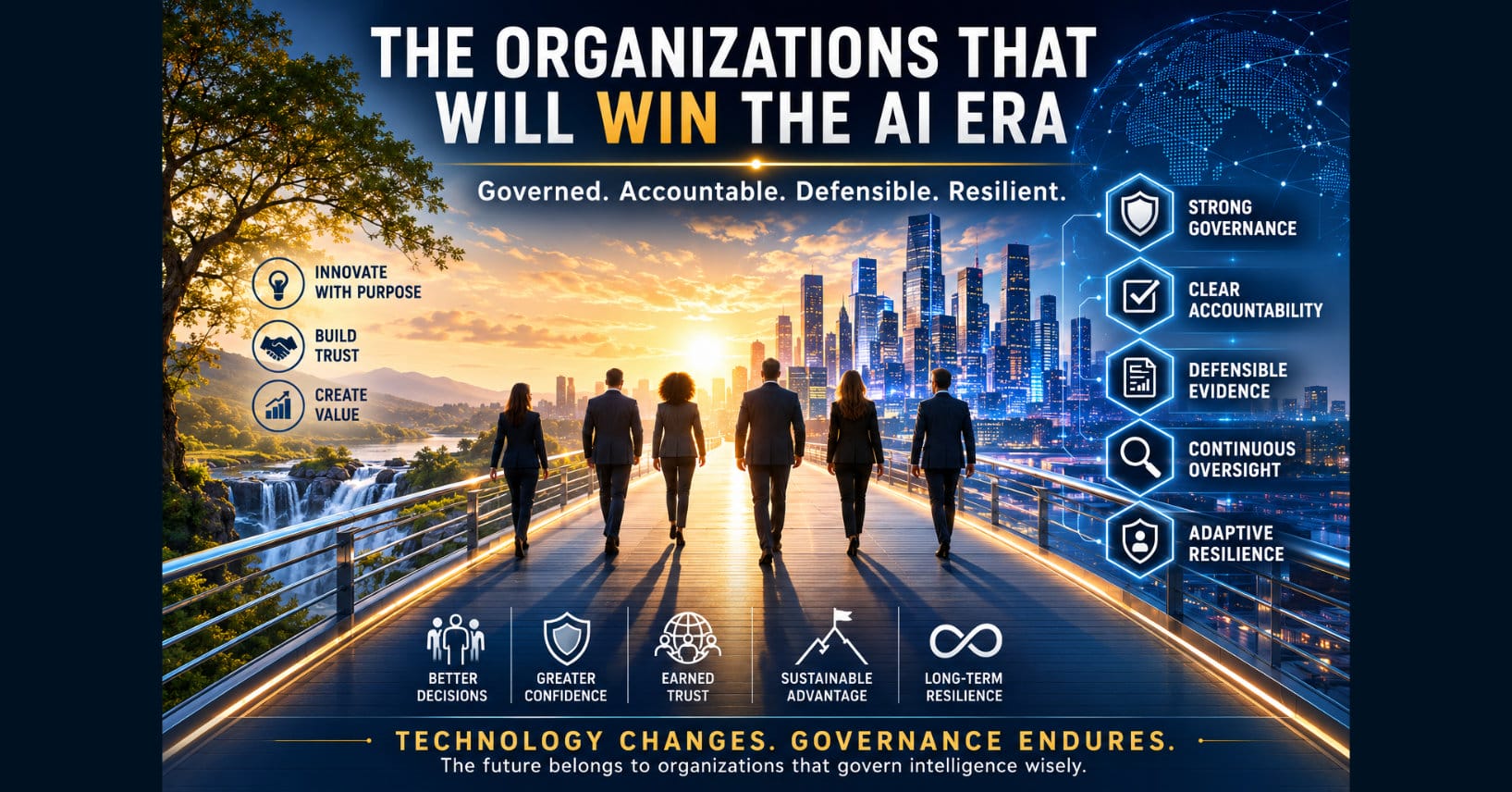
The Organizations That Will Win the AI Era
The concluding article brings together the central themes of this series. It explores why long-term AI success will belong not to the organizations with the most advanced models, but to those that build governance, accountability, defensible evidence, and organizational resilience into every stage of AI adoption. Together, these capabilities create the foundation for sustainable trust, confident leadership, and enduring competitive advantage.