THE CYBER GOVERNANCE CENTER | BREAKING ANALYSIS | NOVEMBER 20, 2026
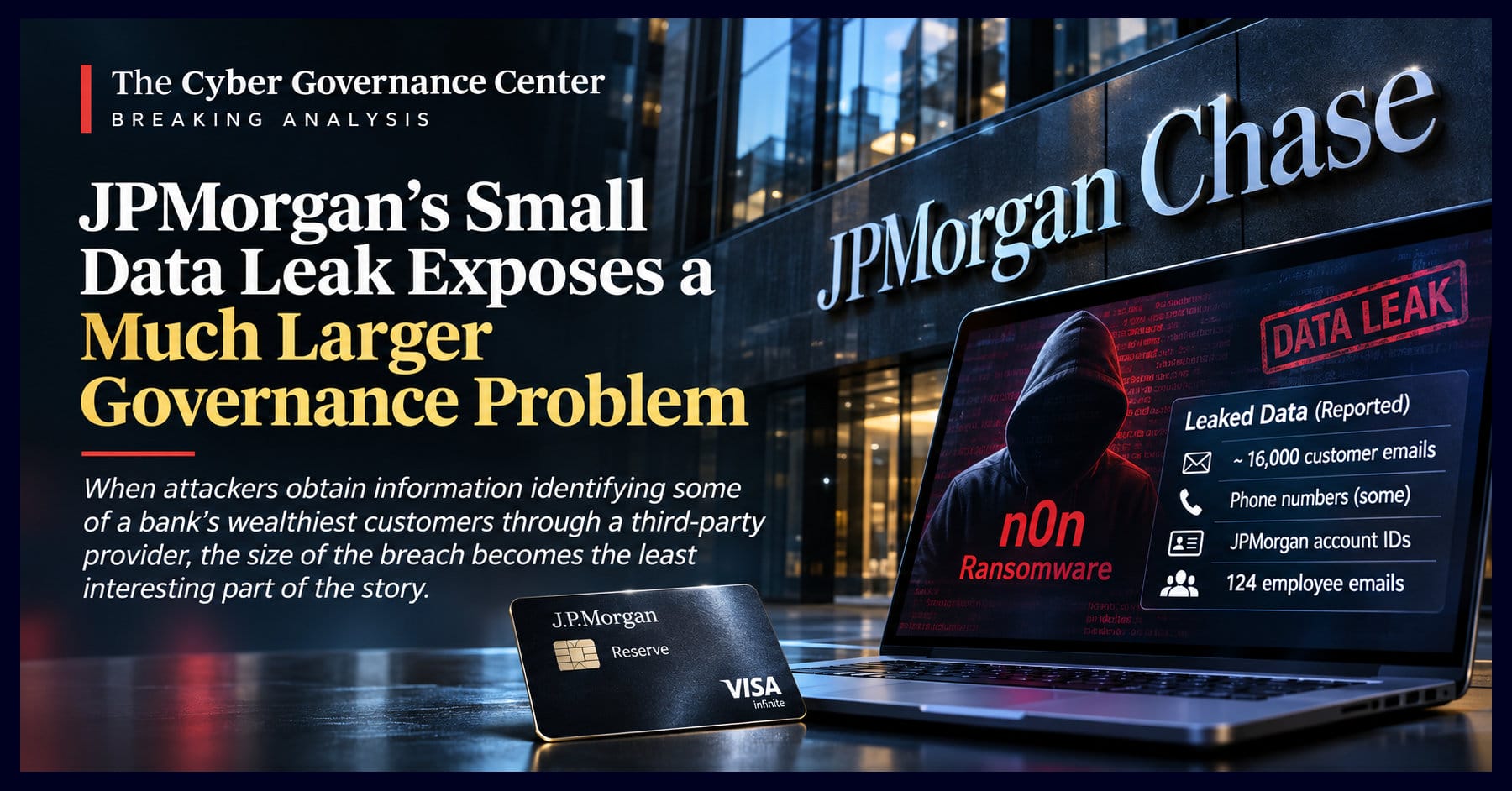
When attackers obtain information identifying some of a bank’s wealthiest customers through a third-party provider, the size of the breach becomes the least interesting part of the story.
Summary
JPMorgan Chase has acknowledged a cybersecurity incident involving third-party providers that maintained customer marketing information. Although the reportedly leaked dataset contains approximately 16,000 customer email addresses, its potential association with the bank’s exclusive Reserve credit card program introduces significant concentration-of-risk concerns. This analysis examines why breach severity cannot be measured by record count alone, how third-party data handling expands enterprise exposure, and why boards need verifiable evidence of vendor controls, data retention, incident response, and remediation.
Sixteen thousand customer email addresses. Some telephone numbers. A collection of employee email addresses. A leaked file reportedly measuring approximately 502 kilobytes.
By conventional breach metrics, the reported exposure involving JPMorgan Chase might appear relatively modest.
But what if those records identify individuals who collectively represent billions of dollars in managed wealth?
What if the exposed information is associated with an invitation-only financial product reserved for some of the bank’s most affluent customers?
And what if the attackers never needed to penetrate the bank’s infrastructure because the information was already sitting inside a third-party provider’s environment?
Those questions transform what might otherwise be treated as a limited data exposure into a much larger cybersecurity governance discussion.
The significance of a data breach is not necessarily determined by how much information was stolen. Sometimes it is determined by whose information was exposed, what that information reveals, and who was supposed to protect it.
What Happened
On November 19, JPMorgan Chase acknowledged that third-party service providers had been targeted in a cyberattack.
According to the bank, its preliminary investigation indicated that attackers accessed certain marketing information maintained by outside vendors, potentially including customer names and email addresses.
JPMorgan stated that its services were not disrupted and that affected customers would be contacted where appropriate, with support including complimentary credit monitoring.
The disclosure followed claims by a cyber-extortion group known as n0n, which had published data it attributed to JPMorgan Chase, Visa, and Mastercard.
Reuters examined the JPMorgan-related material and identified what appeared to be more than 16,000 customer email addresses and 124 employee email addresses, with some records containing additional contact information.
Importantly, Reuters could not independently authenticate the published dataset, and JPMorgan did not confirm that the specific records were genuine
Cybernews reported another potentially consequential detail: the customer records appeared associated with JPMorgan Chase’s Reserve credit card program.
The Reserve card is an invitation-only product associated with high-net-worth clients, typically those maintaining at least $10 million in managed assets.
That association has not been independently established for every affected record. Nevertheless, it introduces a materially different risk profile from an ordinary exposure of customer contact information.
Visa and Mastercard also acknowledged vendor-related security incidents. Both indicated that their payment networks were unaffected, and the reported exposures concerned limited customer or marketing information rather than payment-card credentials.
There is an important distinction here.
The available evidence does not establish that attackers penetrated JPMorgan’s core banking infrastructure, compromised customer accounts, or obtained financial transaction records.
It does establish that a major financial institution has acknowledged a security incident involving information maintained by external providers.
For cybersecurity governance, that distinction matters enormously.
The Problem With Measuring Breaches by Record Count
Organizations routinely describe data breaches using numerical measures.
How many records were exposed?
How many customers were affected?
How many gigabytes were stolen?
How much did remediation cost?
Those measurements are useful, but they are incomplete.
Consider two hypothetical incidents.
In the first, an attacker obtains one million generic email addresses from a public-facing marketing database.
In the second, an attacker obtains 10,000 email addresses that reliably identify individuals belonging to an exclusive private banking program.
The first incident involves substantially more records.
The second could create a far more concentrated opportunity for financial fraud, targeted impersonation, extortion, and social engineering.
The critical difference is not data volume.
It is the intelligence that can be derived from the data.
An email address, considered independently, may appear relatively innocuous. But when associated with membership in a high-net-worth financial program, that same address potentially reveals something valuable about its owner.
It identifies a person worth investigating.
It creates an opportunity to construct a credible impersonation.
It provides a starting point for identifying family members, business relationships, professional advisers, and other potential targets.
None of those outcomes is established by the reported JPMorgan incident. They are foreseeable threat scenarios that organizations should evaluate when assessing the sensitivity of exposed information.
Data classification must account for what information reveals through association, not merely what individual fields contain.
A customer email address is not necessarily low-risk simply because it is not a Social Security number, password, or payment-card number.
Context changes sensitivity.
And sensitivity changes the governance obligation.
Your Third-Party Provider Is Part of Your Security Boundary
The second major issue concerns the location of the information.
JPMorgan’s disclosure indicates that the affected information was maintained by third-party service providers.
This is where traditional approaches to vendor risk management become insufficient.
Financial institutions routinely share information with external organizations supporting marketing campaigns, customer engagement, loyalty programs, concierge services, analytics, and other business functions.
These relationships can be commercially legitimate and operationally necessary.
But every transfer creates additional questions.
Who authorized the provider to receive the information?
Was every data element necessary to perform the contracted service?
How long was the provider permitted to retain it?
Could the provider share information with subcontractors?
Were access privileges restricted to specific business purposes?
Did the institution have sufficient visibility into the provider’s security controls?
And perhaps most importantly, could the institution independently establish what happened if the provider experienced a security incident?
These are not merely procurement questions.
They are enterprise governance questions.
A vendor security questionnaire may establish that a provider claims to maintain certain controls.
A contractual agreement may establish obligations concerning confidentiality, notification, and incident response.
A third-party assessment may provide evidence that particular controls existed at a specific point in time.
None of those instruments, standing alone, proves that sensitive customer information remained adequately protected throughout the relationship.
A signed vendor agreement is not evidence that a vendor’s security controls remained effective after the agreement was signed.
The distinction becomes especially important when customer information moves through multiple service providers, platforms, and subcontractors.
An organization may understand the security architecture of its own infrastructure while possessing substantially less visibility into the environments where its information is processed externally.
The resulting exposure exists whether or not the institution’s internal systems were compromised.
Outsourcing a business function does not eliminate the organization’s responsibility to govern the associated risk.
The Hidden Risk of Data That Should No Longer Exist
There is another governance question worth examining.
Why was the information still available to the affected provider?
That question does not presume the data was improperly retained. The provider may have had a legitimate, current business purpose for maintaining it.
But the incident illustrates why retention must be part of third-party assurance.
Organizations often concentrate on controlling access to information when a vendor relationship begins.
They may devote considerably less attention to verifying what happens to that information after a campaign concludes, a service changes, or a contract expires.
Marketing datasets can be replicated, exported, archived, incorporated into analytics environments, or transferred between operational systems.
Without reliable data inventories and enforceable retention controls, an organization may struggle to determine how many copies exist and where they reside.
This creates an important distinction between contractual deletion and verified deletion.
A vendor may certify that information has been removed.
But what evidence supports that certification?
Does the organization know whether the information remains in backups, analytics repositories, or downstream systems?
Are retention exceptions documented and approved?
Can deletion be demonstrated through independently reviewable evidence?
The governance objective should not be to prohibit legitimate information sharing.
It should be to ensure that every external copy has a defined purpose, an accountable owner, an authorized retention period, and a verifiable disposition.
Information that no longer serves an authorized business purpose should not become an indefinite source of enterprise exposure.
Incident Classification Must Follow the Evidence
The JPMorgan disclosure also arrives amid a separate banking service disruption earlier in the week.
The timing understandably invites questions about whether the events were connected.
JPMorgan has explicitly stated that they were not.
The earlier disruption was attributed to a software defect affecting on-premises hardware systems. The subsequent data exposure involved attacks against external service providers.
These are distinct incidents based on the available reporting.
That distinction should be preserved.
Cybersecurity governance requires organizations to classify incidents according to evidence rather than coincidence, speculation, or public pressure.
A service outage is not automatically a cyberattack.
A ransomware group’s claim does not independently establish that an organization’s internal infrastructure was compromised.
And an absence of evidence showing an internal intrusion does not establish that customer information was never exposed elsewhere.
These statements can all be true simultaneously.
The challenge is maintaining a defensible evidentiary record supporting each conclusion.
What systems were examined?
What evidence established the likely source of exposure?
What information was available when management issued its initial statement?
What uncertainties remained?
What additional findings changed the organization’s assessment?
Who authorized external communications?
And how were those decisions documented?
A credible incident response process must preserve the difference between confirmed findings, preliminary assessments, and unresolved allegations.
That is particularly important when the organization is responding to claims involving customer information, financial markets, or regulatory obligations.
The Missing Layer: Evidentiary Architecture™
This incident illustrates a principle central to Evidentiary Architecture™.
Governance cannot be demonstrated solely through policies, contracts, risk registers, or management assurances.
It must produce evidence that connects authorized decisions to operational reality.
Consider what an effective evidence chain for third-party customer information would contain.
The third-party governance evidence chain
- Business authorization: Why the provider needed the information and who approved its use
- Data classification: What information was shared and how its sensitivity was evaluated
- Control assurance: Which security requirements applied and how their effectiveness was verified
- Data lifecycle: Where information was stored, how long it was retained, and whether downstream copies existed
- Incident reconstruction: What was accessed, when it occurred, and which evidence supports those findings
- Response accountability: Who authorized containment, notification, remediation, and residual-risk decisions
- Independent verification: What evidence demonstrates that remediation was effective and remaining exposure was addressed
These records form more than an audit package.
They provide the organization with a means of reconstructing decisions and establishing whether governance requirements were actually executed.
Without that architecture, an institution may possess extensive documentation while still struggling to answer basic questions about an incident.
Who had the data?
Why did they have it?
Was the exposure foreseeable?
Were the relevant controls operating?
What decisions were made?
And what evidence demonstrates that the risk has been contained?
The objective is not simply to prove that the organization followed a process.
It is to demonstrate that the process produced defensible outcomes.
The Board Cannot Govern What Management Cannot Explain
For boards of directors, the JPMorgan incident presents a broader oversight lesson.
Third-party cybersecurity reporting often emphasizes vendor assessments, risk ratings, contract compliance, and remediation status.
Those measures have value.
But they may fail to communicate the concentration of exposure created by particular datasets.
A board might learn that a marketing provider has been classified as a moderate-risk vendor.
That classification says relatively little about the consequences of exposing information associated with an organization’s most financially significant customers.
The relevant board-level questions are different.
What information would create disproportionate harm if exposed?
Which external providers possess that information?
How is the concentration of risk evaluated?
What evidence demonstrates that controls remain effective?
How quickly could management determine the scope of an exposure?
Who has authority to suspend information sharing or terminate access?
And how would the organization verify that the resulting exposure had been contained?
Boards do not need to approve every vendor transaction or examine every security control.
They do need reasonable assurance that management has established an operating model capable of answering those questions.
That is the difference between reviewing a third-party risk dashboard and exercising meaningful governance oversight.
A green vendor rating cannot substitute for evidence that a critical exposure is understood and controlled.
Boardroom Takeaway
The reported JPMorgan Chase exposure is not evidence of a catastrophic compromise of the bank’s internal infrastructure.
Nor does the currently available information establish that customer financial accounts or payment credentials were compromised.
Those distinctions matter.
But the incident raises a consequential governance issue that extends far beyond one financial institution.
Organizations increasingly depend on third parties to process information about their customers, employees, suppliers, and business relationships.
The resulting exposure cannot be evaluated solely through record counts, conventional data classifications, or annual vendor assessments.
A relatively small dataset may create substantial risk when its contents identify valuable individuals, reveal sensitive relationships, or enable targeted exploitation.
And an organization cannot demonstrate control over that exposure unless it can reconstruct where the information traveled, why it was shared, how it was protected, and what happened when those protections failed.
The next generation of third-party risk governance must measure the consequences of information exposure—not merely the quantity of information exposed.
The question every board should ask is straightforward:
If one of our vendors exposed information identifying our most valuable customers tomorrow, could management demonstrate precisely what was at risk, who was accountable, and whether the exposure had actually been contained?
If the answer depends on waiting for the vendor to reconstruct its own records, the organization may have a more significant governance problem than its current risk dashboard suggests.
Editorial note: This analysis reflects publicly available reporting as of November 20, 2026. JPMorgan Chase has confirmed a third-party security incident involving potential exposure of marketing information. The authenticity, completeness, and precise customer associations of the dataset published by the n0n group have not been independently established. No evidence cited here demonstrates compromise of JPMorgan’s core banking systems or a connection to its separate service disruption earlier in the week.
Reporting references: Reuters, November 19, 2026 · Associated Press, November 20, 2026 · Infosecurity Magazine, November 20, 2026