Why Oversight Capability Is Now a Board Composition Issue
Boards have long been constructed around core competencies.
Finance.
Legal.
Operations.
Industry expertise.
These capabilities support oversight across traditional risk domains.
But as organizations become increasingly digital, a new question is emerging:
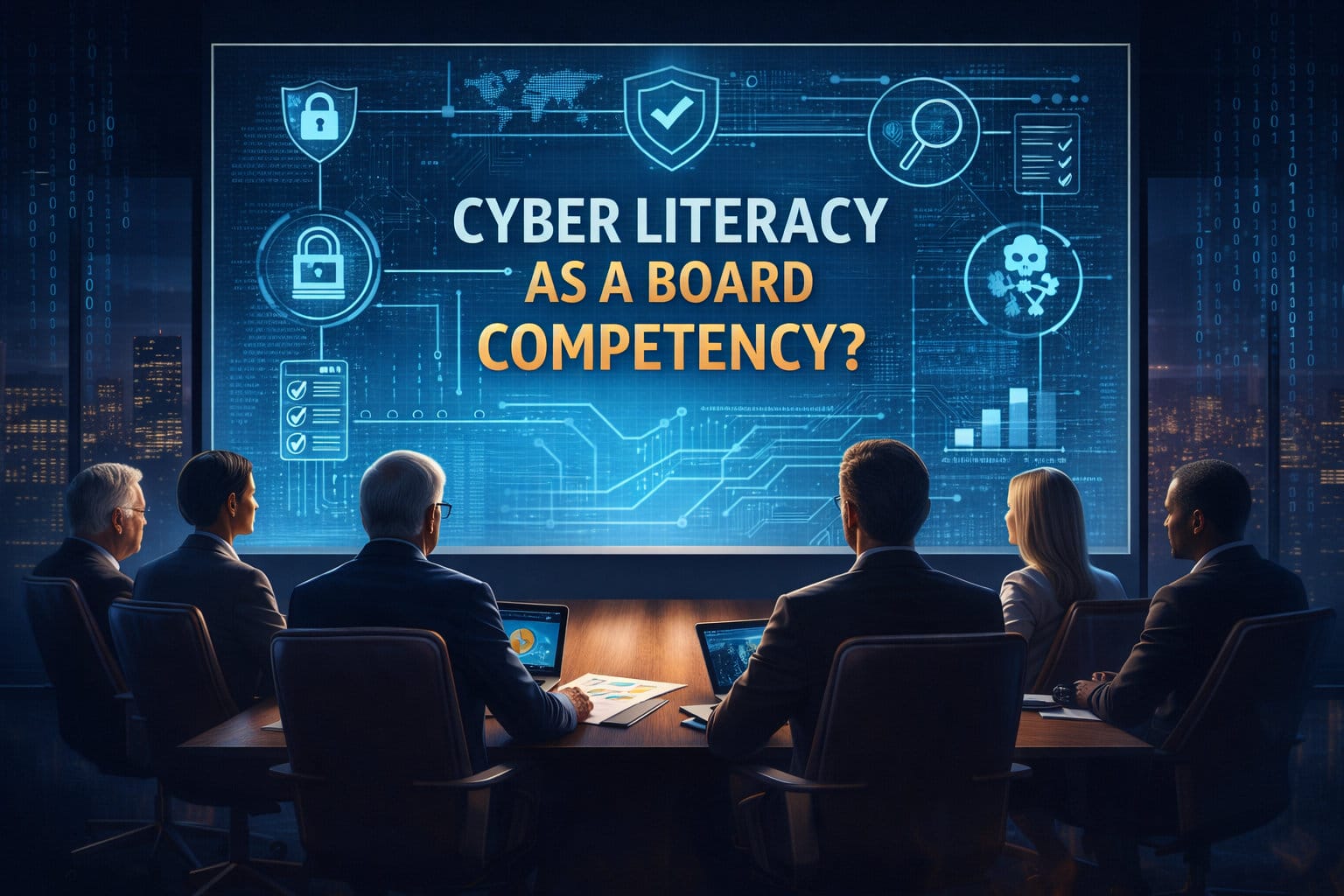
Is cyber literacy now a required board competency?
Not technical expertise.
Literacy.
The ability to understand, question, and govern cyber risk at the enterprise level.
The Shift From Awareness to Capability
For years, boards were encouraged to “be aware” of cybersecurity.
Awareness is no longer sufficient.
Today, directors are expected to:
- Understand how cyber risk affects enterprise value
- Interpret risk reporting in a meaningful way
- Ask consequence-oriented questions
- Evaluate management’s response to risk
- Participate in informed decision-making
This requires more than passive familiarity.
It requires capability.
What Cyber Literacy Actually Means
Cyber literacy does not mean:
- Writing code
- Configuring systems
- Managing security tools
It means understanding:
- How digital systems support business operations
- Where disruption could materially impact the organization
- How cyber risk intersects with financial, operational, and regulatory risk
- What constitutes effective oversight
In other words, it is the ability to govern, not operate.
Regulatory and Market Signals
Across sectors, expectations are evolving.
Regulators increasingly examine:
- Board oversight of cyber risk
- Director engagement in cyber discussions
- Documentation of governance activity
Investors and stakeholders are also paying attention.
Cyber incidents are no longer viewed solely as technical failures.
They are increasingly evaluated as governance failures.
The Composition Question
This raises a practical issue for boards:
Do we have sufficient cyber literacy within our current composition?
Historically, boards have addressed emerging risks by:
- Adding directors with relevant experience
- Engaging external advisors
- Establishing specialized committees
Cyber risk is now reaching that threshold.
Some boards are:
- Recruiting directors with cyber or digital risk backgrounds
- Providing structured education for existing members
- Increasing reliance on independent expertise
The approach may vary.
The requirement for capability does not.
The Risk of Over-Correction
There is also a risk of overcorrecting.
Cyber literacy does not require every director to be a technical specialist.
Boards function through collective capability.
The objective is not technical depth.
It is governance competence.
A board with one highly technical expert but limited overall literacy may still struggle.
Questions Boards Should Be Asking
- Do we understand cyber risk in enterprise terms?
- Are we asking the right questions during briefings?
- Can we evaluate whether management’s responses are adequate?
- Is cyber risk integrated into our broader governance discussions?
- Do we need additional expertise at the board or advisory level?
These questions reflect capability, not compliance.
Education vs. Composition
Boards have two primary paths:
Education
- Structured briefings
- Scenario-based exercises
- Ongoing learning
Composition
- Adding directors with relevant expertise
- Engaging advisors
- Strengthening committee structures
Most boards will require a combination of both.
The Core Principle
Cyber literacy is becoming a governance requirement.
Not because technology has changed.
But because enterprise dependency has.
Boards are expected to govern the risks that matter most.
For many organizations, cyber risk now sits firmly in that category.
And governance requires understanding.
In our next edition, we will examine whether boards should create dedicated cyber committees — or integrate cyber oversight into existing structures.
If you serve on a board or advise executive leadership teams, subscribe to The Cyber Governance Brief for continued analysis on cybersecurity as fiduciary responsibility.