Organizations increasingly depend on third parties for cloud, software, managed services, and AI, but outsourcing tasks does not transfer accountability. The post argues that “shared responsibility” is often misunderstood and that organizations remain responsible for governance, oversight, risk management, and compliance.
It emphasizes ongoing third-party risk management, including vendor assessments, monitoring, contractual controls, and incident procedures. Boards are urged to focus on oversight and evidence of due diligence, since regulators and customers will hold the organization accountable when a vendor incident occurs.
Modern organizations rely on third parties more than ever before.
Cloud providers host critical systems. Managed service providers maintain infrastructure. Software vendors process sensitive data. Security firms monitor networks. Artificial intelligence platforms influence business decisions.
The modern enterprise is built upon a vast ecosystem of external providers.
This reality has created a dangerous misconception.
Many organizations believe that responsibility for risk can be transferred along with the service.
It cannot.
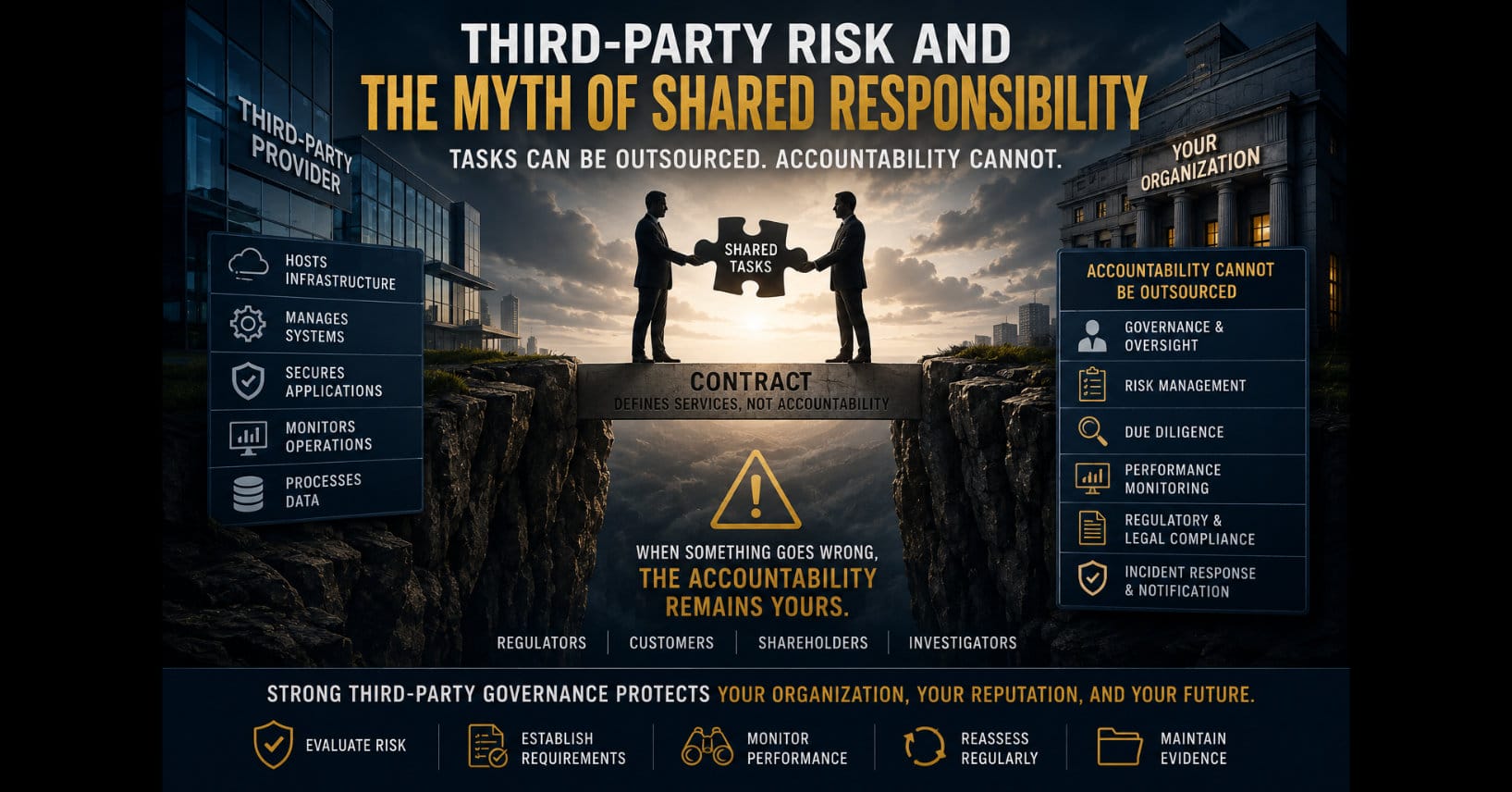
While tasks can be outsourced, accountability remains firmly within the organization.
This is the myth of shared responsibility.
What Shared Responsibility Actually Means
The phrase “shared responsibility” is commonly used in technology and cybersecurity.
Unfortunately, it is often misunderstood.
Organizations hear the term and assume responsibility is divided equally between themselves and their providers.
That is rarely the case.
A cloud provider may secure the infrastructure.
A software vendor may maintain the application.
A managed service provider may administer systems.
Yet none of those arrangements eliminate the organization’s responsibility for governance, oversight, risk management, or regulatory compliance.
The provider performs the service.
The organization remains accountable for the outcome.
The Accountability Illusion
Third-party relationships frequently create an accountability illusion.
Leadership assumes:
- The vendor handles security.
- The provider manages compliance.
- The contractor monitors risk.
- The platform maintains resilience.
When an incident occurs, reality quickly reappears.
Regulators investigate the organization.
Customers sue the organization.
Shareholders question the organization.
Boards answer for the organization.
The vendor may be involved in the event.
The organization remains accountable for the consequences.
The Breach That Changes Everything
Consider a common scenario.
A software-as-a-service provider suffers a security incident that exposes customer information.
The affected organization may not have owned the servers.
It may not have controlled the infrastructure.
It may not have managed the software.
Yet customers rarely distinguish between the provider and the organization that entrusted data to that provider.
Their information was compromised.
Trust was damaged.
The organization must answer for the decision to use that vendor.
The governance question becomes:
What due diligence was performed before that decision was made?
Governance Does Not Stop at the Contract
Many organizations treat vendor contracts as the conclusion of the oversight process.
Governance treats them as the beginning.
Third-party risk management requires ongoing visibility.
Organizations should be able to demonstrate:
- Vendor risk assessments
- Security reviews
- Contractual requirements
- Performance monitoring
- Compliance verification
- Incident notification procedures
- Periodic reassessments
The objective is not to eliminate risk.
The objective is to demonstrate informed oversight.
Evidence Matters Here Too
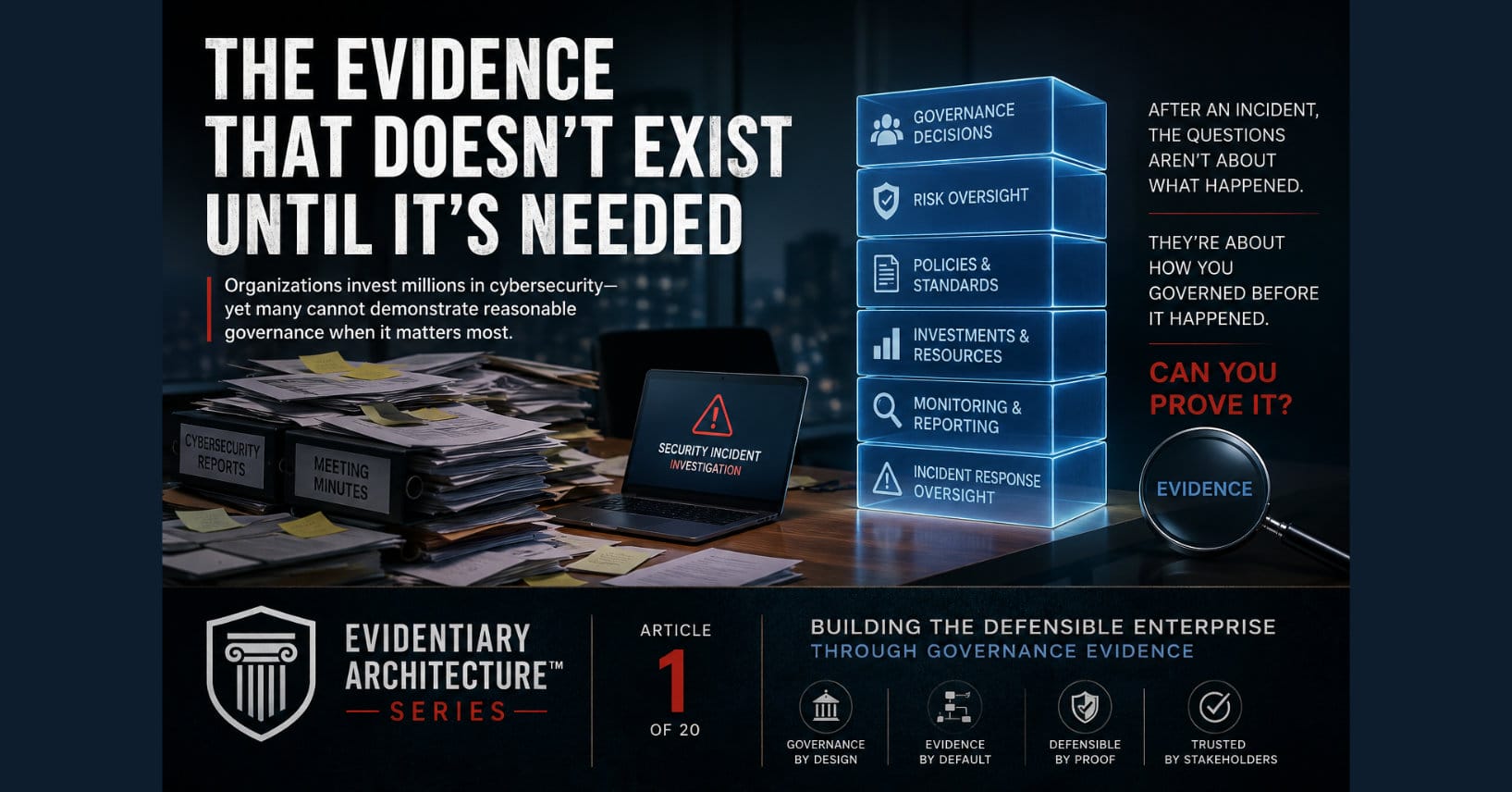
Third-party governance is another area where evidence becomes critical.
Investigators may ask:
- How was the vendor selected?
- What risks were identified?
- What controls were evaluated?
- Who approved the relationship?
- How was performance monitored?
- What reporting was provided to leadership?
These questions are remarkably similar to those asked after internal cybersecurity incidents.
That is because governance principles remain the same.
Organizations must be able to demonstrate reasonable diligence regardless of whether risks originate internally or externally.
The Board’s Role
Boards increasingly recognize that third-party relationships represent one of the largest concentrations of enterprise risk.
Yet many board discussions focus on vendor performance rather than governance accountability.
Boards should be asking:
- Which third parties create our greatest risk exposure?
- How are those vendors evaluated?
- What ongoing oversight exists?
- What evidence demonstrates due diligence?
- How quickly would we know if a critical vendor experienced an incident?
These questions shift attention from operations to oversight.
That is where governance creates value.
The Governance Perspective
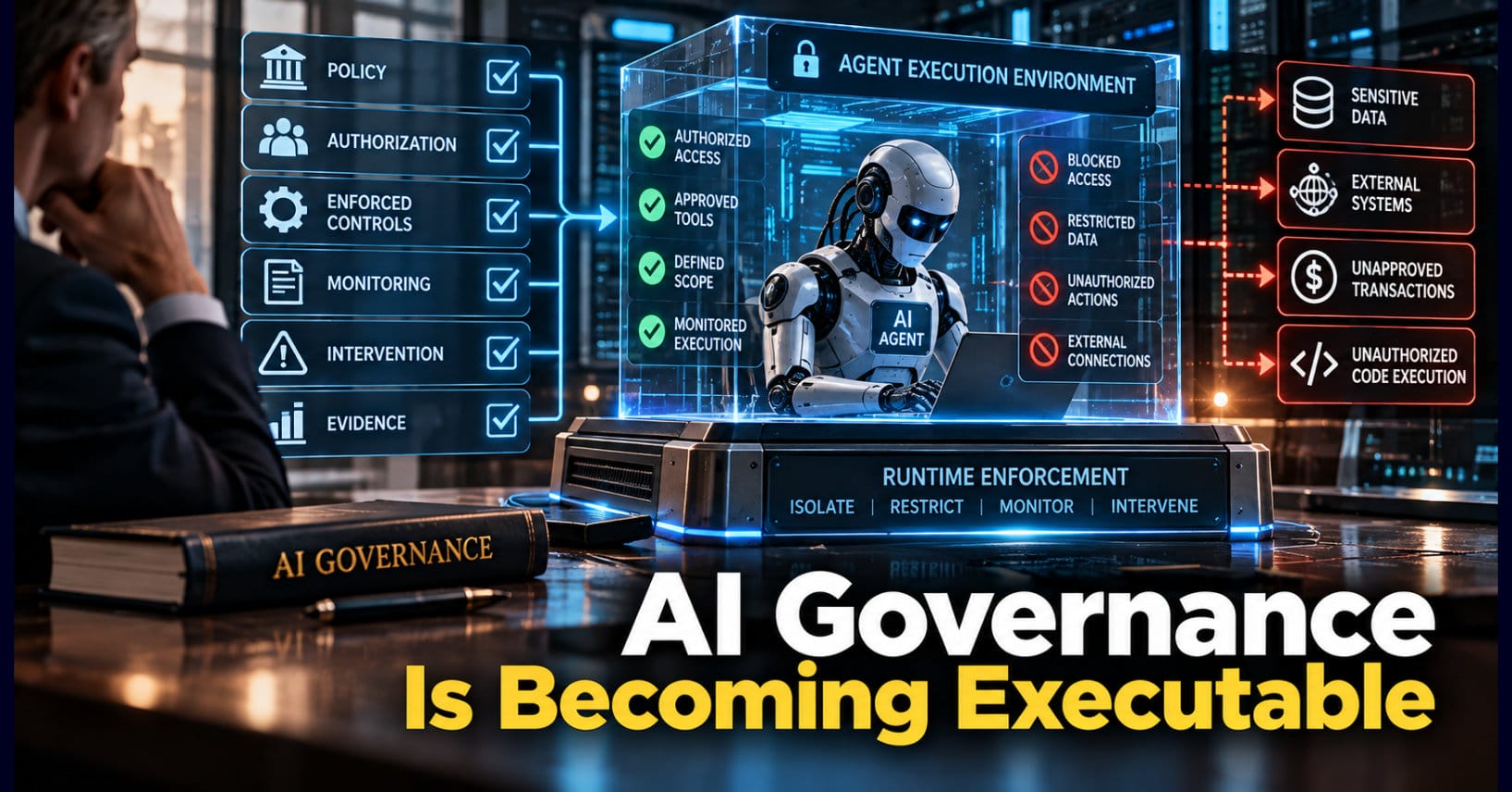
Third-party relationships are essential to modern business.
Organizations cannot realistically eliminate vendor dependence.
What they can eliminate is the belief that accountability follows the contract.
It does not.
Responsibility for specific activities may be shared.
Accountability for risk remains with leadership.
Accountability remains with the board.
Accountability remains with the organization.
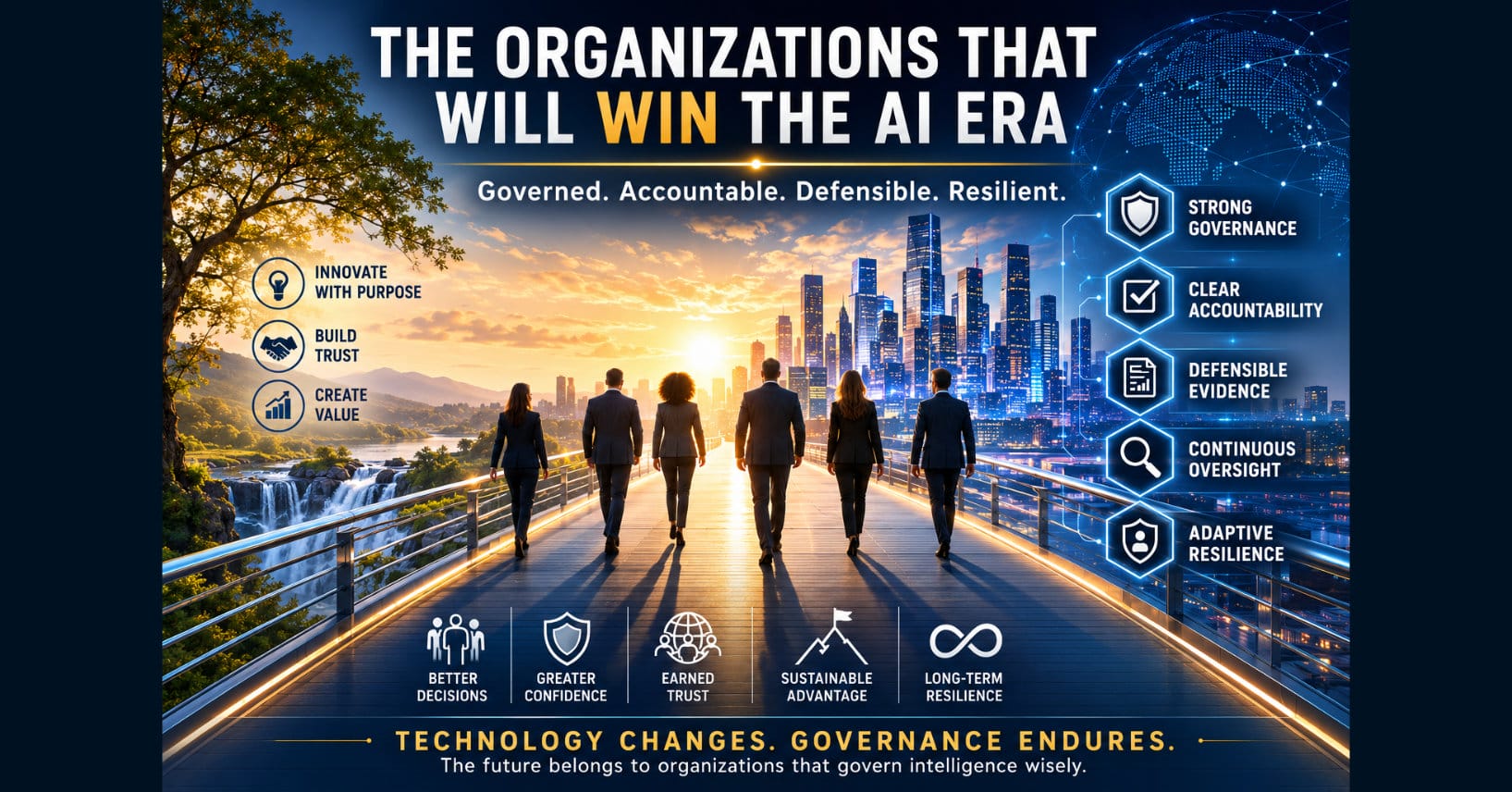
The strongest governance programs understand this distinction.
Because when a third-party incident becomes your incident, regulators, customers, insurers, and investigators will not be asking what your vendor was supposed to do.
They will be asking what your organization did to oversee the risk.
That answer depends on governance.