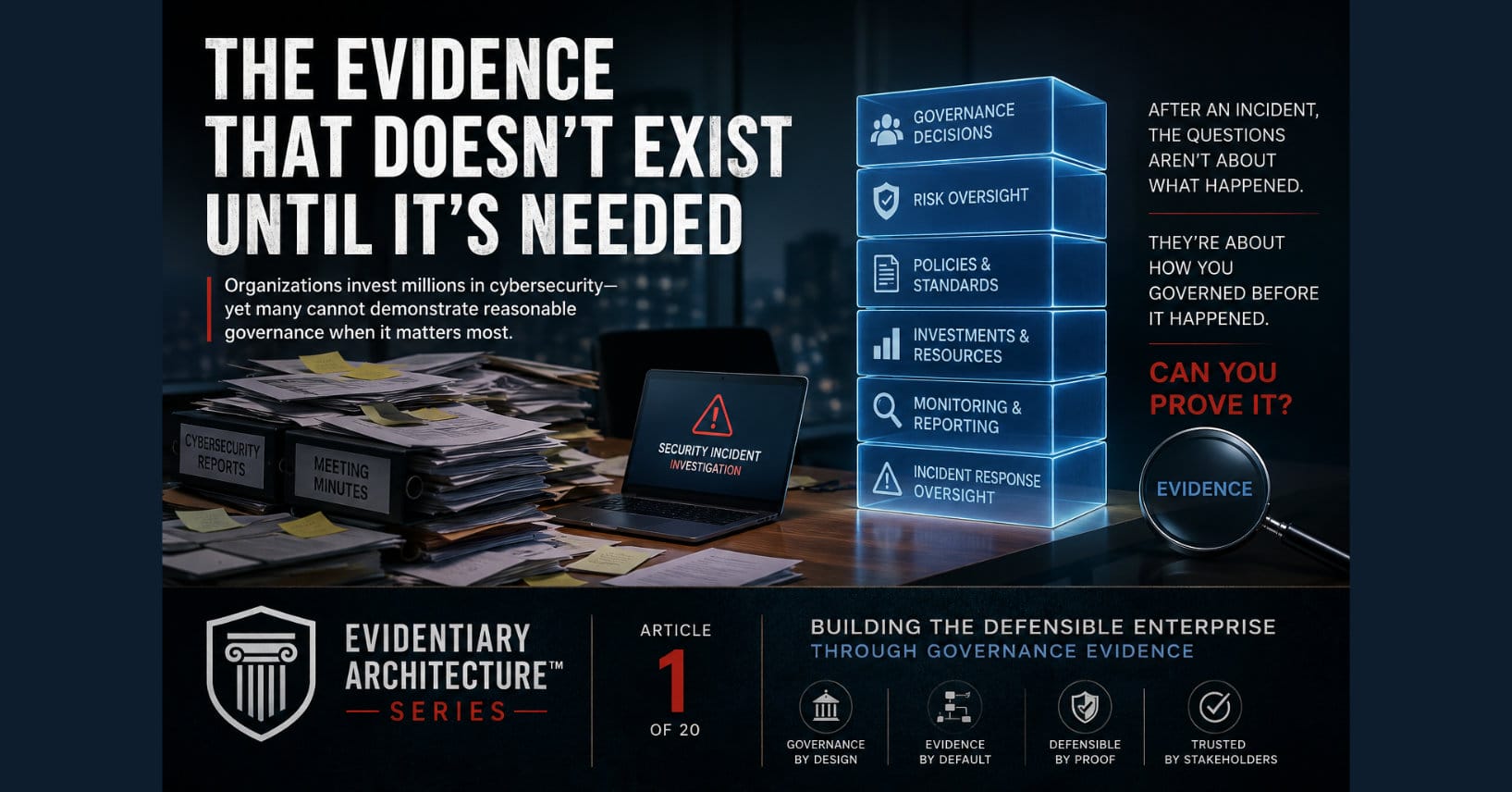
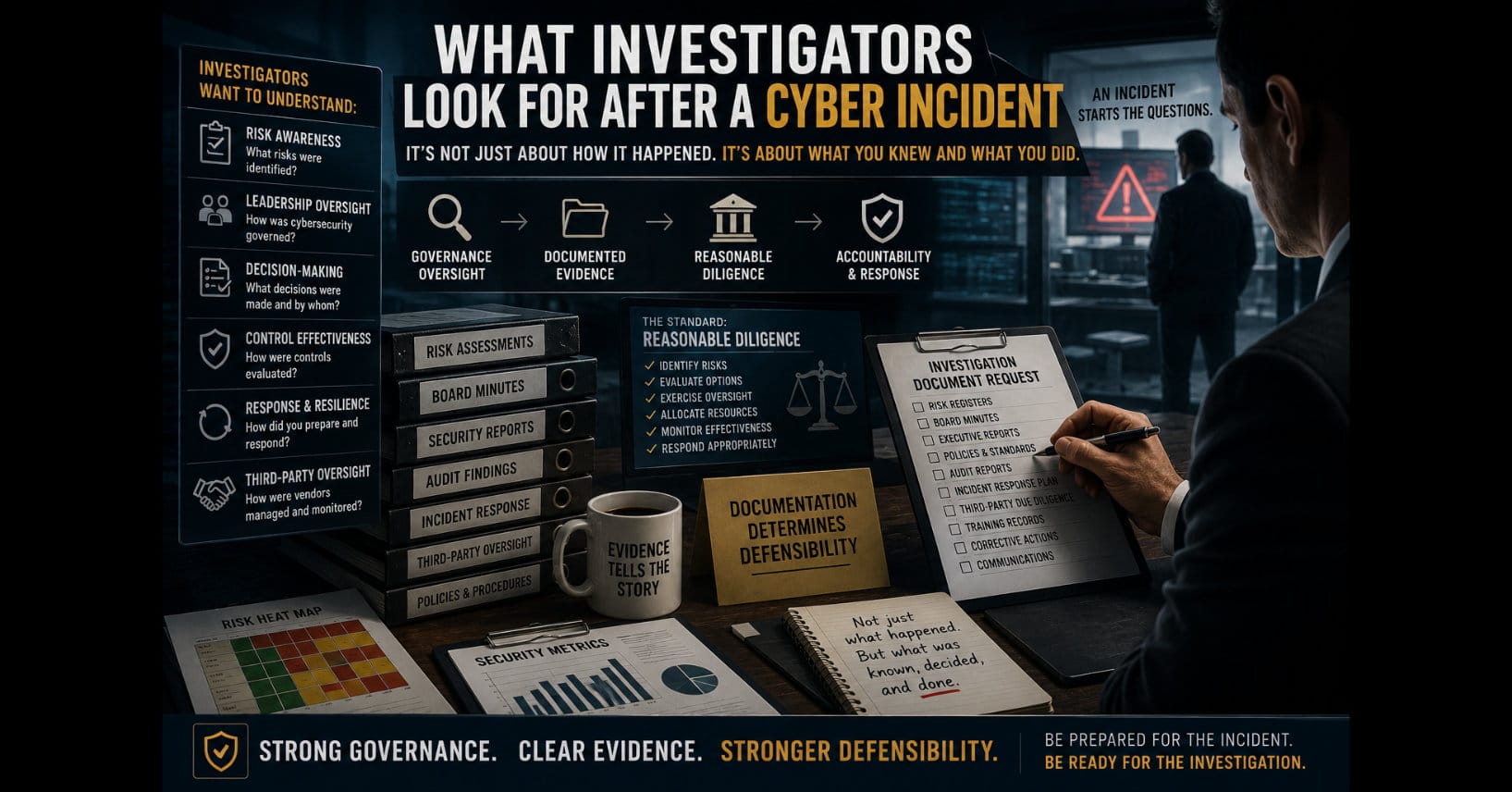
Cyber incident investigations often focus less on how attackers entered and more on what leadership knew, how risks were managed, and whether governance was effective. Investigators typically review board materials, risk assessments, incident response plans, and vendor oversight records to assess reasonable diligence.
The article argues that documentation and evidence of oversight are central because investigations are treated as governance reviews. Organizations that can show informed decision-making, monitoring, and follow-up are generally better positioned than those that cannot prove these actions occurred.
When a significant cyber incident occurs, organizations often focus on the wrong question.
They ask:
“How did the attackers get in?”
Investigators certainly want that answer.
But it is rarely their first concern.
Regulators, insurers, auditors, attorneys, and forensic investigators are often more interested in a different question:
“What did leadership know, and what did leadership do?”
This distinction surprises many executives.
Cyber incidents are often viewed as technical failures.
Investigations are frequently governance reviews.
The Investigation Begins Before the Incident
One of the most important realities in cybersecurity governance is that investigations rarely begin at the moment of the breach.
They begin months or years earlier.
Investigators want to understand the organization’s overall approach to risk management and oversight.
They examine:
- Risk assessments
- Governance structures
- Board reporting
- Security policies
- Control evaluations
- Incident response planning
- Third-party oversight
- Leadership decision-making
The objective is to determine whether the organization exercised reasonable diligence before the event occurred.
The breach simply provides the reason to ask the questions.
The First Documents Requested
Organizations are often surprised by the documents requested during investigations.
The list rarely starts with technical logs.
Instead, investigators frequently request:
- Risk registers
- Board minutes
- Executive reports
- Security assessments
- Audit findings
- Incident response plans
- Tabletop exercise results
- Vendor due diligence records
- Policy reviews
- Corrective action plans
These materials tell the story of organizational oversight.
They help investigators understand whether cybersecurity was treated as a governance responsibility or merely a technical function.
Risk Awareness Matters
One of the most significant questions investigators ask is whether the organization was aware of the risks involved.
Organizations are not expected to eliminate every risk.
That would be impossible.
However, organizations are expected to identify, evaluate, and manage risks appropriately.
Investigators often focus on:
- Known vulnerabilities
- Prior warnings
- Audit findings
- Unresolved deficiencies
- Accepted risks
If leadership knew about a risk and failed to address it, the investigation may take a very different direction than if the risk was unknown.
Documentation becomes critical.
Evidence often determines whether a risk appears ignored or managed.
The Role of Leadership
Investigations frequently extend beyond technical teams.
Leadership decisions become part of the review.
Investigators may examine:
- Budget decisions
- Resource allocations
- Risk acceptance approvals
- Policy exceptions
- Escalation procedures
- Board oversight activities
The goal is not to assign blame.
The goal is to determine whether governance processes functioned as intended.
Cybersecurity is increasingly viewed as an enterprise risk issue.
Enterprise risks require leadership involvement.
Evidence of Oversight
Organizations often assume that good intentions will be recognized during an investigation.
Unfortunately, investigations do not operate on assumptions.
They operate on evidence.
Investigators seek proof that oversight occurred.
Examples include:
- Board presentations
- Executive briefings
- Risk committee reports
- Security metrics
- Remediation tracking
- Follow-up actions
- Governance reviews
The existence of these artifacts demonstrates that cybersecurity was actively managed.
Their absence can create the opposite impression.
Third-Party Risk Is Included
As organizations rely more heavily on vendors, cloud providers, and managed service providers, investigators increasingly examine third-party governance.
Questions may include:
- How was the vendor selected?
- What due diligence was performed?
- What security requirements existed?
- How was performance monitored?
- What oversight occurred?
Organizations often discover that outsourcing services does not reduce investigative scrutiny.
In many cases, it increases it.
The organization remains accountable for the vendor relationship.
The Standard Is Reasonable Diligence
A common misconception is that investigators expect perfection.
They do not.
Cybersecurity incidents can occur even in well-managed environments.
The standard is typically reasonable diligence.
Investigators want to determine whether leadership:
- Identified risks
- Evaluated options
- Exercised oversight
- Allocated resources
- Monitored effectiveness
- Responded appropriately
Organizations that can demonstrate these activities are often in a stronger position than those that simply claim they occurred.
Once again, evidence becomes the differentiator.
The Governance Perspective
Many organizations prepare extensively for cyberattacks.
Far fewer prepare for cyber investigations.
Yet the investigation often has a greater long-term impact than the incident itself.
Reputations are shaped by how organizations respond.
Regulatory outcomes are influenced by governance records.
Insurance claims depend on documentation.
Legal defenses rely on evidence.
The organizations that navigate investigations most successfully are rarely the ones that avoided every risk.
They are the ones that can demonstrate that risks were identified, decisions were informed, oversight was exercised, and accountability was clear.
In other words, they can prove that governance occurred.
And that is often what investigators are looking for.