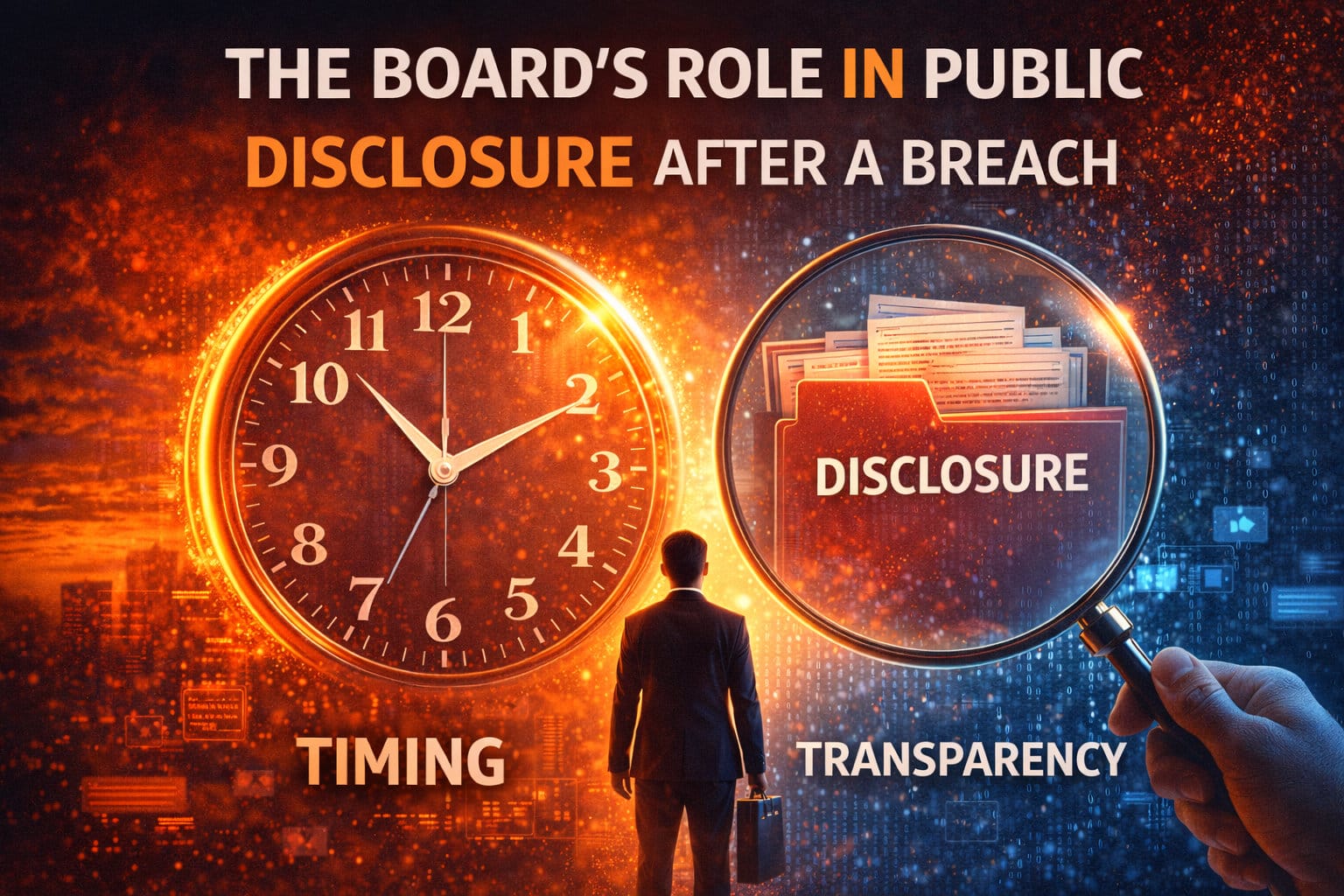
After a cyber incident, one question quickly rises:
What do we disclose — and when?
This is not only a legal decision.
It is a governance decision.
Disclosure Is Not Just Compliance
Regulatory requirements define minimum disclosure obligations.
But minimum compliance is not the same as effective governance.
Boards must consider:
- Accuracy
- Timing
- Completeness
- Consistency
Disclosure shapes how stakeholders interpret the event.
The Tension
Organizations often face competing pressures:
- Legal caution
- Regulatory timelines
- Reputational impact
- Operational uncertainty
Disclose too early, and information may be incomplete.
Disclose too late, and trust erodes.
This tension cannot be resolved by management alone.
Why Boards Must Be Engaged
Public disclosure following a breach affects:
- Investor confidence
- Customer trust
- Regulatory posture
- Legal exposure
These are board-level concerns.
Directors should not draft statements.
But they must oversee the approach.
The Governance Role
Boards should ensure:
- A defined disclosure framework exists
- Roles and responsibilities are clear
- Legal, communications, and executive teams are aligned
- Escalation pathways are established
- Decision rationale is documented
In a crisis, structure matters.
Consistency and Credibility
Inconsistent messaging creates risk.
Contradictions between:
- Initial disclosures
- Follow-up updates
- Regulatory filings
- Public statements
can undermine credibility.
Boards should ensure that messaging is coordinated across channels.
The Investigative Lens
After a breach, external parties will examine:
- When leadership became aware
- When disclosure decisions were made
- What information was available at the time
- How decisions were documented
Disclosure timing is often evaluated in hindsight.
Governance must withstand that review.
Transparency vs. Exposure
Transparency builds trust.
But disclosure must be:
- Accurate
- Controlled
- Aligned with legal obligations
Boards must balance openness with responsibility.
Preparation Before the Event
Effective disclosure begins before an incident occurs.
Boards should ask:
- Do we have a tested disclosure protocol?
- Who has authority to approve messaging?
- How quickly can we assemble accurate information?
- Have we rehearsed disclosure scenarios?
Preparation determines response quality.
The Core Principle
Public disclosure after a breach is not just about what is said.
It is about how leadership exercises judgment under pressure.
And that is the essence of governance.

#BoardGovernance #CyberRisk #CrisisManagement #Disclosure #FiduciaryDuty