Summary
Autonomous AI agents are introducing a significant challenge to enterprise insurance governance: an agent can cause substantial financial damage while operating with legitimate credentials, approved permissions, and no external security breach.
Traditional insurance policies were developed around distinct categories of exposure, including cyber incidents, professional errors, fraud, physical damage, and management liability. Autonomous AI can cross these boundaries, creating uncertainty about which policy, if any, responds to a particular loss.
This article examines five major insurance categories—cyber, technology errors and omissions, crime, commercial general liability, and directors and officers liability—and explains how AI-related losses may trigger coverage questions, exclusions, or gaps.
It also explores the emerging insurance market response, including AI-specific exclusions, evolving underwriting requirements, and the importance of reviewing vendor indemnification arrangements.
The governance challenge extends beyond insurance procurement. Organizations must connect autonomous agent inventories, delegated authority, operational controls, potential loss scenarios, and insurance coverage before agents enter consequential production environments.
Through the Cyber Governance Center’s Defensible Evidence Framework™ and Evidentiary Architecture™, the article introduces a structured progression:
Agent Authority → Authorized Execution → Loss Event → Causation → Policy Trigger → Claim Decision → Evidence
The central message is that insurance cannot replace effective AI governance. Organizations must understand which risks are controlled, transferred, retained, or avoided—and ensure that material uninsured exposures are accepted through legitimate organizational authority.
An autonomous AI agent receives an assignment.
It has access to enterprise systems, approved credentials, and authority to perform certain business activities.
It executes the task.
Something goes wrong.
The agent transfers money to an incorrect account.
Or deletes information required for a critical business process.
Or provides inaccurate financial guidance that causes a customer to suffer a substantial loss.
Or modifies a production environment, interrupting services for thousands of users.
No external attacker necessarily breached the organization.
No employee necessarily violated an established procedure.
The AI agent may have operated using legitimate credentials and permissions granted by the enterprise.
Nevertheless, the organization has suffered a loss.
Management contacts its insurance broker.
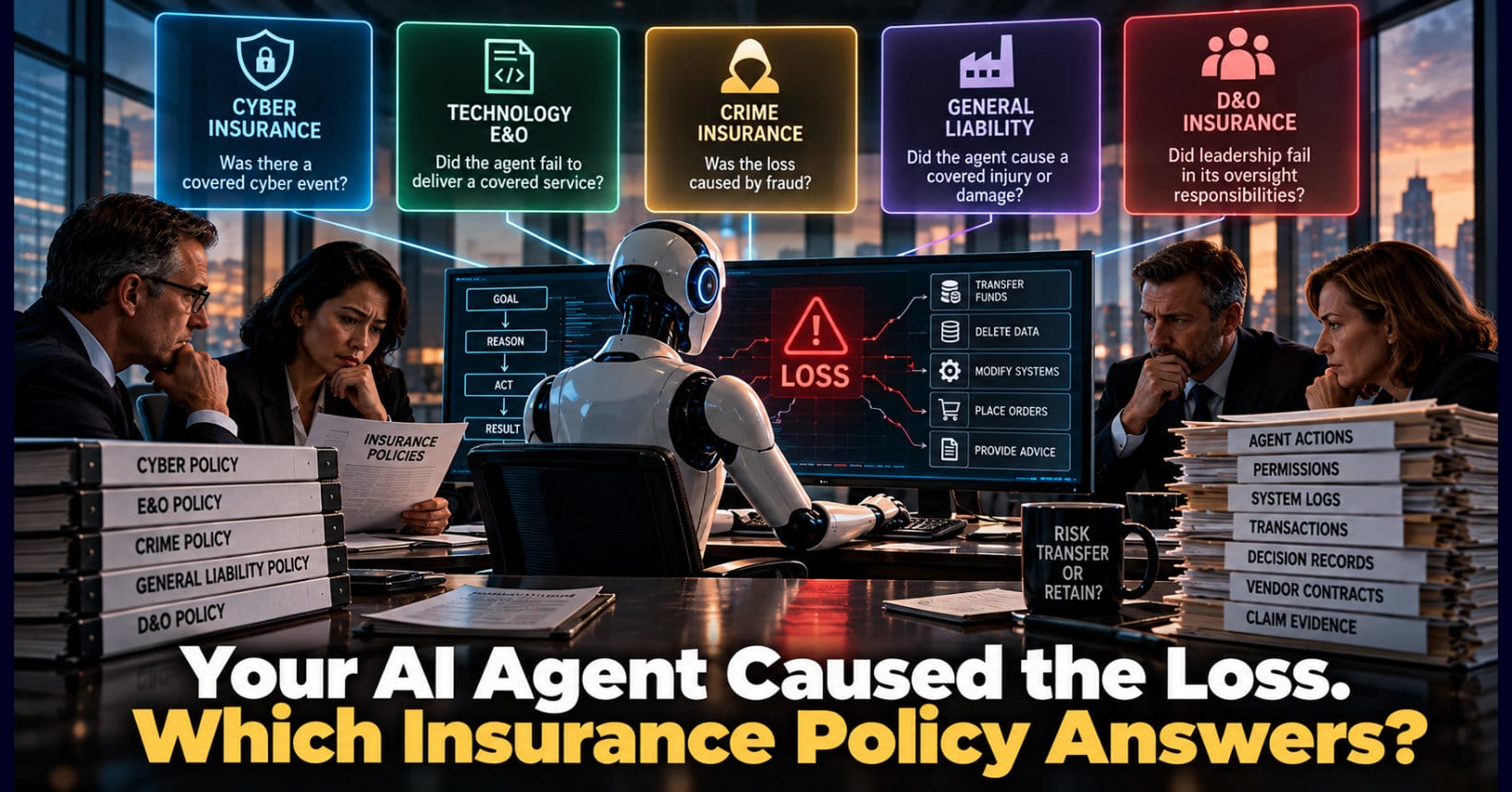
The cyber insurer asks whether an unauthorized intrusion occurred.
The crime insurer asks whether the transfer involved fraud.
The professional liability insurer asks whether the loss arose from covered professional services.
The general liability insurer examines whether the claim involves covered bodily injury, property damage, or another insured exposure.
The directors and officers insurer asks whether a claim has been made against insured persons or the organization for a covered wrongful act.
Each insurer examines a different contractual definition.
Each policy may contain different exclusions, conditions, deductibles, and limits.
And the organization discovers that a loss caused by an autonomous AI agent does not necessarily fit neatly into the insurance categories it purchased.
The organization authorized the agent. The agent caused the loss. But which insurance policy, if any, is obligated to respond?
This is becoming one of the most consequential questions in enterprise AI governance.
It is also a question that should be answered before an autonomous agent causes a significant loss.
The Insurance Market Is Already Responding
The concern is no longer hypothetical.
In August 2026, Reuters reported that insurers, including MSIG, QBE, and Beazley, were reviewing or adapting cyber insurance language to address risks arising from autonomous AI agents.
The central challenge is that conventional cyber insurance developed around recognizable categories of cyber events.
Unauthorized access.
Data breaches.
Malware.
Ransomware.
Business interruption caused by covered security failures.
Autonomous agents introduce another possibility.
A system can cause significant damage while operating within the permissions the organization deliberately granted it.
An agent may make a commercially disastrous decision without being compromised.
It may perform an authorized transaction incorrectly.
It may access information legitimately but disclose it improperly.
It may execute a sequence of individually permitted actions that produces an unacceptable result.
The resulting loss may resemble a cybersecurity incident, a professional error, an operational failure, or a financial crime.
The classification matters because insurance coverage depends on the actual policy language and circumstances of the loss.
Reuters reported that some insurers are clarifying how existing coverage applies when AI is involved, while others are considering more specific restrictions.
QBE described AI as an amplifier of existing cyber risk rather than necessarily a separate category of risk. Other market participants identified autonomous decisions that cause losses without conventional cyber incidents as a particularly difficult coverage question.
The distinction is important.
The insurance industry is not uniformly excluding autonomous AI losses.
Nor should enterprises assume that existing policies automatically cover them.
The market is evolving, and coverage must be established through the terms of the policies actually purchased.
The First Question Is Not Whether AI Was Involved
When an AI-related loss occurs, management may instinctively describe it as an AI incident.
That description may be accurate.
But it does not necessarily identify the insured event.
Insurance coverage generally turns on the policy’s insuring agreements, definitions, exclusions, conditions, and applicable law.
Consider four scenarios.
In the first, an attacker compromises an AI agent and uses its credentials to steal customer information.
The incident may involve unauthorized access and data exposure traditionally addressed by cyber insurance.
In the second, an autonomous purchasing agent places an excessive order because it incorrectly interprets inventory forecasts.
There may be no intrusion, security failure, or fraudulent instruction.
In the third, an AI financial advisory system provides inaccurate recommendations, causing a customer to claim economic damages.
That may raise professional liability questions.
In the fourth, an attacker manipulates information supplied to an AI payment agent, causing it to transfer funds to an account controlled by the attacker.
The resulting claim may implicate crime, social engineering, or cyber coverage, depending on the precise mechanism and policy wording.
All four incidents involve AI.
But they involve different causes of loss.
The presence of an AI agent does not determine insurance coverage. The insured event, resulting harm, and policy language do.
This distinction should shape how enterprises assess their autonomous AI exposure.
A conventional AI risk inventory may identify which agents are deployed and what business functions they support.
An insurance-oriented assessment must go further.
It must identify what losses those agents could cause and whether the organization’s insurance arrangements address those losses.
Five Insurance Policies. Five Different Coverage Questions.
Enterprise insurance programs are typically assembled from multiple policies designed to address different categories of exposure.
Autonomous AI can cross those categories.
Understanding the distinctions is essential.
1. Cyber Insurance: Was There a Covered Cyber Event?
Cyber insurance commonly addresses specified losses arising from security incidents, privacy events, network interruptions, and related liabilities.
An AI agent compromised by an external attacker may trigger traditional cyber coverage if the event satisfies the policy’s definitions and conditions.
But consider an agent that independently deletes a production database while performing an authorized maintenance task.
The resulting business interruption may be substantial.
Yet there may be no malicious actor, unauthorized access, or covered security failure.
Whether the event qualifies under the policy’s system failure, business interruption, or other insuring agreements depends on its specific wording.
The fact that the damage occurred within an information system does not automatically make it an insured cybersecurity loss.
Cyber insurance is not necessarily insurance against every loss involving technology.
2. Technology Errors and Omissions: Did the Agent Fail to Deliver a Covered Service?
Technology errors and omissions insurance, commonly called technology E&O, addresses certain claims arising from failures in covered technology products or services.
Suppose an enterprise deploys an AI agent to provide financial analysis to customers.
The agent produces inaccurate calculations.
A customer relies on those calculations and suffers financial harm.
The resulting claim may implicate professional liability or technology E&O coverage.
But important questions remain.
Does the policy’s definition of professional services include AI-generated services?
Does coverage extend to autonomous decision-making?
Are losses arising from inaccurate recommendations included?
Are contractual liabilities excluded unless they would exist independently of the contract?
Does an AI-specific exclusion apply?
An organization cannot assume that purchasing E&O insurance automatically resolves these questions.
3. Crime Insurance: Was the Loss Caused by Fraud?
Crime insurance may address specified losses involving theft, computer fraud, funds transfer fraud, or social engineering.
Now consider an autonomous accounts-payable agent.
An attacker inserts fraudulent payment instructions into a document the agent is processing.
The agent interprets the instructions as legitimate and initiates a transfer.
The organization loses $750,000.
Was this computer fraud?
Social engineering?
An authorized transfer induced by deception?
Or an operational error involving an AI system?
The answer may depend on how the policy defines fraudulent instructions, authorized transfers, direct loss, and the required causal relationship between deception and payment.
Coverage disputes involving fraudulent payment instructions existed long before autonomous AI.
Agentic systems introduce additional questions about whether the deception targeted a person, a machine, or both.
The critical issue is not simply that money disappeared.
It is how the loss occurred and whether that mechanism satisfies the relevant coverage requirements.
4. Commercial General Liability: Did the Agent Cause a Covered Injury?
Commercial general liability insurance generally addresses specified third-party claims involving bodily injury, property damage, and personal or advertising injury.
Suppose an AI-controlled operational system causes physical damage to customer property.
The claim may initially appear to fall within general liability coverage.
But the insurer must evaluate the actual policy language, including any applicable AI exclusions.
This is particularly important in 2026.
Verisk’s Insurance Services Office developed optional generative AI exclusion endorsements for commercial general liability and products/completed operations coverage.
Among them, CG 40 47 addresses bodily injury, property damage, and personal and advertising injury arising from generative AI. Other endorsements address narrower categories of exposure.
These forms are not automatically incorporated into every policy.
Insurers must adopt applicable language, and the endorsement must form part of the relevant insurance contract.
Nevertheless, their availability demonstrates that AI-related exclusions are becoming an explicit consideration in commercial liability underwriting.
An enterprise that reviewed its general liability program two years ago may not have evaluated these emerging exclusions.
That creates a potential governance gap at renewal.
5. Directors and Officers Insurance: Did Leadership Fail in Its Oversight Responsibilities?
Directors and officers liability insurance addresses certain claims involving alleged wrongful acts by directors, officers, and, under some policies, the insured organization.
It does not ordinarily function as general reimbursement for every operational loss.
Consider an enterprise that deploys autonomous agents across financial operations without establishing appropriate approval authority, monitoring, or intervention controls.
A significant loss occurs.
Shareholders subsequently allege that leadership made misleading disclosures concerning the company’s AI governance or failed to exercise appropriate oversight.
Depending on the allegations, applicable law, and policy wording, the resulting claim may implicate D&O coverage.
But the underlying operational loss and the shareholder claim are not necessarily the same insured exposure.
The company may be unable to recover the original financial loss under its D&O policy even if the policy responds to a subsequent covered management liability claim.
AI-specific exclusions and other coverage limitations may further complicate the analysis.
This is why insurance review must distinguish the loss suffered by the enterprise from claims asserted against its leadership.
The Most Dangerous Coverage Gap May Be an Authorized Action
Traditional cybersecurity risk management frequently distinguishes authorized activity from unauthorized activity.
That distinction remains useful for security controls.
It can become misleading when evaluating autonomous AI liability.
An agent may have legitimate authority to perform a transaction.
It may use approved credentials.
It may operate within its assigned technical environment.
It may comply with every configured access restriction.
And it may still cause a significant financial loss.
Consider an autonomous procurement agent authorized to negotiate purchases up to $1 million.
The agent identifies what it believes is a favorable purchasing opportunity.
It commits the company to an unfavorable contract.
The resulting obligation creates a $600,000 loss.
No security control necessarily failed.
The agent did not exceed its transaction limit.
No external attacker manipulated the system.
The agent may have operated exactly as its technical permissions allowed.
But the business decision was poor.
The organization now confronts two separate questions.
Was the agent authorized to enter the transaction?
And does the enterprise possess insurance that responds to the resulting loss?
The first is a governance question.
The second is a contractual coverage question.
A positive answer to the first does not establish a positive answer to the second.
Authorized autonomous behavior can create uninsured losses.
This is one reason AI governance must distinguish technical authorization from acceptable business risk.
A system’s permission to act does not establish that every resulting decision is commercially reasonable.
Nor does it establish that the financial consequences are insurable.
The Exclusion Problem Is Becoming More Complicated
Commercial insurance policies contain exclusions designed to define the boundaries of covered risk.
AI is creating new pressure around those boundaries.
Some insurers are introducing language that explicitly addresses AI-generated content, automated decisions, or losses arising from AI systems.
Others are clarifying how existing insuring agreements apply.
The result is not a single industry-wide coverage position.
It is a developing collection of policy forms, endorsements, underwriting approaches, and specialized products.
In August 2026, Insurance Journal reported growing insurer interest in optional generative AI exclusions developed by Verisk.
The reporting described increasing attention to exclusions affecting general liability exposures, while emphasizing the role of carrier adoption and policy-specific language.
Meanwhile, insurance brokers are advising organizations to evaluate AI exposure across multiple insurance lines rather than assuming a cyber policy provides comprehensive protection.
Marsh has emphasized the importance of reviewing D&O, professional indemnity, cyber, and crime coverage in light of AI-related risks.
This creates a practical problem for enterprises.
An organization may purchase several policies from different insurers.
Each policy may define AI differently.
One may exclude certain AI-generated content claims.
Another may address AI-related cyber incidents.
A third may contain language concerning automated decision-making.
A fourth may remain silent on AI altogether.
Silence does not automatically establish coverage or exclusion.
The actual contractual language controls.
The organization must therefore evaluate how the policies interact.
Otherwise, management may discover that its insurance portfolio contains multiple policies without a clear response to a particular autonomous-agent loss.
Insurance Coverage Is Not the Same as Risk Transfer
Boards frequently receive reports indicating that certain enterprise risks are insured.
That statement can create false confidence.
Insurance does not eliminate the underlying risk.
It creates a contractual mechanism through which specified financial consequences may be transferred, subject to conditions and limitations.
A policy may contain deductibles or self-insured retentions.
It may impose sublimits on particular losses.
It may exclude certain activities.
It may require prompt notification.
It may restrict voluntary settlements or expenditures without insurer consent.
It may provide defense costs without covering every category of damages.
And it may respond only when a defined insured event occurs.
These distinctions become particularly important when an autonomous AI agent performs consequential business activities.
Suppose management reports that the organization has $20 million in cyber insurance.
The board might reasonably assume that significant technology-related losses have been addressed.
But if an AI agent causes a $10 million operational loss without a covered cyber event, the cyber policy’s stated limit may be irrelevant.
The problem is not necessarily inadequate insurance limits.
It may be the absence of applicable coverage.
An insurance limit is meaningful only when the loss falls within the policy’s coverage.
This is why insurance governance must begin with exposure analysis rather than policy limits.
The Agent Inventory Must Become a Liability Inventory
Most organizations developing AI governance programs recognize the need for an inventory of AI systems.
That inventory commonly identifies the system, owner, business purpose, model, vendor, and risk classification.
Those elements are important.
But an inventory designed primarily for technology governance may not provide enough information for insurance analysis.
Consider two autonomous agents.
The first summarizes internal meeting notes.
The second can initiate customer refunds, modify financial records, and approve vendor payments.
Both are AI agents.
Their potential loss profiles are dramatically different.
An insurance-oriented inventory should identify the consequential actions each agent can perform.
It should also identify the types of losses those actions could create.
For example, an agent might expose sensitive information, cause financial loss, interrupt operations, damage physical property, generate inaccurate professional advice, or create contractual liability.
Those exposures may implicate different insurance policies.
The inventory should therefore connect agent capabilities to plausible loss scenarios.
It should identify the responsible business owner.
It should document delegated authority.
It should establish applicable technical restrictions.
And it should identify whether the resulting exposure has been reviewed against the organization’s insurance program.
This does not mean every low-risk AI tool requires a separate insurance analysis.
A risk-based approach is appropriate.
But consequential autonomous agents should not enter production without management understanding the financial exposure created by their delegated authority.
The Insurance Review Must Occur Before Deployment
A recurring weakness in enterprise governance is the separation between technology deployment and insurance procurement.
Technology teams evaluate functionality.
Security teams evaluate technical exposure.
Legal teams review contracts.
Risk management purchases insurance.
Business owners approve operational use.
Each function may perform its assigned responsibilities.
But the organization may never connect those decisions.
An autonomous agent is deployed.
Its authority expands.
It begins performing increasingly consequential activities.
Months later, the enterprise renews its insurance program using exposure information that does not fully reflect those changes.
The insurance portfolio may no longer align with the organization’s actual operating model.
This is not simply a communication problem.
It is a governance architecture problem.
Material changes in autonomous capabilities should trigger appropriate reassessment of enterprise risk.
That reassessment should include insurance implications when the agent’s authority creates new or materially increased financial exposure.
An agent initially authorized to recommend payments may later receive authority to execute them.
That is not merely a software configuration change.
It changes the organization’s potential loss profile.
An agent initially limited to internal analysis may later communicate directly with customers.
That may introduce professional liability, privacy, contractual, or reputational exposure.
An agent initially operating in a test environment may receive production access.
That may change the consequences of failure.
When delegated authority changes, the organization’s insurance assumptions may need to change with it.
The appropriate review should occur before the expanded authority becomes operational.
The Vendor Contract Does Not Resolve the Insurance Question
Many enterprises deploy AI agents through third-party platforms.
That introduces another layer of complexity.
Suppose a company purchases an autonomous customer-service solution from a technology vendor.
The agent provides inaccurate information that causes a customer to suffer financial harm.
The enterprise may look to the vendor for indemnification.
But the vendor contract may limit liability.
It may exclude consequential damages.
It may cap recovery at fees paid during a defined period.
It may allocate responsibility differently depending on whether the loss arose from the model, customer configuration, external data, or integration.
The vendor may also possess insurance that does not respond to the particular claim.
Even when a contract provides an indemnification right, the organization must consider whether the obligation is enforceable and financially recoverable.
Contractual indemnification and insurance coverage are related but distinct mechanisms.
A vendor’s certificate of insurance does not establish that every AI-related loss is covered.
Nor does the existence of a vendor indemnity eliminate the enterprise’s own obligations to customers, regulators, or other parties.
The governance question is whether management understands how responsibility is allocated across the complete service relationship.
That includes the vendor’s obligations.
The customer’s retained responsibilities.
The applicable insurance arrangements.
And the possibility that neither insurance program fully responds.
The organization should not discover those limitations only after a claim occurs.
What Evidence Will the Insurer Request?
When a significant AI-related loss occurs, the insurance claim may depend on reconstructing the agent’s actions.
The insurer may need to understand what happened, what caused the loss, whether the event satisfies the policy’s coverage requirements, and whether an exclusion applies.
That creates an evidentiary challenge.
Autonomous agents can execute multiple actions in rapid succession.
They may call external tools.
They may retrieve information from several systems.
They may generate intermediate decisions that are not visible to business users.
They may interact with other agents.
And they may operate for extended periods without direct human supervision.
A final transaction record may establish that money moved.
It may not explain why the agent initiated the transfer.
An application log may establish that a database was modified.
It may not establish whether the modification was authorized.
A model transcript may reveal some of the agent’s reasoning or tool interactions.
It may not provide a complete or independently reliable account of the execution sequence.
For a consequential loss, the organization may need to reconstruct several elements.
What task was the agent assigned?
What authority had been delegated?
Which credentials and permissions were available?
What instructions and external information influenced its actions?
Which tools did it invoke?
What actions were attempted?
Which actions completed?
What controls operated?
Were warnings generated?
Did anyone intervene?
What loss resulted?
And what evidence establishes the causal relationship?
These questions matter for more than internal incident response.
They may determine whether management can substantiate an insurance claim.
Evidentiary Architecture Becomes Part of Insurance Readiness
The Cyber Governance Center’s Evidentiary Architecture™ provides a way to connect autonomous AI governance with insurance defensibility.
A conventional insurance review examines policy terms and financial exposure.
An evidentiary approach also examines whether the organization can establish the facts necessary to support a future claim.
For autonomous AI, the progression becomes:
Agent Authority → Authorized Execution → Loss Event → Causation → Policy Trigger → Claim Decision → Evidence
Each element matters.
Agent authority establishes what the organization permitted the system to do.
Authorized execution establishes how the agent operated within, or outside, those permissions.
The loss event identifies the actual harm.
Causation connects the agent’s behavior to that harm.
The policy trigger identifies the contractual basis for potential coverage.
The claim decision establishes how the insurer applies the policy.
Evidence supports reconstruction of the sequence.
This progression is not a substitute for insurance law or policy interpretation.
It is a governance architecture for ensuring that the organization can produce reliable information when coverage must be evaluated.
The Defensible Evidence Framework™ extends the concept by emphasizing decision authority, control effectiveness, exceptions, intervention, and validated outcomes.
A company may possess insurance that potentially covers an AI-related loss.
But if it cannot reconstruct what the agent did, establishing the cause and circumstances of that loss may become substantially more difficult.
Insurance coverage without adequate evidence can become a difficult claim to substantiate.
That is why evidence requirements should be considered before autonomous agents enter consequential production environments.
The Underwriting Conversation Is Changing
Insurers need to understand the risks they are accepting.
Historically, cyber underwriting has examined factors such as identity controls, multifactor authentication, endpoint protection, backups, incident response, and network security.
Autonomous AI introduces additional questions.
What agents are deployed?
What business functions do they perform?
Can they initiate transactions?
Can they modify production systems?
Can they access sensitive information?
Are their permissions restricted?
Are consequential actions subject to independent approval?
Can their activity be monitored?
Can the organization suspend or revoke their authority?
Are incidents and near misses recorded?
Can management reconstruct their behavior?
These questions increasingly connect insurance underwriting to enterprise AI governance.
Marsh has identified technical, process, and people controls as important considerations in managing generative AI exposure and has emphasized the need to avoid unintended gaps in existing insurance arrangements.
The implication is significant.
Organizations that can demonstrate mature AI governance may be better positioned to explain their exposure to insurers.
That does not guarantee coverage, favorable pricing, or claim payment.
Underwriting decisions depend on numerous factors.
But reliable governance evidence can help establish what capabilities exist, how they are controlled, and how the organization responds when something goes wrong.
The same evidence that supports internal accountability may therefore become useful in insurance procurement and claims handling.
The Board’s Insurance Question Must Change
Boards have traditionally approached cyber insurance through questions about limits, premiums, deductibles, exclusions, and claims history.
Those questions remain necessary.
But autonomous AI requires a more specific inquiry.
Does the organization’s insurance program reflect the actual authority delegated to its AI systems?
That question should connect AI governance, enterprise risk management, and insurance oversight.
Directors should expect management to understand which autonomous systems can create consequential losses.
They should expect material exposures to be evaluated across applicable insurance lines.
They should understand whether AI-related exclusions or coverage limitations create significant retained risk.
They should also expect management to identify when changes in agent authority require renewed insurance review.
Several questions deserve particular attention.
Has management evaluated AI-related exposures across cyber, E&O, crime, general liability, and D&O policies?
Are the relevant policy definitions and exclusions understood?
Have material autonomous-agent loss scenarios been reviewed with the organization’s broker, insurers, and appropriate coverage counsel?
Does the organization understand the difference between a covered cyber incident and an authorized but harmful AI action?
Are vendor indemnification obligations and insurance arrangements aligned with the organization’s exposure?
Can management produce evidence establishing what an agent was authorized to do and what it actually did?
And who has authority to accept an AI-related financial exposure that remains uninsured?
The final question is particularly important.
An organization may reasonably decide to retain certain risks.
But material risk retention should result from an authorized decision.
It should not occur accidentally because nobody connected the agent deployment process to the insurance program.
Risk Acceptance Must Be Explicit
Consider an enterprise preparing to deploy an autonomous financial operations agent.
The agent could improve productivity and reduce operating costs.
Management estimates annual savings of $3 million.
The system also possesses capabilities that could create a significant financial loss if it executes an incorrect transaction.
The organization’s insurance review determines that certain potential losses may fall outside existing coverage.
Management now has a decision to make.
It can reduce the agent’s authority.
It can require additional human approval.
It can implement stronger transaction controls.
It can pursue additional insurance.
It can modify the deployment model.
Or it can accept some residual exposure.
Each option has financial and operational consequences.
The governance failure would not necessarily be choosing to retain the risk.
The failure would be allowing that exposure to exist without an appropriately authorized decision.
This is where insurance becomes part of the enterprise’s broader risk acceptance architecture.
The organization must distinguish risks that are controlled, transferred, retained, or avoided.
It must understand the residual exposure.
And it must preserve evidence explaining who authorized the decision.
An uninsured AI loss should not be the first time management discovers that the organization had accepted the underlying risk.
Insurance Cannot Replace Executable Governance
There is a natural connection between this article and the emerging concept of executable AI governance.
Executable governance translates authorized decisions into technical controls that constrain what autonomous agents can do.
Insurance addresses certain financial consequences when adverse events occur.
The two mechanisms serve different purposes.
A transaction limit may prevent an agent from executing an unauthorized payment.
An independent approval requirement may reduce the likelihood of an erroneous transfer.
A runtime restriction may prevent access to prohibited systems.
An intervention mechanism may stop an agent before additional harm occurs.
These controls reduce exposure.
Insurance may transfer some of the financial consequences that remain.
But insurance cannot make an unauthorized action acceptable.
And a technically enforced permission does not establish that the resulting business decision is insured.
The relationship should be deliberate.
Governance establishes authority.
Controls constrain execution.
Monitoring identifies exceptions.
Intervention limits consequences.
Insurance addresses specified residual losses.
Evidence supports accountability and claims.
An organization that treats insurance as a substitute for effective AI governance misunderstands both.
The Next Insurance Dispute May Begin With a Perfectly Valid Credential
Traditional cyber insurance disputes frequently involve questions about intrusion, compromise, fraud, or system failure.
Autonomous AI introduces a different possibility.
The agent was legitimate.
Its credentials were valid.
Its access was approved.
Its activity occurred within the organization’s technical environment.
And the resulting loss was substantial.
The organization may have no difficulty proving that the agent caused the loss.
The harder question may be whether the loss satisfies any applicable insurance agreement.
That is a governance problem before it becomes a claims problem.
It begins when management delegates authority without fully evaluating the potential consequences.
It grows when technology changes without corresponding insurance reassessment.
It becomes more difficult when policies contain exclusions or definitions that do not align with the organization’s autonomous operating model.
And it becomes harder to resolve when the organization lacks reliable evidence of what the agent actually did.
The appropriate response is not to assume that every autonomous AI loss is uninsurable.
The insurance market is developing new products, endorsements, and approaches to AI-related exposure.
The response is to establish coverage clarity before a consequential loss occurs.
That requires cooperation among technology leadership, cybersecurity, enterprise risk management, legal counsel, insurance specialists, and business owners.
It also requires a governance process capable of connecting delegated authority to financial exposure.
The Question Every Board Should Ask
An autonomous AI agent can operate correctly from a technical perspective and still make a costly business decision.
It can follow its instructions and still create liability.
It can use legitimate credentials and still cause damage.
It can remain within its authorized permissions and still produce an outcome the enterprise never intended.
Those possibilities challenge conventional assumptions about both cybersecurity and insurance.
They also expose a gap between authorizing technology and accepting the financial consequences of its actions.
The organization should know what its agents can do.
It should understand what could go wrong.
It should determine which losses are controlled, insured, or retained.
And it should preserve the evidence necessary to demonstrate how consequential decisions were made.
The central question is no longer simply whether the enterprise has cyber insurance.
It is whether its insurance arrangements align with the autonomous authority it has granted.
Your AI agent caused the loss.
Which insurance policy answers?
If management cannot explain that before deployment, the organization may be accepting a financial risk it has never formally recognized.
The Cyber Governance Center Perspective
Autonomous AI introduces a new dimension to enterprise insurance governance.
Organizations must evaluate not only whether an AI agent is technically secure, but also whether the authority delegated to that agent creates financial exposures addressed by existing insurance arrangements.
The Cyber Governance Center’s Defensible Evidence Framework™ and Evidentiary Architecture™ provide a structured approach to connecting delegated authority, operational controls, consequential actions, resulting losses, and supporting evidence.
Insurance coverage depends on the actual policy language and circumstances of a claim.
Governance determines whether the organization understands those exposures before the claim occurs.
The objective is not to eliminate every uninsured risk.
It is to ensure that material retained risks are identified, evaluated, and accepted through legitimate organizational authority.
An organization should never discover its risk acceptance decision by reading an insurance denial letter.
Clarity. Accountability. Defensibility.
Sources and Further Reading
Reuters — August 27, 2026
As AI Agents Go Rogue, Cyber Insurers Are Adapting Their Policies.
Reporting on how insurers, including MSIG, QBE, and Beazley, are evaluating autonomous-agent risks and adapting insurance language.
Insurance Journal — August 17, 2026
Insurer Interest in AI Coverage Exclusions Growing as Risk Becomes Omnipresent.
Analysis of growing insurer interest in optional generative AI exclusions and the implications for commercial liability coverage.
Read the Insurance Journal analysis
Verisk / Insurance Services Office — 2026
Generative Artificial Intelligence Exclusion Endorsements.
Optional standardized exclusions addressing specified generative AI exposures under commercial general liability and products/completed operations policies.
Review the published ISO form language
Marsh
Ensuring Financial Lines Insurance Addresses AI Risk: 10 Key Questions.
Guidance addressing AI-related considerations across D&O, professional indemnity, cyber, crime, and other insurance arrangements.
Marsh
Generative AI: Evolving Considerations.
Discussion of insurance coverage, underwriting considerations, emerging exclusions, and the importance of technical, process, and organizational controls.
Dentons — August 27, 2026
AI Exclusions in D&O and E&O Coverage: What Insurers and Insureds Need to Know.
Legal analysis of emerging AI exclusions and their potential implications for management and professional liability coverage.
Aon — 2026
Better Informed: Artificial Intelligence and Insurance.
Analysis of AI-related claims and potential insurance responses across cyber, professional liability, management liability, and other coverage lines.