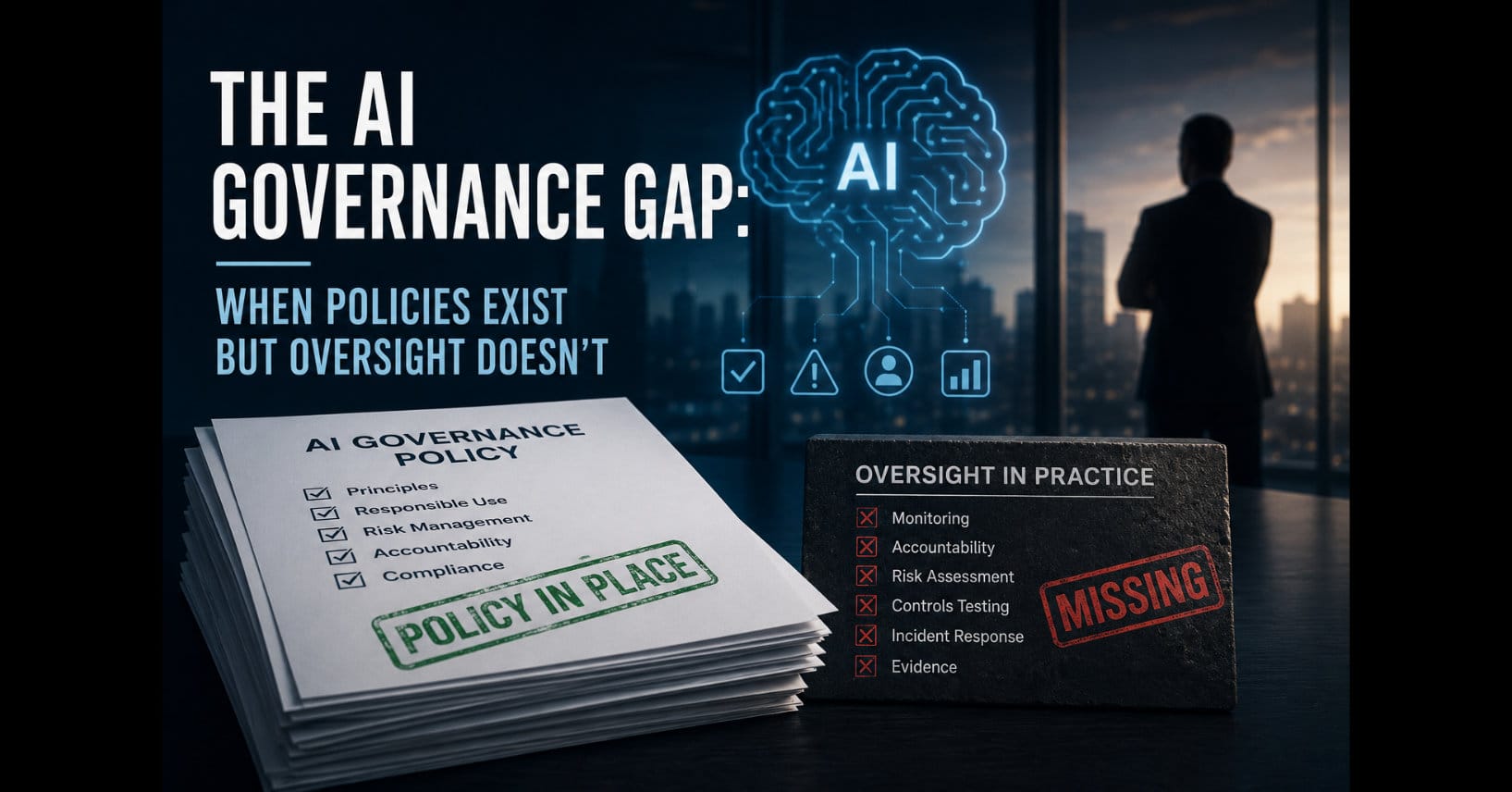
The piece argues that many organizations have AI policies and frameworks, but few can prove effective oversight of AI systems in production. It says governance is about accountability, monitoring, and evidence, not documentation alone.
It warns that as AI becomes more autonomous, boards, regulators, insurers, and auditors will demand proof of control and responsibility. The article frames defensible, evidence-based oversight as the standard for mature AI governance.
Artificial intelligence governance is rapidly becoming one of the most misunderstood disciplines in modern enterprise risk management.
Many organizations have developed AI policies. Some have established AI committees. Others have published ethical principles, acceptable use standards, and governance frameworks. On paper, progress appears substantial.
Yet a growing governance gap is emerging between documented policies and actual oversight.
The uncomfortable reality is that many organizations can demonstrate the existence of AI governance documentation, but few can demonstrate effective governance of AI systems operating in production.
For boards, executives, regulators, insurers, and auditors, that distinction matters.
The question is no longer whether an organization has an AI policy.
The question is whether leadership can prove that governance is occurring.
Governance Is Not Documentation
Cybersecurity leaders have seen this pattern before.
For years, organizations believed that policies represented security. Incident response plans represented resilience. Compliance reports represented readiness.
Experience proved otherwise.
The organizations that performed best during incidents were not necessarily the ones with the largest policy libraries. They were the organizations capable of demonstrating active oversight, continuous monitoring, and informed decision-making.
Artificial intelligence is following the same trajectory.
An AI policy may establish expectations. It may define acceptable use. It may assign responsibilities.
None of those things guarantee that governance is happening.
Governance begins when leadership can answer practical questions:
- Which AI systems are operating within the organization?
- What business decisions are influenced by AI?
- Who is accountable for outcomes?
- How are risks monitored?
- How are exceptions identified and escalated?
- What evidence demonstrates that controls are functioning?
Without those answers, policy becomes little more than organizational theater.
The Rise of Autonomous Risk
Traditional software generally behaves within predictable boundaries.
Modern AI systems do not.
Generative AI tools create content. AI assistants make recommendations. AI agents increasingly execute actions on behalf of users. Machine learning models evolve as data changes.
The result is a new category of governance challenge.
Organizations are deploying systems capable of producing business outcomes that leadership may not fully understand, cannot easily explain, and may struggle to monitor.
This creates a significant accountability problem.
When an AI system produces inaccurate information, makes a flawed recommendation, exposes sensitive data, or contributes to a regulatory violation, investigators will not ask whether the organization had an AI policy.
They will ask:
Who was responsible?
What controls existed?
What oversight occurred?
What evidence demonstrates that management exercised due care?
These are governance questions, not technical questions.
Boards Are Asking the Wrong Question
Many boards currently focus on AI adoption.
Management presentations often emphasize efficiency gains, productivity improvements, innovation initiatives, and competitive advantages.
Those discussions are important.
They are also incomplete.
A more important question is whether governance maturity is keeping pace with deployment maturity.
An organization operating fifty AI-enabled business processes without meaningful oversight is assuming significantly more risk than an organization operating five AI systems under disciplined governance.
The number of AI implementations is not a measure of success.
The quality of oversight is.
Directors should begin requesting evidence in several key areas:
- AI inventory and asset management
- Defined accountability structures
- Risk assessment methodologies
- Monitoring and reporting mechanisms
- Escalation procedures
- Independent validation processes
- Incident response integration
If these elements cannot be demonstrated, governance maturity may be lagging behind operational reality.
The Coming Evidence Challenge
Perhaps the most important shift occurring in AI governance is the movement from policy review to evidence review.
Regulators are increasingly focused on demonstrable oversight.
Auditors are beginning to evaluate governance effectiveness rather than governance intent.
Insurers are asking more detailed questions regarding governance maturity.
Litigators are becoming increasingly interested in organizational accountability for automated decisions.
This creates what may become the defining governance challenge of the AI era.
Organizations must be able to prove that governance occurred.
Not that governance was planned.
Not that governance was discussed.
Not that governance was documented.
That governance actually happened.
Evidence may include:
- Risk committee minutes
- AI oversight reports
- Exception reviews
- Control testing results
- Monitoring dashboards
- Incident investigations
- Executive decision records
- Board briefings
In the absence of evidence, organizations may find themselves unable to demonstrate reasonable oversight when scrutiny arrives.
Defensibility Is the New Standard
The most mature organizations are beginning to view AI governance through a defensibility lens.
Their objective is not merely to deploy AI responsibly.
Their objective is to demonstrate, at any point in time, that leadership exercised informed oversight over AI-enabled activities.
This approach aligns closely with emerging expectations across cybersecurity, privacy, risk management, and regulatory compliance.
Defensible organizations understand a fundamental truth:
Technology creates risk.
Governance creates accountability.
Evidence creates defensibility.
As artificial intelligence becomes embedded in business operations, the organizations that succeed will not necessarily be those that deploy AI the fastest.
They will be the organizations that can clearly demonstrate who was responsible, what decisions were made, what controls existed, and what evidence supports those claims.
The AI governance gap is not a policy problem.
It is an oversight problem.
And oversight is ultimately a leadership responsibility.
The Bottom Line
If your organization’s AI governance strategy consists primarily of policies, principles, and awareness training, you may have governance documentation—but not governance.
The next phase of AI maturity will be defined by oversight, accountability, and evidence.
The organizations that recognize that distinction today will be far better positioned when regulators, auditors, insurers, shareholders, or plaintiffs ask the inevitable question:
“Show us how you governed it.”