Cybersecurity risk cannot be eliminated, so the focus shifts from perfect prevention to defensible governance. The post argues that organizations should be able to show they identified risks, documented decisions, exercised oversight, preserved evidence, and assigned clear accountability.
It presents five pillars of defensibility and says these practices affect regulators, insurers, auditors, and other stakeholders. Defensibility is built through ongoing governance, not during a crisis, and is treated as a more realistic standard than breach-free performance.
No organization is immune from cyber risk.
Not the largest enterprise.
Not the most mature government agency.
Not the most heavily regulated industry.
Cyber incidents occur despite investments, technologies, expertise, and planning.
The question is no longer whether organizations can eliminate cyber risk.
The question is whether they can demonstrate that they governed it responsibly.
This is the defining characteristic of a defensible organization.
The Wrong Goal
For years, cybersecurity programs have been measured against an unrealistic objective.
Prevent every incident.
Eliminate every vulnerability.
Stop every attack.
These goals sound reasonable.
They are also impossible.
Modern organizations operate in a threat environment that changes constantly. New vulnerabilities emerge daily. Threat actors adapt continuously. Technology evolves faster than policies can often keep pace.
Perfect security does not exist.
Organizations that pursue perfection frequently become frustrated.
Organizations that pursue defensibility become resilient.
What Defensibility Means
Defensibility is not a technical concept.
It is a governance concept.
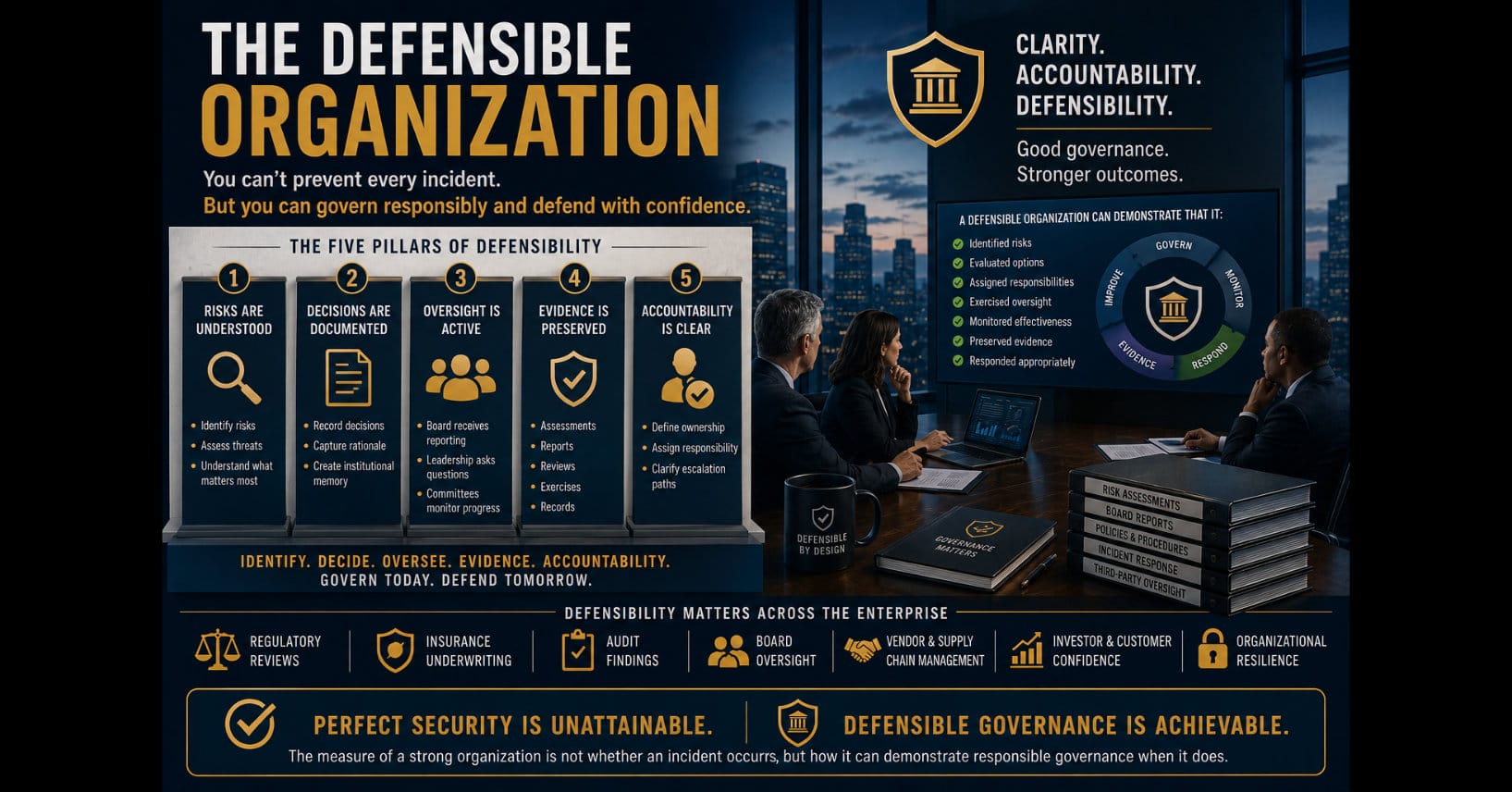
A defensible organization can demonstrate that it:
- Identified risks
- Evaluated options
- Assigned responsibilities
- Exercised oversight
- Monitored effectiveness
- Preserved evidence
- Responded appropriately
Notice what is absent from this list.
There is no requirement that incidents never occur.
Defensibility focuses on diligence rather than perfection.
The Five Pillars of Defensibility
Through our discussions over the past several weeks, a common framework has emerged.
Defensible organizations consistently demonstrate five characteristics.
1. Risks Are Understood
Defensible organizations maintain visibility into the risks they face.
They conduct assessments.
They evaluate threats.
They identify vulnerabilities.
Most importantly, they understand which risks matter most.
Risk awareness is the foundation of every governance decision that follows.
2. Decisions Are Documented
Good decisions deserve documentation.
Risk acceptance.
Resource allocations.
Control selections.
Policy exceptions.
Strategic priorities.
Defensible organizations preserve records showing how and why important decisions were made.
Documentation creates accountability.
It also creates institutional memory.
3. Oversight Is Active
Governance requires more than awareness.
It requires participation.
Boards receive reporting.
Executives review risks.
Committees monitor progress.
Leadership asks questions.
Defensible organizations demonstrate active oversight rather than passive observation.
4. Evidence Is Preserved
Throughout this series, one theme has appeared repeatedly.
Evidence matters.
Risk assessments.
Board reports.
Training records.
Control reviews.
Vendor evaluations.
Incident response exercises.
These artifacts collectively demonstrate reasonable diligence.
Without evidence, organizations often struggle to prove that governance occurred.
5. Accountability Is Clear
When responsibility becomes unclear, governance weakens.
Defensible organizations define ownership.
They establish reporting structures.
They assign responsibilities.
They clarify escalation paths.
Everyone understands who owns the risk, who exercises oversight, and who makes decisions.
Accountability creates confidence.
Ambiguity creates exposure.
Why Defensibility Matters
Defensibility influences outcomes long before an incident occurs.
It affects:
- Regulatory reviews
- Insurance underwriting
- Audit findings
- Board oversight
- Vendor management
- Investor confidence
- Organizational resilience
Most importantly, it affects how organizations are evaluated when challenges arise.
Investigators look for it.
Insurers look for it.
Auditors look for it.
Regulators look for it.
Increasingly, customers look for it as well.
A Different Standard of Success
Traditional cybersecurity success is often defined by the absence of incidents.
Governance requires a more meaningful standard.
A mature organization should be able to answer questions such as:
- What risks have been identified?
- What decisions were made?
- Who approved those decisions?
- What oversight occurred?
- What evidence exists?
- How was effectiveness monitored?
Organizations that can answer these questions confidently are often far more resilient than those that simply report a breach-free year.
Building a Defensible Organization
Defensibility is not created during an investigation.
It is not created during a lawsuit.
It is not created during an insurance claim.
It is built gradually through consistent governance practices.
One decision.
One assessment.
One report.
One review.
One piece of evidence at a time.
The organizations that perform best during periods of scrutiny are usually the ones that invested in governance long before scrutiny arrived.
The Governance Perspective
Throughout this series we have examined board oversight, evidence, accountability, third-party risk, investigations, governance metrics, and cyber insurance.
Although these topics appear different, they all point to the same conclusion.
Organizations are increasingly being evaluated not simply on what happened, but on how they governed what happened.
That is the essence of defensibility.
A defensible organization is not one that never experiences adversity.
It is one that can demonstrate that risks were understood, decisions were informed, oversight was exercised, and accountability was clear.
Perfect security is unattainable.
Defensible governance is not.
And in today’s environment, that may be the more important objective.