AI Governance Series | Article 14 of 20
Governing Intelligence Before It Governs You
Summary: Organizations increasingly rely on third-party AI platforms, but purchasing AI does not transfer accountability for its outcomes. This article explains why vendor governance is a board-level responsibility, covering AI due diligence, contractual protections, continuous oversight, shared responsibility, and evidence-based governance. Effective organizations evaluate vendor AI before procurement and continue monitoring it throughout the relationship because accountability for AI decisions always remains with the organization that chooses to use the technology.
Organizations purchase software every day.
Increasingly, they’re also purchasing artificial intelligence.
Some assume that because the AI belongs to a vendor, responsibility belongs to the vendor as well.
It doesn’t.
Buying AI may transfer technology ownership.
It never transfers governance accountability.
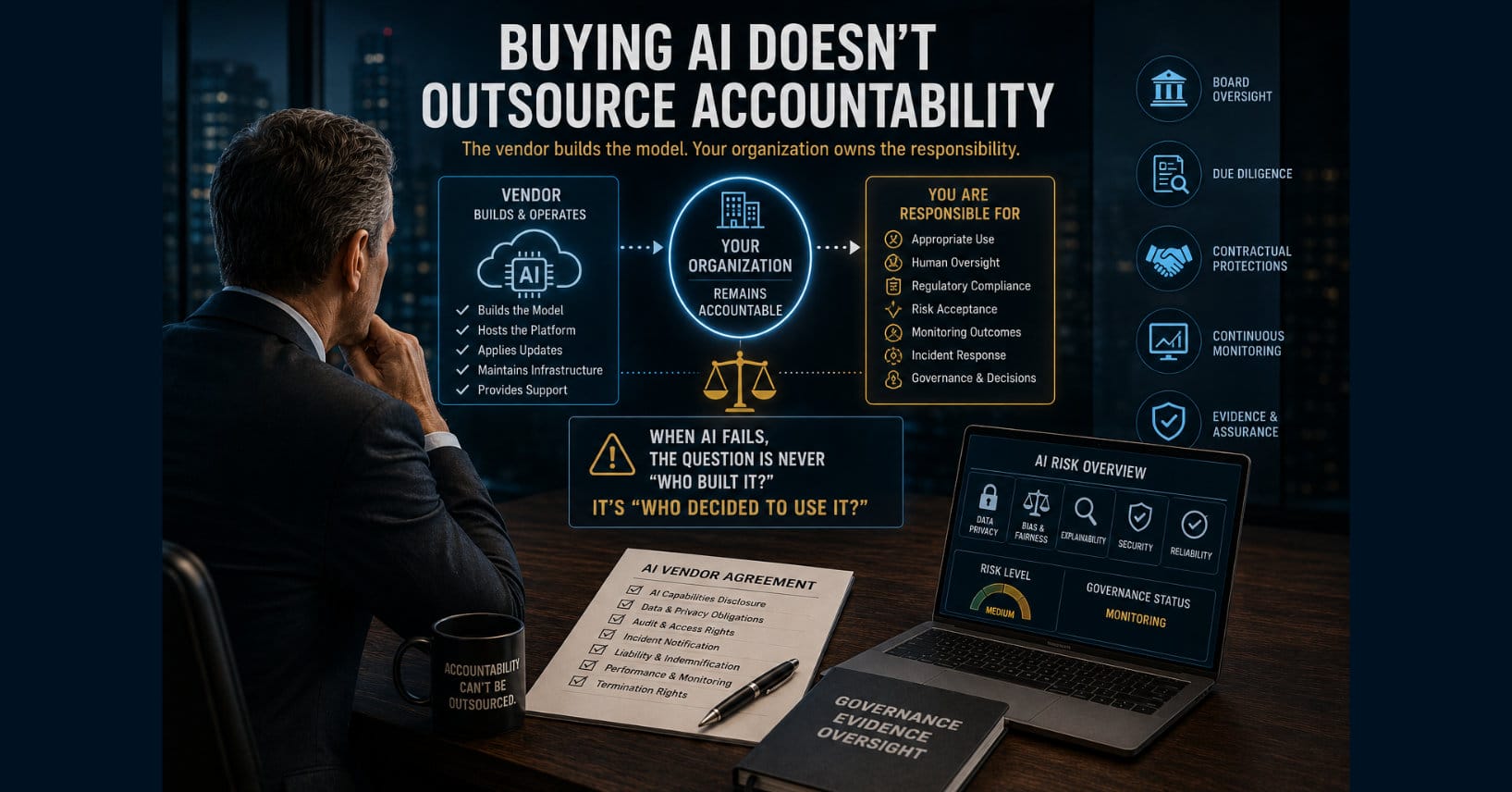
When an AI system makes a decision that harms customers, violates regulations, exposes confidential information, or creates financial loss, regulators, courts, investors, and boards rarely begin by asking who wrote the software.
They ask who decided to use it.
Procurement Is a Governance Decision
Technology acquisitions are often viewed as procurement exercises.
For AI, they are governance decisions.
Selecting a vendor means accepting risks that include:
- Data privacy
- Cybersecurity
- Regulatory compliance
- Intellectual property
- Bias
- Explainability
- Operational resilience
- Reputational exposure
Those risks become part of your enterprise the moment the contract is signed.
The Accountability Chain Never Breaks
Organizations frequently rely upon vendors to:
- Screen job applicants
- Detect fraud
- Recommend medical treatments
- Score loan applications
- Generate legal documents
- Analyze contracts
- Assist customer service
- Detect cybersecurity threats
The vendor may build the model.
Your organization decides whether to trust it.
That decision belongs to leadership.
Vendor Due Diligence Must Change
Traditional vendor assessments typically evaluate:
- Financial stability
- Security controls
- Privacy practices
- Service availability
- Compliance certifications
AI governance expands that evaluation.
Organizations should understand:
- What AI capabilities are included?
- What models are used?
- What data trained them?
- Can outputs be explained?
- How often are models updated?
- How is model performance monitored?
- What human oversight exists?
- What governance evidence is available?
These questions belong in procurement—not after deployment.
Contracts Cannot Replace Governance
Organizations sometimes assume contractual protections eliminate AI risk.
Contracts reduce uncertainty.
They do not eliminate accountability.
Even the strongest agreement cannot prevent:
- Hallucinations
- Biased outputs
- Poor recommendations
- Unsafe automation
- Regulatory scrutiny
- Public criticism
Contracts define obligations.
Governance defines responsibility.
Trust Is Not a Governance Strategy
Vendor demonstrations are designed to inspire confidence.
Governance requires verification.
Organizations should request evidence such as:
- Independent assessments
- Security reports
- AI governance policies
- Audit results
- Testing methodologies
- Incident response procedures
- Change management processes
- Assurance reports
Marketing explains what AI can do.
Evidence demonstrates how responsibly it is governed.
Shared Responsibility Is Still Responsibility
Cloud security introduced the concept of shared responsibility.
AI governance follows the same principle.
The vendor may be responsible for:
- Building the model
- Operating the infrastructure
- Applying updates
- Maintaining the platform
The customer remains responsible for:
- Appropriate use
- Human oversight
- Regulatory compliance
- Business decisions
- Risk acceptance
- Governance
- Monitoring outcomes
Shared responsibility never means shared accountability.
Leadership remains accountable for organizational decisions.
Boards Should Expect Evidence
Boards should ask management:
- Which critical business processes depend upon vendor AI?
- What governance criteria must vendors satisfy?
- How is vendor AI monitored after implementation?
- What contractual protections exist?
- What evidence demonstrates responsible governance?
- How would we respond if vendor AI failed tomorrow?
These questions move procurement from purchasing to governance.
Governance Continues After Purchase
Signing the contract is the beginning—not the end—of AI governance.
Vendor AI should be:
- Periodically reassessed
- Continuously monitored
- Included in enterprise risk reviews
- Evaluated after major updates
- Incorporated into incident response planning
- Reviewed during internal audits
Governance is an ongoing discipline, not a procurement milestone.
Boardroom Takeaway
Organizations cannot purchase accountability away. Whether AI is developed internally or supplied by a third-party vendor, leadership remains responsible for its outcomes. Effective vendor governance requires rigorous due diligence, contractual safeguards, continuous oversight, and defensible evidence that AI risks are being actively governed throughout the vendor relationship.
Coming Next
Ethics Without Governance Is Just Marketing
Every organization claims to use AI ethically. The next article explores why ethical principles alone are insufficient—and why ethics only become meaningful when supported by governance, accountability, controls, and evidence.