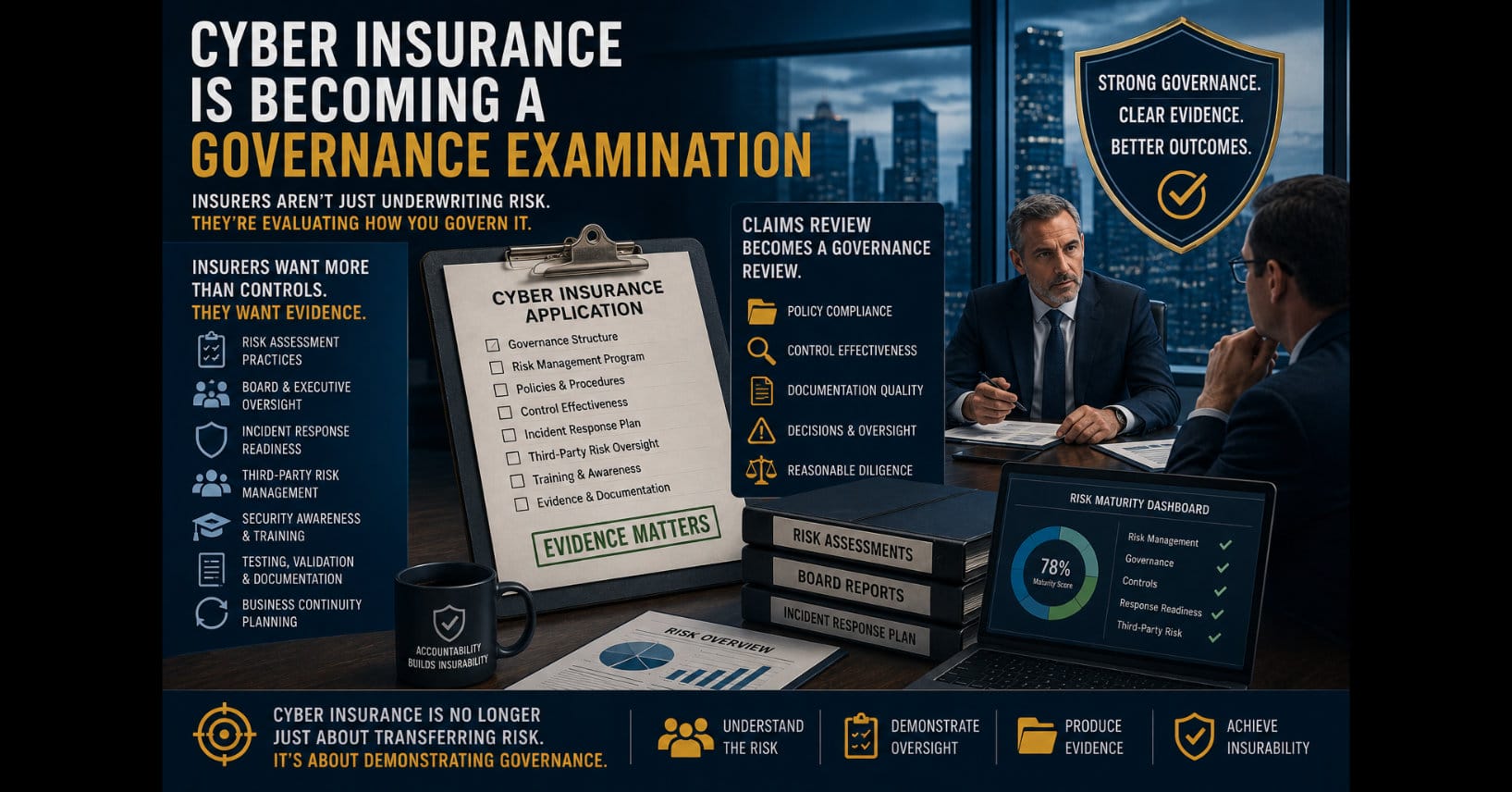
Cyber insurance is increasingly tied to governance maturity rather than only technical controls. Insurers now look for evidence of risk assessments, incident response planning, board oversight, third-party management, and documented accountability when deciding coverage.
Claims reviews can also examine policy compliance, control effectiveness, and prior decisions made before an incident. Boards are encouraged to verify that insurance applications are supported by evidence and that coverage does not create false confidence.
For years, many organizations viewed cyber insurance as a financial safety net.
The assumption was simple.
Purchase a policy, complete an application, pay the premium, and rely on coverage if a significant cyber incident occurred.
That world is disappearing.
Cyber insurers are increasingly behaving less like traditional insurance providers and more like governance assessors.
Today, obtaining and maintaining cyber insurance often requires organizations to demonstrate far more than technical controls.
Insurers want evidence.
They want oversight.
They want accountability.
In many cases, they want proof of governance.
The Changing Economics of Cyber Risk
The cyber insurance market has experienced significant pressure over the past decade.
Ransomware attacks, supply chain compromises, business interruption claims, and regulatory investigations have increased both the frequency and severity of losses.
Insurers have responded accordingly.
Rather than simply transferring risk, they are becoming more selective about the organizations they insure.
As a result, underwriting processes have become more rigorous.
Organizations are now expected to demonstrate how cyber risks are managed, monitored, and governed.
The application is no longer the end of the conversation.
It is often the beginning.
More Than Technical Controls
Historically, insurance applications focused heavily on technology.
Questions typically addressed:
- Multi-factor authentication
- Endpoint protection
- Backups
- Vulnerability management
- Security monitoring
These controls remain important.
However, insurers increasingly recognize that technical controls alone do not determine organizational resilience.
Two organizations may have similar technologies yet experience dramatically different outcomes during a cyber incident.
The difference often lies in governance.
What Insurers Want to Know
Modern cyber insurance evaluations increasingly focus on organizational maturity.
Insurers may examine:
- Risk assessment practices
- Incident response planning
- Executive involvement
- Board oversight
- Third-party risk management
- Security awareness programs
- Evidence of testing and validation
- Business continuity planning
Notice the pattern.
Many of these questions have little to do with technology.
They focus on how leadership governs cyber risk.
The Evidence Problem
One of the most common challenges organizations encounter during underwriting or claims review is the inability to produce supporting evidence.
A company may state that:
- Risk assessments are conducted regularly.
- Incident response plans exist.
- Vendors are reviewed appropriately.
- Security training is completed.
Insurers increasingly expect organizations to demonstrate these claims.
Documentation matters.
Evidence matters.
Governance records matter.
The same principles discussed throughout this series apply equally to cyber insurance reviews.
Assertions are helpful.
Evidence is better.
Claims Reviews Can Become Governance Reviews
Many organizations focus heavily on obtaining coverage.
Fewer consider what happens after a major claim is submitted.
During claims reviews, insurers may evaluate:
- Compliance with policy requirements
- Control effectiveness
- Risk management practices
- Incident response activities
- Reporting obligations
- Documentation quality
The review may extend well beyond technical events.
It may include governance decisions made before the incident occurred.
Organizations that cannot demonstrate reasonable diligence may find themselves facing difficult questions.
The Rise of Insurability
An emerging concept in cybersecurity is insurability.
Not every organization presents the same level of risk.
Increasingly, organizations must demonstrate that they are worthy of coverage.
This shift mirrors broader trends across cybersecurity governance.
Regulators seek evidence.
Auditors seek evidence.
Investigators seek evidence.
Now insurers seek evidence as well.
The common thread is accountability.
What Boards Should Understand
Boards often view cyber insurance as a risk transfer mechanism.
That remains true.
However, it is increasingly becoming a reflection of governance maturity.
The questions insurers ask provide valuable insight into how external parties evaluate organizational preparedness.
Boards should ask:
- What assumptions underlie our coverage?
- What evidence supports our application responses?
- How often are requirements validated?
- Would we be prepared to defend our claims after an incident?
These questions help ensure that insurance supports resilience rather than creating false confidence.
The Governance Perspective
Cyber insurance remains an important component of risk management.
But it should not be viewed as a substitute for governance.
In many ways, insurers are becoming external evaluators of organizational maturity.
They want to know whether risks are understood.
They want to know whether leadership is engaged.
They want to know whether oversight exists.
Most importantly, they want to know whether organizations can demonstrate these things with evidence.
That is why cyber insurance is increasingly becoming more than a financial product.
It is becoming a governance examination.
And the organizations that perform best are often the ones that have already built a culture of accountability, documentation, oversight, and defensibility long before the application is submitted.