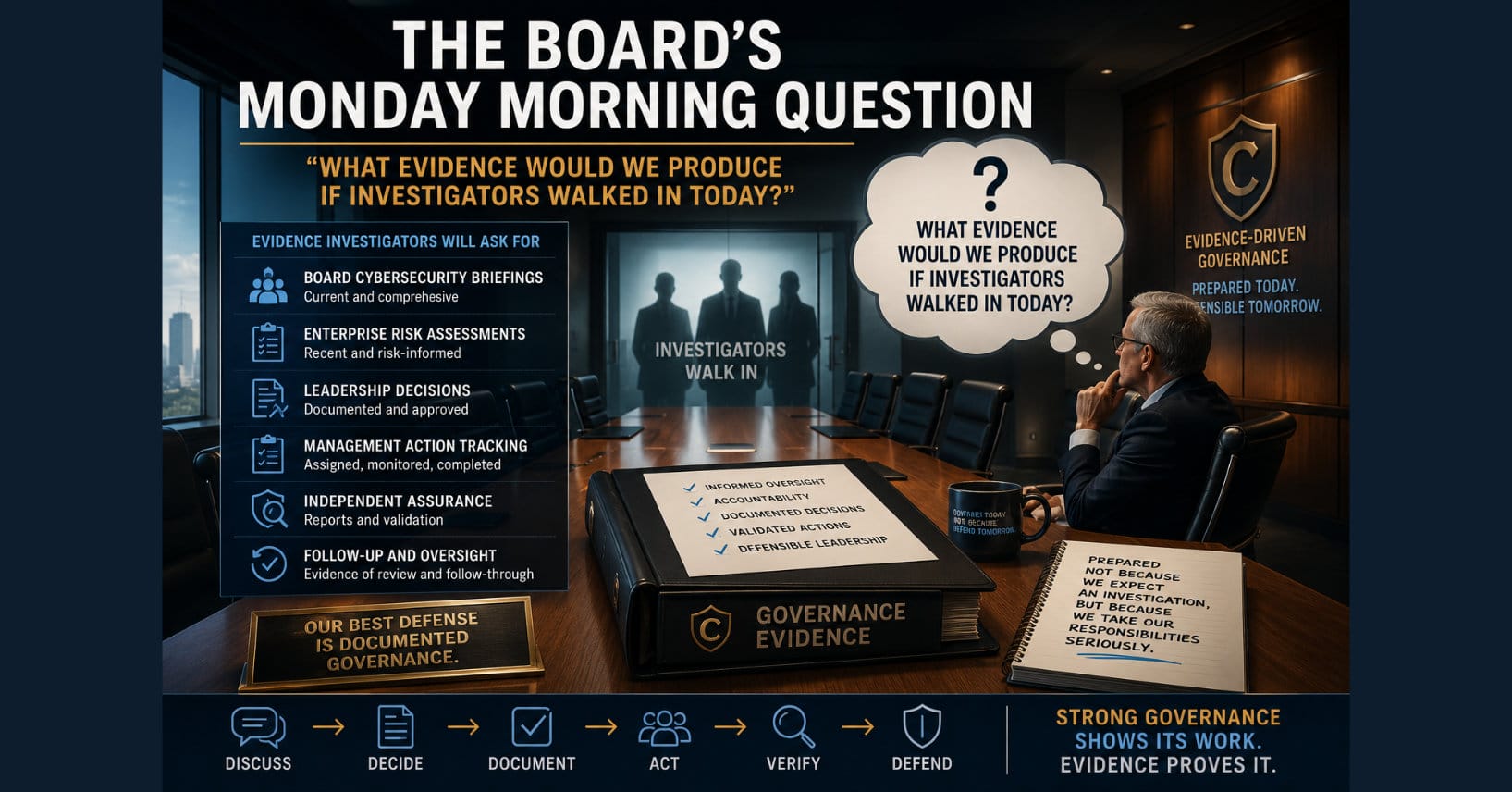


Reframing digital risk as a board-level governance responsibility
For years, cybersecurity has been treated as a technical domain. It sits inside IT. It is measured in patch cycles and vulnerability counts. It is delegated to specialists.
And yet, when a significant breach occurs, no regulator, plaintiff’s attorney, insurer, or federal grant monitor asks how many patches were applied.
They ask what the board knew.
They ask what the board approved.
They ask what the board documented.
The consequences of cyber failure do not stop in IT. They reach the boardroom, the regulator, the courtroom, and the public. That reality changes the classification of cybersecurity entirely.
Cyber risk is enterprise risk.
Enterprise risk falls under fiduciary oversight.
Therefore, cybersecurity is a fiduciary obligation.
This edition reframes digital risk in governance terms and outlines what reasonable board oversight actually looks like.
The Shift: From Technical Function to Enterprise Exposure
A decade ago, many cyber incidents were disruptive but containable. Today, digital dependency has transformed exposure into enterprise-level consequence.
A material cyber incident can:
- Halt core operations
- Trigger regulatory enforcement
- Create litigation exposure
- Disrupt federal or grant funding
- Undermine investor or donor confidence
- Force executive turnover
- Permanently damage reputation
Boards are accountable for enterprise continuity. If cyber failure can destabilize the enterprise, oversight responsibility follows.
This is not alarmism. It is structural logic.
Fiduciary Duty in the Digital Age
Directors operate under two foundational obligations:
Duty of Care – to act with informed judgment and reasonable diligence.
Duty of Loyalty – to act in the best interests of the organization.
Neither duty requires directors to configure firewalls or interpret log files. Both duties require attention to material risk.
Cyber risk is now routinely material.
The duty of care demands that boards:
- Ensure reporting systems exist for significant risks
- Receive structured updates sufficient to inform decision-making
- Engage in documented discussion
- Align resource allocation with stated risk tolerance
Courts and regulators rarely ask whether an organization was breached. They ask whether leadership exercised reasonable oversight.
The difference is decisive.
Delegation Does Not Eliminate Accountability
Boards appropriately delegate management to executives. But delegation is not immunity.
Hiring a CIO, outsourcing to a managed security provider, or purchasing cyber insurance does not remove oversight responsibility. Just as boards do not personally prepare financial statements but remain responsible for financial oversight, the same logic applies to cyber risk.
After a breach, investigators examine:
- Whether escalation protocols existed
- Whether reporting structures were clear
- Whether risk was discussed at the board level
- Whether minutes reflect informed engagement
- Whether resource decisions were documented
Oversight is not technical. It is structural.
The Governance Gap: Activity vs. Assurance
Many boards receive cybersecurity updates. Far fewer receive cybersecurity oversight.
The difference lies in reporting structure.
Operational reports often include:
- Number of blocked attacks
- Patch compliance percentages
- Open vulnerabilities
These metrics may reflect management diligence. They do not necessarily reflect governance assurance.
Boards need reporting that answers different questions:
- What cyber risks could materially disrupt the organization?
- Where does current posture exceed defined risk tolerance?
- What material exposures remain unmitigated?
- What investment decisions have been deferred?
- What scenarios would require immediate board notification?
Without this translation from technical activity to enterprise risk posture, oversight remains incomplete.
What Reasonable Oversight Looks Like
Recognizing cybersecurity as a fiduciary obligation is only the first step. Governance must be structured intentionally.
Reasonable board-level oversight typically includes:
1. Formal Risk Recognition
Cyber risk is explicitly included in enterprise risk management frameworks.
2. Defined Reporting Cadence
Structured cyber reporting reaches the board or appropriate committee regularly.
3. Clear Escalation Thresholds
Management and board agree on what constitutes a board-notifiable incident.
4. Documentation Discipline
Oversight discussions are accurately reflected in minutes.
5. Independent Assurance
Periodic external assessments validate management representations.
6. Policy Governance
Cyber-related policies are board-approved, versioned, and reviewed on defined cycles.
This is governance architecture. It is calm, deliberate, and defensible.
The Nonprofit and Public Trust Dimension
For nonprofit organizations, the stakes are often misunderstood.
Nonprofits handle:
- Donor financial information
- Beneficiary personal data
- Sensitive case records
- Federal or state grant information
Public trust is their primary asset. Increasingly, grant compliance frameworks require documented internal controls that include safeguarding information.
Volunteer status does not reduce fiduciary standards. It heightens the importance of disciplined oversight.
Cyber governance in nonprofit environments is not a luxury. It is stewardship.
Tone at the Top: Culture as a Governance Lever
Governance is not merely structural. It is cultural.
When boards treat cybersecurity as a routine agenda item buried in operational updates, management follows suit. When boards ask disciplined questions and require clarity around risk posture, organizational seriousness rises.
Tone at the top shapes:
- Budget prioritization
- Transparency in reporting
- Escalation comfort
- Accountability norms
Cyber resilience is influenced as much by governance posture as by technical tooling.
The Cost of Misclassification
Treating cybersecurity as an IT problem creates a governance blind spot.
The cost of that misclassification may include:
- Regulatory penalties
- Litigation expenses
- Insurance disputes
- Reputational damage
- Funding disruption
- Leadership turnover
Proactive governance investment is rarely inexpensive. Reactive crisis response is often catastrophic.
The choice is not between spending and saving. It is between structured oversight and unmanaged exposure.
Practical Board Actions
If you serve on a board, consider these starting points:
- Ask whether cyber risk is formally integrated into enterprise risk discussions.
- Confirm that escalation thresholds are defined and documented.
- Review how oversight conversations are reflected in minutes.
- Request reporting that frames cyber exposure in business terms, not technical language.
- Evaluate whether independent assessment has occurred within the past 12–18 months.
Directors do not need to become technologists. They do need to become intentional architects of oversight.
Looking Forward
Cybersecurity will continue to evolve. So will regulatory expectations, litigation standards, and public scrutiny.
The most resilient organizations will not be those with the most advanced tools. They will be those with the clearest governance structures.
Cybersecurity is no longer about servers.
It is about stewardship.
If you serve on a board or advise leadership teams, subscribe to The Cyber Governance Brief for ongoing insights on cybersecurity as enterprise risk and fiduciary duty.
And stewardship is the essence of fiduciary responsibility.
In our next edition:
Three Questions Every Board Should Ask About Cyber Risk