AI Governance Series | Article 4 of 20
Governing Intelligence Before It Governs You
Summary: Strong AI governance depends on more than policies and committees—it depends on clearly defined ownership. This article explains why every significant AI decision must have an accountable decision-maker with the authority to act. It distinguishes responsibility from ownership, explores decision rights across organizational levels, and demonstrates how explicit accountability creates better oversight, stronger governance, and more defensible AI decisions.
Authority, Accountability, and Decision Rights
Artificial intelligence makes decisions at extraordinary speed.
Organizations cannot afford to make decisions about AI with extraordinary ambiguity.
One of the fastest ways governance breaks down is when no one can answer a simple question:
Who had the authority to make this decision?
When that answer is unclear, accountability becomes fragmented, oversight weakens, and organizational risk grows.
Every significant AI decision needs an identified owner.
Not because one person does all the work—but because governance requires someone who has both the authority to decide and the accountability for the outcome.
Ownership Is More Than Responsibility
Organizations often assign responsibility without assigning authority.
A data science team may be responsible for developing a model.
A cybersecurity team may be responsible for protecting it.
Legal may be responsible for regulatory guidance.
Compliance may monitor adherence to policy.
Operations may integrate the AI into business processes.
Each team has responsibilities.
That does not mean any of them owns the decision.
Governance requires explicit decision rights.
Someone must have the authority to approve, reject, delay, suspend, or retire an AI capability.
Without that authority, ownership becomes little more than coordination.
Decision Rights Create Accountability
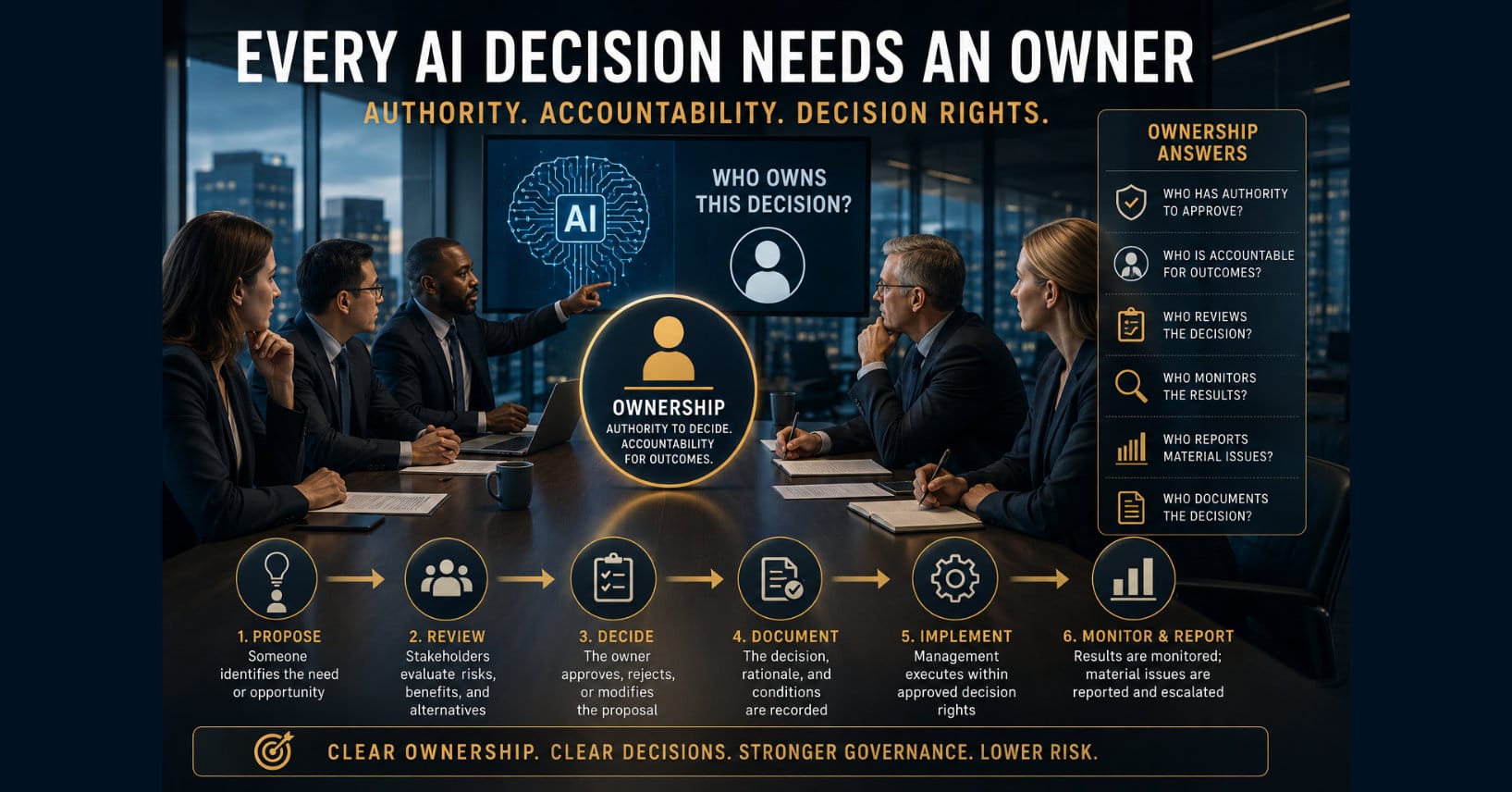
Every significant AI decision should answer several governance questions.
Who proposes the decision?
Who reviews it?
Who approves it?
Who may veto it?
Who documents it?
Who monitors its outcomes?
Who reports material issues?
These questions are not administrative exercises.
They define how accountability flows throughout the organization.
Clear decision rights reduce confusion before a decision is made rather than assigning blame after something goes wrong.
AI Decisions Are Not Equal
Not every AI decision belongs at the same organizational level.
Routine operational adjustments should remain with management.
Strategic decisions deserve broader oversight.
For example:
A development team may decide how to optimize a model.
An AI governance committee may approve deployment into production.
Executive leadership may authorize AI systems that affect multiple business units.
The Board should oversee decisions that create material enterprise risk.
Governance ensures decisions are made at the appropriate level—not necessarily the highest level.
Authority Must Match Risk
One of the most common governance failures occurs when decision-making authority does not match business impact.
Junior employees sometimes approve technologies with enterprise-wide consequences.
Conversely, executives are occasionally forced to approve routine technical changes that create unnecessary delays.
Neither is effective governance.
Decision authority should increase as organizational risk increases.
The greater the potential financial, legal, regulatory, operational, or reputational impact, the greater the level of oversight required.
This principle keeps organizations both agile and accountable.
Committees Do Not Replace Owners
Many organizations establish AI steering committees or governance councils.
These groups play an important role.
They should not become substitutes for accountability.
Committees provide review.
Owners make decisions.
Committees recommend.
Owners accept accountability.
When everyone participates in a decision but no individual owns it, accountability disappears into the process.
Governance succeeds when committees support decision-making—not when they obscure it.
Document the Decision, Not Just the Outcome
Organizations frequently document what happened.
Effective governance documents why a decision was made, who approved it, what information was considered, and what risks were accepted.
That evidence becomes invaluable when leadership is asked:
Why was this AI deployed?
Who approved the decision?
What alternatives were considered?
What safeguards existed at the time?
Good governance creates those answers before anyone asks the questions.
Ownership Builds Organizational Confidence
Clear ownership benefits everyone.
Operational teams know who has final authority.
Executives understand where accountability resides.
Auditors can trace decisions.
Regulators can evaluate oversight.
Boards gain confidence that AI decisions are being made intentionally rather than informally.
Ownership does not slow innovation.
It removes uncertainty.
When everyone understands who decides, organizations spend less time debating authority and more time delivering value responsibly.
Boardroom Takeaway
Every significant AI decision should have a clearly identified owner with defined authority, documented decision rights, and measurable accountability. Governance is strongest when ownership is explicit, decisions are traceable, and accountability is never left to assumption.
Coming Next
AI Risk Is Enterprise Risk
Many organizations still measure AI primarily through technical performance metrics such as accuracy and precision. The next article explores why effective AI governance requires looking beyond the model to understand AI as an enterprise-wide source of financial, operational, legal, cybersecurity, and reputational risk.