
Executive Brief
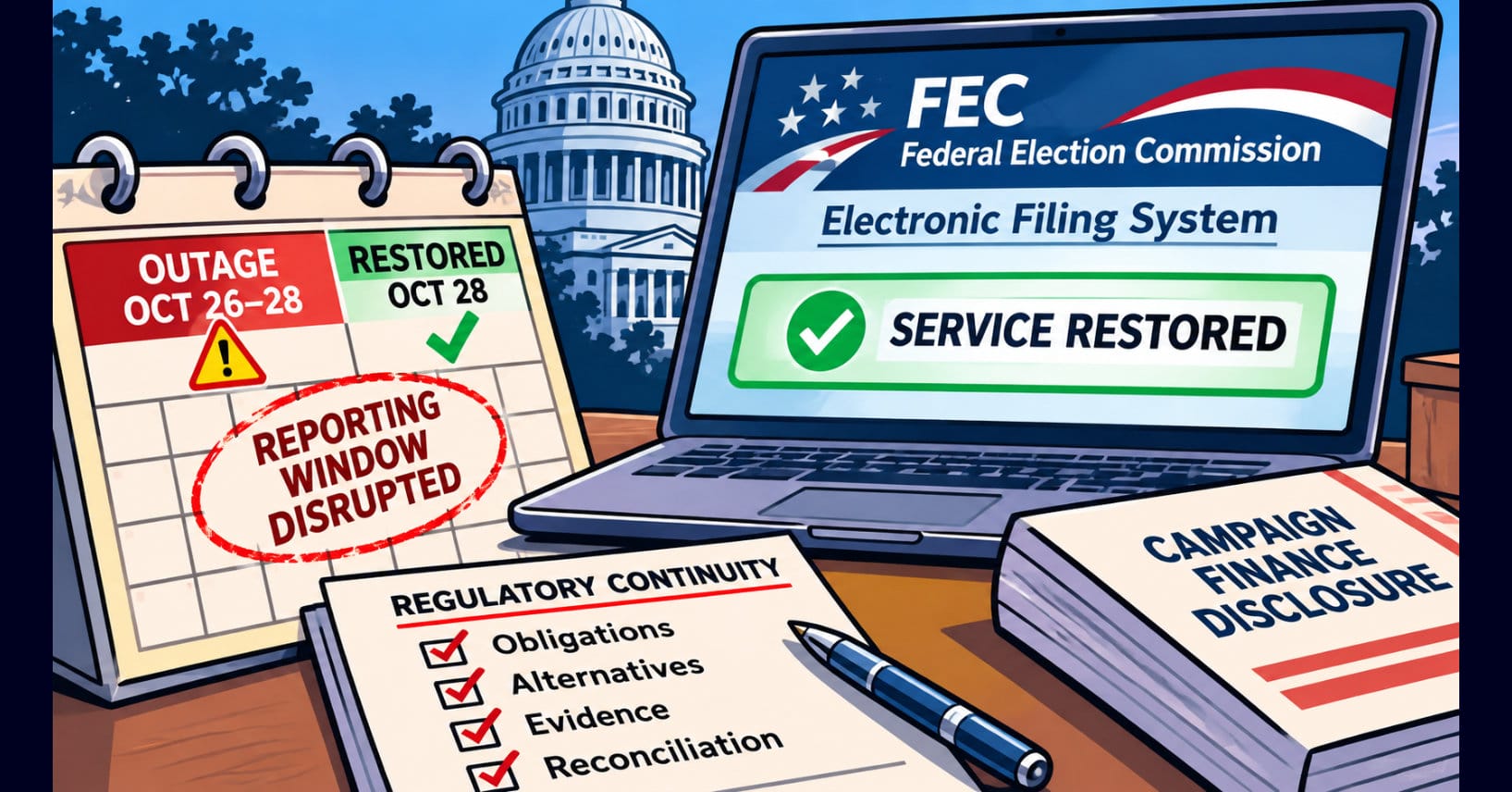
A cybersecurity incident disrupted the Federal Election Commission’s electronic filing system just days before the November 3 midterm elections, temporarily preventing political committees from submitting campaign-finance disclosures. The system returned to service on October 28, and the FEC formally resolved the incident on October 30. But restoring a system does not necessarily restore the value of information that was supposed to be available earlier. The incident exposes a governance problem extending far beyond election-related reporting: when an organization depends on external technology to fulfill a legal obligation, who is responsible for maintaining that obligation when the technology becomes unavailable?
The System Came Back. The Reporting Window Did Not.
On October 26, 2026, the Federal Election Commission experienced a disruption to its electronic filing services following an attempted cyber intrusion.
The timing was consequential.
With the November 3 midterm elections approaching, political committees were operating within a reporting environment in which the timely availability of campaign-finance information matters to candidates, journalists, regulators, and the public.
The disruption prevented electronic filing through the affected system. Previously submitted reports remained available for public inspection.
The FEC restored electronic filing services on October 28. Its official incident-status record subsequently identified October 30 at 4:48 p.m. Eastern as the formal resolution time.
From a technical perspective, the service was restored.
From a governance perspective, the more important question is what happened to the reporting obligations and information-access expectations during the interruption.
A filing system can be repaired. A missed opportunity to make information available at the intended time cannot necessarily be recreated.
That distinction deserves attention well beyond the Federal Election Commission.
The Business Reality: Technology Supports Obligations It Does Not Create
The FEC administers federal campaign-finance disclosure requirements. It does not administer elections or operate voting systems.
There is no basis in the publicly established facts of this incident to conclude that Americans’ ability to vote was affected.
The governance significance lies elsewhere.
Federal campaign-finance law establishes reporting obligations. Electronic filing infrastructure provides the mechanism through which many regulated organizations satisfy those obligations.
When that infrastructure becomes unavailable, the underlying legal framework does not simply disappear.
The FEC has explained in its reporting guidance that it generally lacks statutory authority to extend filing deadlines, although enforcement discretion may be available under certain circumstances involving unforeseen events.
That is an important distinction between an obligation and the administrative treatment of an interruption.
A system outage may justify special handling. It does not automatically eliminate the responsibility to determine what must be filed, when it must be filed, and what documentation should be retained.
The same dependency exists throughout the enterprise.
Public companies depend on electronic systems for securities disclosures.
Healthcare organizations depend on technology for regulatory reporting, clinical communications, and patient notifications.
Financial institutions rely on external infrastructure for required submissions, payment processing, and supervisory communications.
Critical-infrastructure operators depend on specialized systems to satisfy safety, operational, and regulatory requirements.
In each case, the technology is a delivery mechanism for a responsibility that exists independently of the technology.
The system may be outsourced, externally operated, or temporarily unavailable. The organization’s obligation to govern its response remains.
What Leadership Often Misses: Recovery Has More Than One Meaning
Most organizations maintain some form of business-continuity or disaster-recovery capability.
They identify critical applications, establish recovery priorities, and measure how quickly services can be restored.
Those capabilities matter.
But they do not necessarily establish whether the organization can continue fulfilling its legal, contractual, and regulatory obligations during an interruption.
Consider three different recovery outcomes.
Technical recovery establishes that an application or service has returned to an acceptable operating state.
Operational recovery establishes that the organization can resume the business processes dependent upon that service.
Regulatory recovery establishes that obligations interrupted by the event have been identified, reconciled, fulfilled where possible, and supported by appropriate evidence.
These outcomes are related, but they are not interchangeable.
A restored reporting platform does not establish that every interrupted filing was submitted.
A successful database recovery does not establish that all required notifications were delivered.
A repaired financial system does not establish that every time-sensitive transaction or regulatory submission was properly reconciled.
And a closed incident ticket does not establish that the organization has addressed the consequences of the interruption.
This is where conventional incident-response metrics can become misleading.
An organization may report that service was restored within its recovery time objective.
That metric says something useful about technology availability.
It says considerably less about whether the organization fulfilled the obligations that depended on the unavailable service.
Recovery time is not a substitute for evidence of obligation fulfillment.
The Missing Control: Regulatory Continuity
Business continuity is generally concerned with sustaining or restoring essential operations.
Regulatory continuity is concerned with preserving the organization’s ability to satisfy legally significant responsibilities when normal operating mechanisms fail.
The concept should be part of the enterprise’s broader governance and continuity architecture, not an isolated compliance exercise.
A defensible approach begins by identifying obligations that depend upon specific technology services.
For each obligation, management should understand the required action, the responsible party, the deadline or triggering condition, the supporting technology, and the consequences of interruption.
The organization must then establish what happens when that technology becomes unavailable.
Can an alternative submission method be used?
Must the regulator be contacted?
Who is authorized to approve a temporary process?
What evidence must be preserved to establish that the organization attempted to comply?
Who determines whether a delayed submission requires additional explanation or corrective action?
How will management verify that every interrupted obligation has been reconciled after service returns?
These are governance questions because they involve authority, accountability, risk decisions, and evidence.
They cannot be answered solely by restoring servers or reopening an application.
The necessary progression is:
Regulatory Obligation → Technology Dependency → Service Disruption → Contingency Decision → Restoration → Reconciliation → Evidence
Each transition requires an accountable owner.
Each consequential decision should leave a record.
And the process should be established before the interruption occurs.
The Evidence Problem Begins Before Restoration
Suppose an organization must submit a regulatory filing by a specified deadline.
The designated electronic filing system becomes unavailable.
An employee attempts to submit the filing, encounters an error, and notifies management.
Management determines that the system is experiencing an outage and instructs the employee to try again later.
Eventually, the system returns, and the filing is submitted.
From an operational perspective, the task is complete.
But what happens if a regulator later questions the timing?
The organization may need to establish when the filing was ready, when submission was attempted, what error occurred, who was notified, what alternative procedures were considered, who authorized the response, and when the filing was ultimately accepted.
Without contemporaneous evidence, the organization may be left reconstructing those facts from email messages, employee recollections, and incomplete system records.
That is not an ideal foundation for regulatory defensibility.
The better approach is to preserve the evidence as the event unfolds.
This is a practical application of Evidentiary Architecture™: designing organizational processes so that consequential actions and decisions produce usable evidence during normal execution.
For a regulatory-system outage, the evidence might include submission attempts, system notices, timestamps, escalation records, management decisions, regulator communications, alternative-process approvals, successful filing acknowledgments, and reconciliation results.
The objective is not to generate documentation for its own sake.
It is to establish a reliable record demonstrating how the organization managed an obligation under abnormal operating conditions.
Evidence created during the disruption is generally more defensible than explanations assembled after someone begins asking questions.
The Third-Party Dependency Nobody Can Fully Control
The FEC incident also illustrates an uncomfortable reality about enterprise governance.
Organizations frequently depend upon systems they do not own, administer, or secure.
Those systems may belong to regulators, financial institutions, cloud providers, business partners, or other external organizations.
The enterprise may have no ability to restore the service itself.
It may have limited visibility into the underlying incident.
It may not know when the service will return.
Yet the business consequences of the outage can still fall upon the dependent organization.
That creates a distinction between control over infrastructure and accountability for organizational response.
An enterprise cannot reasonably be expected to prevent every incident affecting an external government platform.
It can, however, identify critical dependencies, establish escalation procedures, monitor official communications, preserve evidence of interrupted activity, and determine how its obligations will be managed.
The same principle applies to outsourced services.
A supplier may own the technical recovery.
The customer still owns the decision about how to operate while the service is unavailable and how to verify that its obligations have been satisfied afterward.
This is why third-party risk management cannot end with a vendor security questionnaire or contractual service-level agreement.
It must address the business consequences of dependency failure.
Questions Every Executive and Board Should Ask
Boards do not need to supervise individual regulatory filings or direct technical recovery.
They do need reasonable assurance that management has established the necessary governance arrangements.
Five questions deserve attention:
- Which legal and regulatory obligations depend on external technology systems? Management should be able to identify dependencies whose interruption could affect statutory deadlines, required notifications, or other consequential responsibilities.
- Who has authority to activate an alternative process? Emergency decision rights should be established before an outage, including when legal or compliance approval is required.
- What evidence is preserved when a required transaction or submission cannot be completed? The organization should not depend entirely on an external provider’s logs or an employee’s later recollection.
- How does management distinguish system restoration from obligation reconciliation? Recovery reporting should identify unresolved submissions, missed actions, exceptions, and decisions requiring further attention.
- Can the organization demonstrate that its continuity procedures actually work? A documented plan is not evidence of operational effectiveness. Exercises, testing, and corrective-action validation provide a stronger basis for assurance.
These questions are applicable regardless of whether the unavailable platform belongs to a government agency, a commercial vendor, or the organization itself.
Governance Takeaway: Restoration Is Not the End of Accountability
The Federal Election Commission’s electronic filing system returned to service before the November 3 election.
That is an important operational outcome.
But the incident illustrates a broader governance principle: restoring technology does not automatically restore the timing, completeness, or evidentiary integrity of every business obligation interrupted by its failure.
The next generation of cybersecurity governance must account for the responsibilities that technology enables—not merely the technology itself.
That means identifying critical dependencies, establishing contingency authority, preserving contemporaneous evidence, and verifying that interrupted obligations have been reconciled.
A defensible organization should be able to answer not only when a system came back online, but also what happened to every consequential responsibility while it was unavailable.
The system can be restored. The missed reporting window cannot be recreated. What leadership can preserve is the evidence of how the organization responded.