Summary
Modern enterprises increasingly depend on shared infrastructure, cloud platforms, technology providers, and interconnected services that extend beyond their direct operational control.
When a major cybersecurity incident affects these dependencies, an organization may remain accountable for critical business outcomes without possessing the authority to make every decision necessary to protect or restore those services.
The Next Cyber Crisis May Require Decisions Your Company Cannot Make Alone examines the growing governance challenge of distributed decision authority and systemic cyber risk.
Drawing on lessons from the July 2024 CrowdStrike disruption, the article explores how concentrated technology dependencies can produce widespread operational consequences across financial services, healthcare, transportation, communications, and critical infrastructure.
It distinguishes information sharing from coordinated decision-making, contractual rights from operational authority, and crisis coordination from command.
The article also examines how competing legal obligations, recovery priorities, regulatory responsibilities, and public safety considerations can complicate incident response across organizational boundaries.
Through the Cyber Governance Center’s Defensible Evidence Framework™ and Evidentiary Architecture™, it introduces a governance progression:
Shared Dependency → Incident Condition → Affected Obligations → Decision Authorities → Coordination → Authorized Actions → Consequences → Validation → Evidence
The central message is that organizations must identify their critical decision dependencies, establish external coordination mechanisms, and test scenarios involving conflicting authorities before a crisis occurs.
The next frontier of cybersecurity governance is not simply governing what an enterprise controls. It is governing how the enterprise acts when control is distributed.
A major cybersecurity incident begins at 2:17 a.m.
A financial institution detects unauthorized activity affecting a critical transaction-processing service.
Its security operations center identifies suspicious commands moving through a third-party technology platform.
The institution’s incident response team activates its emergency procedures.
Within minutes, investigators discover that the same technology provider supports several other financial institutions.
The provider confirms that it is experiencing a widespread disruption.
Some customers have lost access to critical services.
Others are reporting anomalous transactions.
A regional payment network begins experiencing delays.
The financial institution’s chief information security officer recommends immediately disconnecting the affected service.
The chief operating officer objects.
Disconnecting the service could prevent customers from accessing funds and disrupt transactions involving other institutions.
The technology provider warns that unilateral changes by individual customers may complicate its recovery process.
Regulators begin requesting information.
Law enforcement expresses interest in preserving evidence.
Another financial institution proposes coordinating containment actions.
The organization’s incident response plan identifies who can declare a cybersecurity emergency.
It identifies who can authorize system isolation.
It identifies who can approve emergency expenditures.
It identifies who must notify the board.
But it does not answer the most important question now confronting management.
Who has authority to make a decision when the consequences extend beyond the organization making it?
The institution can control its own systems.
It cannot direct the technology provider’s response.
It cannot determine how other financial institutions will react.
It cannot independently restore a shared payment network.
And it cannot guarantee that the action best protecting its own customers will produce the best outcome for the broader financial system.
The organization is confronting a cybersecurity crisis whose operational boundaries exceed its governance boundaries.
This is not merely an incident response problem.
It is a problem of distributed decision authority, shared dependencies, and systemic risk.
And it is becoming one of the most consequential challenges in enterprise cybersecurity governance.
Enterprise Governance Was Designed Around Enterprise Authority
Most cybersecurity governance frameworks begin with a familiar assumption.
An organization identifies its assets.
It establishes risk ownership.
It defines policies.
It implements controls.
It assigns decision authority.
It monitors performance.
And it responds when controls fail.
This model remains essential.
But it assumes that the organization possesses sufficient authority over the systems, people, processes, and resources necessary to manage its risks.
Modern enterprises increasingly operate through interconnected environments that challenge that assumption.
Cloud platforms host critical applications.
Managed service providers operate security controls.
Software vendors distribute updates across thousands of customers.
Identity providers authenticate users across multiple organizations.
Telecommunications carriers support essential connectivity.
Payment networks process transactions involving numerous institutions.
Healthcare systems exchange clinical information through shared infrastructure.
Energy, transportation, and communications services depend on interconnected operational technology.
An organization may remain legally accountable for a business service without possessing direct operational control over every component required to deliver it.
This creates a governance distinction.
Responsibility for an outcome does not necessarily establish authority over every dependency that determines that outcome.
An enterprise can assign internal accountability for a critical service.
It cannot necessarily compel a third party to restore that service within the timeframe its business requires.
It can establish incident response procedures.
It cannot guarantee that other organizations will make compatible decisions.
It can authorize emergency action within its own environment.
It may lack authority to change the shared infrastructure on which the emergency depends.
The result is a growing gap between organizational accountability and organizational control.
The Cybersecurity Boundary Is Not the Decision Boundary
Consider a company that relies on a cloud-based identity provider.
The provider experiences a significant cybersecurity incident.
The company’s employees cannot authenticate to essential applications.
Some privileged access sessions remain active.
Others fail.
The organization must decide whether to suspend certain operations.
But the identity provider controls the underlying authentication infrastructure.
The company can restrict its own applications.
It may be able to activate alternative authentication arrangements.
It can communicate with employees and customers.
It cannot independently repair the provider’s platform.
Its recovery depends on decisions made by another organization.
Now expand the scenario.
Thousands of enterprises depend on the same identity provider.
Some attempt emergency workarounds.
Others suspend access.
Some implement temporary authentication exceptions.
Others refuse to relax security requirements.
The provider must restore service while managing the consequences of these different customer responses.
A decision that appears reasonable for one enterprise may introduce risk elsewhere.
For example, an emergency authentication bypass may restore a critical business process while creating opportunities for unauthorized access.
A restrictive containment decision may protect sensitive information while preventing essential services from operating.
Neither decision can be evaluated solely through a narrow technical lens.
The organization must understand how its choices interact with shared infrastructure and other stakeholders.
The cybersecurity boundary defines what an organization must protect. The decision boundary defines what it can actually control.
Those boundaries are no longer reliably identical.
The CrowdStrike Disruption Demonstrated the Scale of Shared Dependencies
The July 2024 CrowdStrike incident remains an important illustration of systemic technology dependency.
A defective CrowdStrike Falcon content update caused Windows systems to crash across numerous organizations.
The incident was not a cyberattack.
That distinction matters.
But its consequences demonstrated how a problem originating within one technology supplier could disrupt operations across airlines, healthcare organizations, financial institutions, government services, and other sectors.
Microsoft estimated that approximately 8.5 million Windows devices were affected.
The number represented a small percentage of Windows devices globally.
Yet the operational consequences were substantial because affected devices supported critical services.
Organizations had to coordinate recovery activities involving their own technical teams, CrowdStrike, Microsoft, managed service providers, and other stakeholders.
Some systems required hands-on remediation.
Recovery priorities differed across industries and organizations.
The incident illustrated a central feature of systemic technology risk.
The significance of a technology failure is not determined solely by the number of affected systems. It is determined by the critical functions that depend on them.
The event also exposed the limitations of organizational recovery authority.
Individual companies could restore systems under their control.
They could not independently correct the original supplier-side failure.
They could not control the recovery schedules of every external dependency.
And they could not ensure that other organizations would prioritize recovery activities in ways that aligned with their own operational needs.
The CrowdStrike incident was a technology disruption rather than a malicious cyber incident.
Nevertheless, it provides a useful example of the coordination problems that a widespread cyberattack against shared infrastructure could create.
The governance lesson is not confined to endpoint security.
It applies wherever concentrated technology dependencies create the potential for simultaneous failures across organizational boundaries.
Systemic Risk Changes the Meaning of Incident Severity
Traditional incident severity classifications frequently emphasize the consequences for the affected organization.
Confidentiality.
Integrity.
Availability.
Financial loss.
Operational disruption.
Legal exposure.
Reputational consequences.
These remain important.
But systemic cyber incidents introduce additional dimensions.
How many organizations depend on the affected service?
Which critical functions are involved?
Can disruptions propagate through interconnected systems?
Could one organization’s containment decision increase another organization’s exposure?
Are recovery resources constrained?
Does the incident affect public safety or essential services?
Could simultaneous failures create consequences greater than the sum of individual organizational losses?
Consider a telecommunications disruption affecting a hospital.
From the telecommunications provider’s perspective, the incident may involve a defined network segment.
From the hospital’s perspective, it may threaten clinical communications and patient care.
From an emergency management perspective, it may affect ambulance coordination, emergency dispatch, and regional healthcare capacity.
The same technical event can have different consequences depending on the stakeholder evaluating it.
A risk classification that considers only the provider’s immediate technical environment may fail to capture the broader consequences.
This creates an important governance challenge.
An incident can be manageable within one organization’s risk framework while becoming unacceptable when its effects are evaluated across an interconnected system.
The organization must therefore understand not only its own exposure, but also the external consequences of decisions affecting shared dependencies.
The Next Crisis May Produce Conflicting Legitimate Decisions
Distributed decision authority does not necessarily mean that one organization is behaving irresponsibly.
Different organizations may possess legitimate obligations that lead to conflicting decisions.
A hospital may prioritize continuity of patient care.
A cloud provider may prioritize containment of a threat affecting multiple customers.
A financial institution may prioritize transaction integrity.
A telecommunications carrier may prioritize network stability.
A regulator may prioritize compliance with legal requirements.
Law enforcement may request preservation of evidence.
An emergency management agency may prioritize public safety.
Each stakeholder may be acting within its legitimate mandate.
Yet their preferred responses may not align.
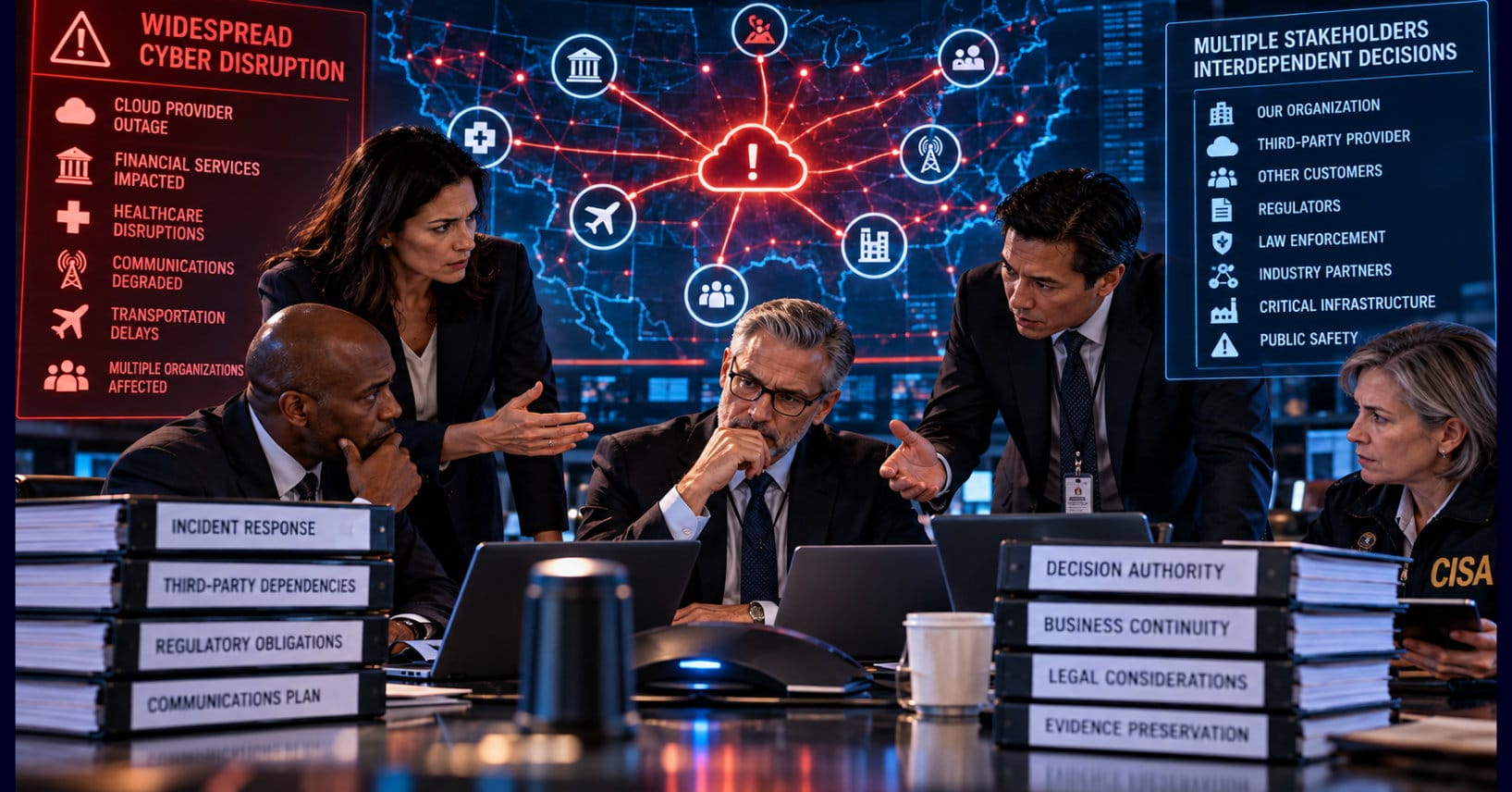
Suppose a cyberattack compromises a shared technology platform supporting emergency services.
The platform provider recommends temporarily shutting down a component to prevent further compromise.
A hospital network warns that the shutdown could interrupt critical clinical workflows.
A government agency requests continued operation of a limited service.
Law enforcement asks that certain systems remain available for forensic collection.
The decisions are interdependent.
The provider may possess technical authority to disable the component.
The hospital may possess clinical authority over patient care decisions.
The government agency may have statutory responsibilities.
Law enforcement may have investigative authority.
No single organization necessarily possesses unrestricted authority over the entire situation.
The challenge is not simply identifying a decision-maker.
It is establishing how separate decision-makers will coordinate when their responsibilities overlap.
Systemic cyber crises can create situations in which several organizations have legitimate authority, but none has complete authority.
That is fundamentally different from an internal incident response escalation.
Information Sharing Is Necessary but Insufficient
Cybersecurity policy discussions frequently emphasize the importance of information sharing.
Organizations should exchange relevant threat intelligence.
They should communicate indicators of compromise.
They should notify affected stakeholders.
They should coordinate with appropriate government agencies.
These activities are important.
But information sharing alone does not establish coordinated decision-making.
Consider three organizations that receive the same threat intelligence concerning a compromised shared service.
The first organization disconnects immediately.
The second continues operating under enhanced monitoring.
The third waits for the service provider to issue formal guidance.
All three possess substantially the same information.
They make different decisions.
The difference may arise from their business requirements, risk tolerance, regulatory obligations, contractual rights, or operational dependencies.
The governance problem is not a lack of shared information.
It is the absence of an agreed mechanism for addressing conflicting actions.
Information sharing answers:
What do we know?
Coordinated governance must also answer:
What must be decided?
Who has authority?
Which organizations must participate?
What happens when decisions conflict?
What evidence supports the chosen course?
And who is accountable for the consequences?
Shared information does not automatically produce shared authority.
Nor should it.
Organizations retain their own legal obligations and responsibilities.
The objective is not to transfer all decision-making to a centralized entity.
It is to establish coordination mechanisms that allow legitimate authorities to act coherently.
The Federal Government Has Recognized the Coordination Problem
The United States has established several mechanisms intended to support cybersecurity coordination across organizational and sector boundaries.
The Cybersecurity and Infrastructure Security Agency, or CISA, plays a central role in coordinating cybersecurity risk management and incident response support across federal, state, local, tribal, territorial, and private-sector stakeholders.
The National Cyber Incident Response Plan provides a framework for coordinating the response to significant cyber incidents.
The Cyber Unified Coordination Group mechanism supports coordination among relevant federal agencies during significant incidents.
Sector Risk Management Agencies also have responsibilities concerning critical infrastructure sectors.
These structures recognize that significant cyber incidents can exceed the capabilities and authority of individual organizations.
But they do not eliminate the need for enterprise-level preparation.
Federal coordination does not automatically transfer responsibility for every private-sector decision to the government.
Nor does the existence of a national response framework guarantee that an enterprise’s operational dependencies will be restored according to its preferred priorities.
Organizations must understand when and how to engage external authorities.
They must also understand the limits of those authorities.
A government agency may provide coordination, technical assistance, threat intelligence, or other support within its mandate.
It may not possess authority to direct every private-sector recovery decision.
The governance objective is to prepare for coordination without assuming that external intervention will resolve every conflict.
An enterprise incident response plan should identify not only internal escalation paths, but also the external authorities and coordination mechanisms on which consequential decisions may depend.
Contractual Rights Are Not the Same as Crisis Authority
Organizations often assume that third-party contracts establish sufficient governance over critical dependencies.
A contract may specify service levels.
It may establish incident notification requirements.
It may require cooperation during investigations.
It may define recovery objectives.
It may provide audit rights.
It may allocate certain liabilities.
These provisions are important.
But they do not necessarily establish practical decision authority during a systemic crisis.
Consider a cloud provider experiencing a widespread disruption.
A customer’s contract may require a defined level of availability.
It may provide service credits when that level is not achieved.
But a service credit does not restore the customer’s operations.
A contractual recovery commitment may establish an obligation.
It does not guarantee that the provider possesses sufficient resources to restore every affected customer simultaneously.
An incident notification clause may require communication.
It does not necessarily give the customer authority to determine the provider’s containment strategy.
An audit right may provide visibility.
It does not automatically confer operational control.
This distinction is especially important when the same supplier supports multiple critical customers.
During a widespread incident, the supplier may need to allocate constrained recovery resources.
Different customers may demand priority.
Contractual commitments may conflict with operational realities.
The enterprise should therefore examine whether its critical third-party arrangements address crisis coordination, escalation, decision rights, dependencies, and recovery prioritization.
A contractual right to demand performance is not the same as operational authority to produce that performance.
This does not diminish the value of contractual governance.
It clarifies what contracts can and cannot accomplish.
Concentration Risk Is Also a Decision-Making Risk
Technology concentration is often discussed in terms of availability.
Too many organizations depend on the same cloud provider.
Too many systems rely on the same identity platform.
Too many enterprises use the same security software.
Too many critical processes depend on a small number of service providers.
These dependencies can create correlated failures.
But concentration also creates decision-making risk.
When a widely used provider experiences a significant incident, its decisions may affect thousands of organizations.
Those organizations may have limited influence over the provider’s response.
The provider must balance competing customer demands.
Regulators may become involved.
Government agencies may request coordination.
Public communications may influence market behavior.
The result is a concentration of operational decision authority within a relatively small number of entities.
An enterprise may have diversified its internal systems while retaining substantial dependence on a single external decision-maker.
That distinction deserves board attention.
The relevant question is not merely whether the organization has a backup provider.
It is whether the backup arrangement can operate independently when the primary provider fails.
A secondary application that depends on the same identity platform may not provide meaningful independence.
A disaster recovery environment hosted in a different region of the same provider may still depend on shared control-plane services.
A second managed security provider may rely on the same underlying technology supplier.
The organization must evaluate whether its alternatives reduce the dependency that matters.
Redundancy does not eliminate concentration risk when the alternatives depend on the same operational authority or failure domain.
Boards Need a Map of Decision Dependencies
Traditional enterprise risk reporting often includes a map of critical systems and service providers.
That is useful.
But systemic cyber governance requires an additional dimension.
The organization should identify which consequential decisions depend on external parties.
Consider a critical business service.
Management should understand who can authorize its suspension.
Who can restore it?
Who controls the underlying infrastructure?
Who can revoke compromised credentials?
Who can modify shared configurations?
Who can approve emergency changes?
Who controls customer communications?
Who determines recovery priorities?
Who can authorize the release of sensitive incident information?
And which decisions require coordination with regulators, law enforcement, or other stakeholders?
These are not merely technical dependencies.
They are decision dependencies.
An organization may possess authority to declare an incident without possessing authority to restore the affected service.
It may possess authority to terminate a vendor relationship without possessing the practical ability to replace the vendor during a crisis.
It may possess authority to notify customers while lacking verified information from the provider responsible for the underlying failure.
A decision dependency map makes these limitations visible.
It also supports more realistic crisis exercises.
Rather than assuming every response action can be directed internally, management can test what happens when a critical external decision-maker is unavailable, delayed, or pursuing a different priority.
The Evidentiary Architecture of Shared Decisions
The Cyber Governance Center’s Evidentiary Architecture™ provides a way to examine the relationship between enterprise obligations, external dependencies, decision authority, and evidence.
For systemic cyber incidents, the progression becomes:
Shared Dependency → Incident Condition → Affected Obligations → Decision Authorities → Coordination → Authorized Actions → Consequences → Validation → Evidence
Each stage addresses a distinct governance requirement.
Shared Dependency
The organization identifies the external service, infrastructure, platform, or relationship supporting a critical business function.
It establishes which capabilities depend on that relationship and what alternatives exist.
Incident Condition
The organization identifies the condition requiring intervention.
The condition may involve compromise, service disruption, loss of integrity, or a failure affecting multiple organizations.
Affected Obligations
Management determines which legal, contractual, operational, and public safety obligations may be implicated.
Different organizations may have different responsibilities.
Decision Authorities
The organization identifies who possesses legitimate authority over each consequential action.
Authority may be distributed across enterprise management, service providers, regulators, and other stakeholders.
Coordination
The relevant parties exchange information, establish communication channels, identify conflicts, and coordinate actions within their respective mandates.
Authorized Actions
Each organization executes decisions within its legitimate authority.
Where joint action is necessary, the parties establish the appropriate approvals and coordination arrangements.
Consequences
The organization evaluates the operational, financial, legal, and external consequences of the actions taken.
Validation
Management determines whether the coordinated response achieved the intended outcomes and whether material residual risks remain.
Evidence
The organization preserves the records necessary to reconstruct what was known, which authorities were involved, what decisions were made, and how the response unfolded.
This architecture does not assume that every stakeholder will agree.
It establishes a means of documenting how decisions were reached, including unresolved disagreements and competing obligations.
That distinction matters.
A defensible response is not necessarily one in which every organization achieves its preferred outcome.
It is one in which decisions are made through legitimate authority, supported by relevant evidence, and evaluated against the obligations and consequences involved.
The Defensible Evidence Framework™ Must Cross Organizational Boundaries
The Cyber Governance Center’s Defensible Evidence Framework™ emphasizes the importance of preserving evidence that connects obligations, decisions, controls, actions, and outcomes.
In a systemic cyber crisis, that evidence may be distributed across multiple organizations.
The enterprise may possess its own incident logs.
The service provider may possess infrastructure telemetry.
A managed security provider may possess detection records.
A regulator may receive formal notifications.
Law enforcement may collect forensic evidence.
Another affected organization may possess information about a related compromise.
No single participant necessarily holds the complete record.
This creates an evidentiary challenge.
An enterprise may be required to explain why it made a consequential decision even though the evidence supporting that decision originated outside its control.
For example, management may suspend a critical service based on information supplied by a technology provider.
If the decision later causes significant operational losses, the organization may need to reconstruct what it knew at the time.
What did the provider report?
When was the information received?
How reliable was it?
What alternatives were available?
Who authorized the decision?
Were other stakeholders consulted?
What consequences were anticipated?
And what evidence subsequently confirmed or contradicted the original assessment?
The organization should preserve the information reasonably available when the decision was made.
It should not assume that the external provider will retain or produce every relevant record indefinitely.
This is one reason crisis coordination agreements should address evidence preservation and access, subject to applicable legal, privacy, security, and contractual constraints.
When decision authority is distributed, defensible evidence must connect decisions made across organizational boundaries.
Exercises Must Test Authority, Not Just Technical Recovery
Many cybersecurity exercises begin with a simulated attack.
Participants identify the affected systems.
They classify the incident.
They activate response procedures.
They isolate compromised assets.
They restore services.
They conduct an after-action review.
These exercises can be valuable.
But they may overlook the most difficult systemic governance questions.
What happens when the organization cannot isolate the affected service without disrupting another critical function?
What happens when the vendor refuses the requested containment action?
What happens when the service provider cannot commit to a recovery timeframe?
What happens when two regulators request information on different schedules?
What happens when law enforcement asks for evidence preservation that conflicts with an operational recovery priority?
What happens when a neighboring organization needs the shared infrastructure restored before the enterprise is ready?
And what happens when the organization’s preferred action could increase risk to the broader system?
A mature exercise should introduce these conflicts.
It should require participants to identify their actual authority.
It should test external communication channels.
It should examine whether contractual escalation mechanisms function.
It should identify where decisions require cooperation.
And it should document what happens when cooperation is delayed or unavailable.
The objective is not to simulate a perfect response.
It is to discover governance limitations before an actual crisis exposes them.
A crisis exercise that assumes every consequential decision can be made internally may validate a response capability the organization does not actually possess.
The Governance Gap Between Coordination and Command
There is a temptation to solve systemic cyber risk by assuming that one organization should possess command authority over the entire response.
That assumption is often unrealistic.
Different stakeholders operate under different legal mandates.
Private-sector organizations retain responsibilities to their customers, employees, shareholders, and contractual partners.
Government agencies exercise authority defined by law.
Critical infrastructure operators may have sector-specific obligations.
Healthcare providers must account for patient safety.
Financial institutions must account for transaction integrity and financial stability.
A centralized command structure cannot simply be imposed across these relationships without a legitimate legal or contractual basis.
The more practical objective is coordinated decision-making among distributed authorities.
That requires clarity about who controls what.
It requires established communication mechanisms.
It requires defined escalation paths.
It requires procedures for addressing conflicting priorities.
It requires evidence preservation.
And it requires recognition that some decisions will remain outside the organization’s control.
The distinction between coordination and command is fundamental.
Coordination seeks to align legitimate decision-makers.
Command assumes authority to direct them.
Confusing the two can produce unrealistic incident response plans and flawed board assurances.
An organization should never represent a coordination capability as though it were command authority over external parties.
What Should Boards Ask Management?
Boards do not need to direct multi-organization cyber incident responses.
They do need to understand whether management has identified the external dependencies that could limit its ability to protect critical business functions.
Several questions deserve attention.
Which critical services depend on external decision-makers?
Management should identify dependencies where the enterprise cannot independently contain, restore, or materially change the service.
Where do we have contractual rights but limited operational control?
The board should understand the difference between enforceable obligations and practical crisis capabilities.
What happens when a critical provider serves multiple affected organizations simultaneously?
Management should evaluate how constrained recovery resources and competing customer priorities could affect the enterprise.
Do our continuity arrangements depend on the same underlying failure domains?
Redundancy should be assessed for genuine operational independence.
Have we identified the external authorities involved in consequential incident decisions?
The organization should understand relevant regulatory, governmental, contractual, and sector coordination mechanisms.
Have we exercised scenarios involving conflicting legitimate priorities?
Exercises should test the organization’s ability to coordinate when stakeholders disagree.
Can we reconstruct decisions based on evidence held by third parties?
Management should establish appropriate evidence preservation and access arrangements.
What risks remain outside our ability to control?
The board should expect those limitations to be identified and addressed through mitigation, contingency planning, contractual arrangements, insurance where appropriate, or authorized risk acceptance.
These questions move cybersecurity oversight beyond the assumption that every significant risk can be managed through internal controls alone.
The Next Crisis May Be a Failure of Collective Decision-Making
Imagine a systemic cyber incident affecting a shared infrastructure provider.
The technical teams identify the compromise.
The affected organizations understand the exposure.
The provider develops a containment strategy.
The regulators receive notifications.
Government agencies establish coordination channels.
Yet the response stalls.
One organization refuses to disconnect.
Another cannot operate without the affected service.
A third demands priority restoration.
The provider lacks sufficient resources to satisfy every customer.
The participating organizations disagree about the acceptable consequences.
The problem is no longer a failure to detect the attack.
It is not necessarily a failure of technical expertise.
It is a failure to reconcile interdependent decisions.
The participants may each possess legitimate authority within their own organizations.
But no mechanism exists to resolve the conflicts quickly enough.
That is the governance problem systemic cyber risk presents.
Organizations have spent decades improving internal cybersecurity decision-making.
They have established security leadership roles.
They have created incident response plans.
They have defined escalation procedures.
They have implemented monitoring and testing capabilities.
They have strengthened board oversight.
Those improvements remain necessary.
But they are not sufficient when the organization’s ability to respond depends on decisions it cannot make alone.
The next major cyber crisis may not be defined by what an organization failed to detect. It may be defined by what multiple organizations failed to decide together.
The Next Frontier of Cybersecurity Governance
Cybersecurity governance has traditionally focused on establishing accountability within an enterprise.
That remains essential.
But the enterprise increasingly operates within systems whose risks and decision authorities extend beyond its boundaries.
A critical service may depend on a cloud provider.
A recovery decision may depend on a technology vendor.
A containment action may affect other organizations.
A disclosure obligation may require information held by a third party.
A systemic disruption may involve regulators, government agencies, and critical infrastructure operators.
No single organization necessarily possesses complete control.
The governance response is not to abandon enterprise accountability.
It is to make the limits of enterprise authority explicit.
Organizations should identify critical decision dependencies.
They should establish coordination arrangements before crises occur.
They should test scenarios involving conflicting obligations.
They should understand the difference between contractual rights and operational capabilities.
They should preserve evidence across organizational boundaries.
And they should ensure that boards understand which material risks cannot be resolved through internal decisions alone.
The next frontier of cybersecurity governance is not simply governing what an enterprise controls. It is governing how the enterprise acts when control is distributed.
The Cyber Governance Center Perspective
The most consequential cybersecurity risks increasingly emerge from interconnected systems, shared infrastructure, and distributed operational authority.
An enterprise may remain accountable for critical business outcomes while depending on external organizations for containment, recovery, evidence, and other consequential decisions.
The Cyber Governance Center’s Defensible Evidence Framework™ and Evidentiary Architecture™ provide a basis for examining these relationships.
The objective is to establish which obligations exist, where authority resides, how decisions are coordinated, what actions follow, and whether the outcomes can be reconstructed.
That requires a broader view of governance.
One that recognizes the limits of internal control.
One that distinguishes coordination from command.
One that accounts for shared dependencies.
And one that prepares organizations to make defensible decisions when their interests and obligations intersect with those of others.
A cybersecurity crisis may begin inside one organization.
Its consequences may extend across an entire sector.
Its resolution may depend on decisions made by parties with different responsibilities, priorities, and legal authorities.
The next cyber crisis may require decisions your company cannot make alone. Effective governance begins by recognizing that reality before the crisis occurs.
Clarity. Accountability. Defensibility.
Sources and Further Reading
Cybersecurity and Infrastructure Security Agency
National Cyber Incident Response Plan.
Federal framework for coordinating the response to significant cyber incidents across government and private-sector stakeholders.
Explore CISA’s National Cyber Incident Response Plan
Cybersecurity and Infrastructure Security Agency
Cybersecurity Incident & Vulnerability Response Playbooks.
Operational guidance for incident and vulnerability response, including coordination and escalation practices.
Read CISA’s Response Playbooks
National Institute of Standards and Technology — February 2024
The NIST Cybersecurity Framework (CSF) 2.0.
Cybersecurity governance and risk management framework emphasizing organizational context, supply chain risk, incident response, and recovery.
National Institute of Standards and Technology — April 2024
Cybersecurity Supply Chain Risk Management Practices for Systems and Organizations (NIST SP 800-161 Revision 1, Update 1).
Guidance addressing cybersecurity risks associated with suppliers, products, services, and external dependencies.
Microsoft — July 20, 2024
Helping Our Customers Through the CrowdStrike Outage.
Microsoft’s estimate that approximately 8.5 million Windows devices were affected by the CrowdStrike incident.
CrowdStrike — July 2024
Falcon Content Update Remediation and Guidance.
Technical information concerning the defective content update and subsequent recovery activities.
Explore CrowdStrike’s Incident Resources
Financial Stability Board — November 2023
Enhancing Third-Party Risk Management and Oversight: A Toolkit for Financial Institutions and Financial Authorities.
Guidance addressing financial institutions’ dependencies on third-party service providers and the associated operational and systemic risks.